Why Knowing the Trek Distance Matters
Several beginners get curious about how much distance they’ll cover each day, and for good reason. You know what? Knowing the trek’s distance matters, as it helps you plan energy, water, and safety margins.
Additionally, the distance influences the cost and duration of the Everest Base Camp (EBC) Trek. Hence, you should be aware of it early to make your planning much easier.
Learning about your everyday kilometers isn’t just about numbers. It actually helps you prepare wisely.
“Time on feet” on real trails builds endurance far better than gym exercises alone, and it keeps you from overdoing it and risking injuries. Walking 5 to 8 km a day is good for first-time trekkers, but 15 km or more requires strong stamina
|
Daily Walking Distance
|
Required Fitness Level
|
Typical Pack Weight
|
|
5 to 7 km
|
Best fitness (good for acclimatization days)
|
Light daypack (water, jacket, snacks)
|
|
8 to 12 km
|
Moderate Trekking Fitness
|
Standard daypack (5 to 7 kg)
|
|
13 to 16 km
|
Strong endurance required
|
Fully trekking day load
|
|
16 km+
|
Advanced stamina & long walking experience
|
Heavier load or long expedition day |
Total Everest Base Camp Trek Distance
The total distance of the EBC Trek is roughly 130 km (round-trip), from Lukla to the base camp and back. You’ll follow the classic Khumbu trail, passing via Sagarmatha National Park and other renowned villages.
The distance may seem long, but the real challenge is elevation and steep terrain. Therefore, you should focus on “time on feet” more than on kilometers. Moreover, the total distance can be slightly different. It varies depending on the hotel's location or the optional hike on acclimatization day.
Below is the table showing the simple breakdown of the distance of this high altitude trek:
|
Route Segment
|
Approximate Distance
|
|
Lukla to EBC
|
65 km
|
|
EBC to Lukla
|
65 km
|
|
Total Distance
|
130 km
|
Daily Walking Distance On Everest Base Camp Trek
Refer to the table below for a simple breakdown of day-by-day distance and time on the EBC Trek:
| Day |
Trail (From - To)
|
Distance (KM)
|
AverageTime
|
| 1 |
Luka-Phakding
|
8 km
|
3-4 hours
|
| 2 |
Phakding-Namche Bazaar
|
11 km
|
6-7 hours
|
| 3 |
Acclimatisation Day (Syangboche)
|
4 km
|
2-3 hours
|
| 4 |
Namche Bazaar-Tengboche
|
10 km
|
5-6 hours
|
| 5 |
Tengboche-Dingboche
|
11 km
|
5-6 hours
|
| 6 |
Acclimatisation Day (Nagarjuna Hill)
|
5 km
|
3-4 hours
|
| 7 |
Dingboche-Lobuche
|
8 km
|
5-6 hours
|
| 8 |
Lobuche-Gorak Shep-EBC-Gorak Shep
|
13 km
|
7-8 hours
|
| 9 |
Gorak Shep-Kala Patthar-Pheriche
|
13 km
|
7-8 hours
|
| 10 |
Pheriche-Namche Bazaar
|
14 km
|
7-8 km
|
| 11 |
Namche Bazaar-Lukla
|
19 km
|
8-9 hours
|
|
Total
|
Full Round Trip Journey
|
116-130 km
|
60+ hours
|
Everest Base Camp Trek Map Explanation
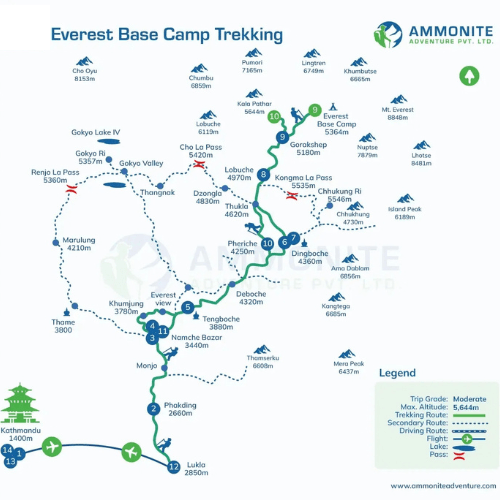
The trailhead of the Everest Trek is Lukla (2,860 m/9,383). From here, you’ll hike through dense forests and suspension bridges to reach the main trading hub in the region, Namche Bazaar (3,440 m/11,286 ft), with the Dudh Koshi River accompanying you. Climb becomes steeper, and mountain panoramas become wider, making you feel the terrain more alpine.
After Namche, the path slowly rises toward Tengboche (3,867 m/12,687 ft), known for its renowned monastery and stunning panorama of the Himalayas. You’ll find less vegetation and more rocky areas as you continue to Dingboche (4,410 m/14,470 ft), making the landscape look more open and wild. Your pace becomes slower as the air becomes thinner.
As you continue to the last settlement of the EBC trail, Gorak Shep (5,164 m/16,942 ft), all you’ll see is dry and glacial terrain. The final push to the base camp follows rocky moraine beside the Khumbu Glacier. To view the full route and learn about each section better, see the detailed Everest Base Camp map.
Average Walking Hours Per Day
The average walking hours per day on the Everest Base Camp Trek are 5 to 7 hours. The important thing when trekking in any alpine location, not only here, is having control over your pace. The rule is simple. We say “bistarai, bistarai,” meaning slowly, slowly in English. The slower you walk, the more time your body gets to adjust to lower air pressure.
You’ll walk less during acclimatization day. However, on a day to EBC and when returning, you’ll walk more, making the journey demanding.
|
Walking Hours
|
Type Of Day
|
Primary Reason
|
|
2 to 4 Hours
|
Acclimatization |
Active recovery: climbing high but sleeping low to trigger red blood cell production.
|
|
5 to 7 Hours
|
Standard Trekking
|
The “cruising” pace required to move between villages while maintaining a safe heart rate.
|
|
7 to 9 Hours
|
Base Camp/Descent
|
High-effort days involving glacial terrain or long downhill ranges back to lower altitudes. |
Which Day Feels The Longest
Personally speaking, from my experience, the day from Phakding (2,660 m/8,727.034 ft) to Namche Bazaar (3,440 m/11,286 ft) is the longest. It’s just not about distance, but the hill approaches steeply after crossing the Hillary Suspension Bridge, testing our legs and lungs.
It’s on the second day of the journey that you face your first big elevation gain. Therefore, expect to invest a heavy effort on this day.
From Lobuche (4,970 m/16,305.77 ft) to EBC (5,364 m/17,598 ft) via Gorak Shep (5,180 m/16,994.75 ft) is another day where you can expect a challenge again, as you walk on a rocky and glacial trail, and also reduced oxygen level at high altitude causes your pace to slow down. You’ll need to put a lot of energy on the line.
As a result, proper acclimatization during the Everest Trek is essential. With good pacing and rest days, you can lower your exhaustion and make these demanding sections manageable to some extent.
Distance Comparison With Other Popular Treks
It’s a common thing that we prefer to compare distances before choosing a trek when planning, and it’s actually a wise move to learn what to expect. The trek to Everest Base Camp is average in distance; nonetheless, it’s still longer compared to some other famous trails. For instance, the Annapurna Base Camp (ABC) Trek is shorter, while climbs like Kilimanjaro involve a shorter walking distance but steeper altitude gain.
Here’s a brief comparison of well-known treks:
| Trek |
Total Distance
|
Estimated Duration
|
Highest Point
|
|
EBC
|
130 Km
|
14 Days
|
Kala Patthar (5,644.5 m/18,519 ft)
|
|
ABC
|
110 Km
|
7 Days
|
4,130 m (13,549.87 ft)
|
|
Kilimanjaro
|
62 Km
|
6 to 7 Days
|
5,895 m (19,340.55 ft)
|
|
Inca Trail (Classic)
|
42 Km
|
4 Days
|
4,215 m (13,828.74 ft)
|
|
Annapurna Circuit
|
160 to 230 Km
|
12 to 18 days
|
5,416 m (17,769 ft)
|
This table shows that even though the Everest Trek is not the longest one, the elevation and duration affect its difficulty level.
Tips To Manage The Walking Distance Easily
To manage the walking distance on the EBC Trek, you’ll need to focus on your pace. Here are some useful tips that you can follow during the journey:
- Walk as slowly as you can. By doing so, you can save energy and adjust to the alpine environment.
- Use trekking poles to support your knees and save them from getting injured, especially during descents.
- Drink at least 3 liters of water a day to stay hydrated and avoid altitude-related issues.
- Consider packing only necessary items. A smart Everest Base Camp packing list helps you reduce tiredness.
Believe me, following these basic tips helps you make the daily distance more manageable during the trip.
How Far Is Everest Base Camp Really
The EBC Trek is around a 130 km round-trip. It’s normally 12 to 14 days long, where you’ll hike for 5 to 7 hours each day. The total trekking length of the journey may not seem too hard. However, the high elevation and geography make it a truly rewarding challenge.
The important thing is that you should walk at a comfortable pace, enjoying the surrounding beauty, while focusing on the destination. Don’t only aim to reach the place for an overnight stay. Have the right mindset and good preparation, and your adventure will be successful. You’ll remember this experience forever.