Dhaulagiri Circuit Trekking - 17 Days

Dhaulagiri Circuit Trek

484 reviews
113 reviews
Recommended by 99% of travelers

The Dhaulagiri Circuit is a premier 17-day trek that circles the world’s seventh-highest peak. More remote and rugged than the Annapurna or Everest routes, this semi-camping trek crosses the French Pass (5,360 m) and Dhampus Pass (5,240 m). For the 2026 season, the estimated cost for this 17-day journey ranges from $1,555 to $1,986 USD per person, depending on group size and service level.

This all-inclusive price typically covers licensed guides, camping crews, permits, and domestic transport, ending in the famous apple-growing village of Marpha. 

⚠️ 2026 Dhaulagiri Trail Update

  • Solo Trekker Status: Solo trekking is permitted, but hiring a licensed guide is mandatory for the 2026 season.
  • Required Permits: Hikers must obtain both the ACAP (Annapurna Conservation Area Permit) and a TIMS card.
  • Terrain Challenges: The route involves crossing the constantly shifting Chhonbarban Glacier and high-altitude sections like French Pass and Hidden Valley.
  • Logistics: Self-sufficient camping is required in remote stretches where no permanent villages or teahouses exist.

Pro Tip: Our lead guide, Krishna Pariyar, recommends carrying a pair of micro-spikes and gaiters even in the shoulder season; the descent from French Pass to Hidden Valley often holds slick, icy patches that can be treacherous without extra traction. 

At a Glance
Duration17 Days
Trip GradeStrenuous
CountryNepal
Maximum Altitude5,360 m
Group Size2-10
StartsKathmandu
EndsKathmandu
Travel StyleTrekking
Best TimeSpring & Autumn

Dhaulagiri Circuit Trek: 17-Day Itinerary and Cost Overview 

The Dhaulagiri Circuit Trekking is one of the most challenging and rewarding 17-day Himalayan excursions in Nepal. This journey encircles the world’s seventh-highest peak, the Dhaulagiri massif (8,167 m), offering adventurers a raw, remote, and unexplored experience of Nepal's cultural and natural beauty.

For the 2026 season, the estimated trekking cost ranges from $1,555 to $1,986 USD, covering essential logistics such as trekking permits, licensed guides, and specialized camping equipment. This high-altitude trek follows a demanding route through the Myagdi district, reaching three pivotal landmarks: Italian Base Camp, Glacier Camp, and Dhaulagiri Base Camp.

Located above 5,000 m, the trail requires navigating technical terrain and crossing the lateral moraine French Pass (5,360 m) and Dhampus Pass (5,234 m), which provide panoramic views of the Tukuche Peak and surrounding giants. While it is not recommended for first-time Himalayan hikers, it serves as the ultimate expedition for experienced trekkers who possess high levels of physical fitness and the right high-altitude gear.

The route transitions through diverse eco-zones, including rhododendron forests, traditional ethnic villages, alpine meadows, and rugged glacial moraines. It is a sanctuary for mountaineers and expedition teams seeking an off-the-beaten-path experience in total solitude.

However, due to the sustained time spent in the "thin air" zone, the itinerary demands meticulous preparation. This includes a strict focus on physical conditioning, a dedicated acclimatization schedule, and awareness of Acute Mountain Sickness (AMS) symptoms to ensure a safe crossing of the high mountain passes.

Highlights

  • Discover the essence of a true Himalayan expedition by venturing an almost entirely desolate, off-the-beaten-trail route.
  • Witness the wide array of landscapes, including that of the distinctive Mustang region.
  • Pave the Himalayan way through two of the major high mountain passes French Pass (5,360 m) and Dhampus (5,234 m).
  • An incredibly enriching insight into the local way of life and culture of Nepal, which is far away from modernization.
  • Thrilling hike through the highest gorge in the globe, Kalo Gandaki, along with some of the deepest canyons.
  • Wonderful vistas of the snow-capped peaks, including that of the seventh-tallest peak in the world, Mt. Dhaulagiri (8,167 m).
  • This is an opportunity to get a glimpse of a vast range of flora and fauna, including some of the rarest Himalayan wildlife.
  • Enjoy the first-hand camping experience at several base camps above 5,200 m (17,060 ft), etc.

Short Itinerary

  • Day 01: Drive Kathmandu to Beni via scenic roads (1,400m → 830m, 7–9 hrs).
  • Day 02: Trek from Beni to Babiachor along the river and through villages (830 m → 950 m, 5–6 hrs).
  • Day 03: Trek from Babiachor to Dharapani through bridges and farms (950 m → 1,560 m, 6–7 hrs).
  • Day 04: Trek Dharapani to Muri with Magar culture views (1,560 m → 1,850 m, 6–7 hrs).
  • Day 05: Trek Muri to Boghara through forests and rivers (1,850 m → 2,080 m, 5–6 hrs).
  • Day 06: Trek Boghara to Dobang via dense forest trails (2,080 m → 2,520 m, 6–7 hrs).
  • Day 07: Trek from Dobang to Choriban Khola, entering a remote zone (2,520 m → 3,110 m, 5–6 hrs).
  • Day 08: Trek to Italian Base Camp via rugged ascent (3,110 m → 3,660 m, 6–7 hrs).
  • Day 09: Acclimatization at Italian Base Camp for rest (3,660 m, 0 hrs hiking).
  • Day 10: Trek to Glacier Camp, crossing glaciers and moraines (3,660 m → 4,210 m, 5–6 hrs).
  • Day 11: Trek Glacier Camp to Dhaulagiri Base Camp (4,210 m → 4,740 m, 5–6 hrs).
  • Day 12: Acclimatization at Base Camp with exploration (4,740 m, 0 hrs hiking).
  • Day 13: Cross French Pass to Hidden Valley (4,740m → 5,050m, 7–8 hrs).
  • Day 14: Cross Dhampus Pass to Yak Kharka descent (5,050m → 3,680m, 7–8 hrs).
  • Day 15: Trek Yak Kharka to Marpha through forests (3,680m → 2,670m, 5–6 hrs).
  • Day 16: Drive Marpha to Pokhara with scenic views (2,670m → 822m, 7–8 hrs).
  • Day 17: Drive Pokhara to Kathmandu, ending the journey (822 m → 1,400 m, 6–7 hrs).

How much does the Dhaulagiri Circuit Trek cost in 2026 

An expedition to the Dhaulagiri Circuit is a significant financial investment, largely due to its remote geography and the complex logistics required for high-altitude glacier camping. On the open market, a fully supported 17-day trek typically ranges between USD 2,000 and USD 4,000 per person.

However, trekking with an experienced local operator can significantly optimize your budget without compromising safety or service quality. At Ammonite Adventure, we specialize in designing high-value, budget-conscious journeys tailored to your specific needs.

By booking a comprehensive package, you cover all essential logistics including mandatory permits, expert high-altitude guides, porters, and all accommodation and meals ensuring a seamless experience from start to finish.

Below is a detailed breakdown of the estimated costs for the 17-day Dhaulagiri Circuit Trek:

Category

Estimated Cost (USD)

Remarks & Inclusions

Permits & Fees

$55 – $65

Includes ACAP, TIMS Card, and local village entry fees.

Professional Crew

$1,100 – $1,600

A licensed high-altitude guide, porters, and a full kitchen/camping team.

Accommodation

$150 – $250

A mix of local tea houses and specialized high-altitude tented camps.

Meals & Water

$450 – $650

3 meals/day. Includes the logistics of carrying fresh supplies to the glacier.

Transportation

$150 – $300

Ground transfers (KTM–Beni) and return logistics from Jomsom/Pokhara.

Camping Equipment

$200 – $400

4-season tents, dining/toilet tents, and cooking fuel for the Hidden Valley.

Insurance & Misc

$250 – $450

Emergency heli-evacuation coverage, tips for staff, and personal snacks.

Market Average Total

$2,355 – $3,715

Estimated total per person for a standard 17-day trek.

Dhaulagiri vs. Annapurna Circuit: Which is right for you

Choosing between these two legendary treks depends on your experience level and what you want to see. While both offer stunning Himalayan views, they provide very different experiences: 

Feature

Dhaulagiri Circuit

Annapurna Circuit

Difficulty

Extreme/Challenging. Requires high physical fitness and previous trekking experience.

Moderate to Strenuous. Accessible to fit beginners or intermediate trekkers.

Terrain

Remote, rugged, and includes glacial walking and high-altitude camping.

Well-established trails, diverse landscapes from lush jungles to high desert.

Accommodation

Primarily Camping (Fully organized).

Comfortable tea houses (lodges) with more facilities.

Crowds

Very Low. A "True Wilderness" experience away from mainstream tourism.

High. One of the most popular treks in the world with a vibrant social scene.

Highest Point

French Pass (5,360m) & Dhampus Pass (5,250m).

Thorong La Pass (5,416m).

Best For...

Hardcore adventurers looking for isolation and technical challenges.

Trekkers who want cultural variety and comfortable amenities.

The Verdict:

  • Choose Dhaulagiri if you want an expedition-style adventure, prefer sleeping in tents, and want to avoid the crowds.
  • Choose Annapurna if you prefer a variety of cultures, better food/lodging options, and a more social atmosphere.

What to Expect on the Dhaulagiri Circuit Trek

The Dhaulagiri Circuit is a high-intensity, "off-the-beaten-path" expedition. Unlike the neighbouring Annapurna Circuit, this route is physically demanding and requires a blend of self-sufficiency and mountaineering awareness.

1. Technical Terrain and High-Altitude Passes Expect significant time spent above 5,000 metres. The trek's difficulty is defined by two major crossings:

  • French Pass (5,360m): Offers a 360-degree view of the Dhaulagiri massif.
  • Dhampus Pass (5,244m): Often involves trekking through deep snow, even in the shoulder seasons.
  • Hidden Valley: You will spend nights in the high-altitude Hidden Valley, where temperatures drop well below freezing.

2. The Transition from Teahouses to Expedition Camping While the lower sections (Muri, Dobang) offer basic teahouses, the core of the trek is an expedition-style camping experience.

  • Italian Base Camp (3,660m): Usually the last point with semi-permanent shelters.
  • Glacier & Dhaulagiri Base Camp: Expect to sleep on rugged glacial moraine. Proper four-season sleeping bags and insulated pads are non-negotiable.

3. Remote Culture and Biodiversity Because the trail sees fewer than 1% of the trekkers that visit Everest, the cultural encounters are more authentic.

  • Ethnic Diversity: You will pass through Magar and Gurung villages in the lower altitudes before entering the high-altitude Tibetan-influenced regions.
  • Wildlife: The Dhaulagiri region is a corridor for the elusive Snow Leopard and Blue Sheep (Bharal).

4. Safety: Acclimatization and AMS Due to the rapid ascent from the Myagdi Khola valley to Italian Base Camp, the risk of Acute Mountain Sickness (AMS) is high.

  • Mandatory Rest: A minimum of two nights at Italian Base Camp is the industry standard for safe acclimatization.
  • Logistics: Trekkers must be prepared for "no-exit" scenarios in the Hidden Valley if the weather closes in.

Why Choose Ammonite Adventure for Dhaulagiri

The Dhaulagiri Circuit is a demanding expedition. We provide the expertise and logistics required for a safe crossing of the French Pass and Hidden Valley.

Our Expedition Advantage

  • Glacier Experts: Government-licensed guides trained in high-altitude navigation and glacier safety.
  • Local Strength: Indigenous Himalayan crew and Sherpas who are naturally acclimatized.
  • Fair Logistics: Professional porters (max 18kg per two trekkers) with full insurance and fair wages.

Expert Leadership

  • Safety First: Leaders certified in Wilderness First Aid and altitude sickness management.
  • Fluent & Cultural: English-speaking guides who share the deep history and stories of the region.
  • Reliable: Proven problem-solvers who handle mountain logistics and weather shifts with ease.

Plan Your Trek: Experience the 17-day Dhaulagiri Circuit with the experts at Ammonite Adventure for $1,555 – $1,986 (depending on group size).

Itinerary

We begin the journey with a scenic 7:00 AM departure from Kathmandu. Traveling along the Prithvi Highway, we follow the winding Trishuli and Marsyangdi rivers, passing through vibrant terraced fields and bustling roadside towns. After a local lunch in Mugling, we continue westward past Pokhara, following the Kali Gandaki River into the heart of the Myagdi district.

The final stretch brings us to Beni, a lively mountain hub sitting at the confluence of the Myagdi and Kali Gandaki rivers. Arriving around 5:00 PM, this is our final opportunity to enjoy modern amenities and a stable mobile network before we dive deep into the rugged wilderness of the Dhaulagiri massif.

Krishna’s Pro-Tip: The Benefit of Private Transport "Many agencies use public buses for this 10-hour stretch, but that often means a dusty, 12-hour ordeal. At Ammonite, we use private jeeps.

Pro-Strategy: Private transport saves your physical energy for the actual trekking days. It allows us to stop for the highest-quality local food and ensures we arrive in Beni early enough for a final equipment check and a calm night’s sleep.

  • Gear Alert: Beni is your last chance for 'forgotten' items. Tonight, I’ll help you double-check your batteries and high-altitude snacks at the local market.
  • My rule: We don't waste your lungs on highway dust; we save them for the French Pass!"

 — Krishna Pariyar, Lead Guide at Ammonite Adventure

About Beni Village and Teahouses

  • Number of Good Facilities Teahouses: 6/8 teahouses
  • Room with attached bathroom: Available
  • Wi-Fi: Available (Strong)
  • Charge in the room: Available
  • Charge in the Hall: Available
  • Hot Shower: Available
  • Mobile Network: Available (NTC/Ncell)
Max. Altitude: 1,400mMeals: Breakfast-Lunch-DinnerAccommodation: Local-Tea-House

The trek officially begins as we leave the paved roads of Beni and follow the emerald waters of the Myagdi Khola. Today is a gentle introduction to the trail, winding through lush subtropical landscapes and expansive terraced fields of rice and millet. You’ll navigate swaying suspension bridges and pass through intimate settlements where the traditional lifestyle of the Myagdi people remains unchanged by time.

As we walk, the valley opens up to reveal vibrant greenery and the distant silhouettes of the foothills. The day concludes in Babiachor, a charming local village that serves as a peaceful gateway to the higher altitudes. It’s an enlightening day of "warm-up" walking that allows your muscles to find their rhythm before the terrain becomes more demanding.

Krishna’s Pro-Tip: The "First Day Rhythm" "I call this the 'Foundation Day.' Many trekkers try to rush because the trail is flat, but that’s a mistake.

Pro-Strategy: Use today to test your boots and find your walking pace. I want you to focus on hydration today even at this low altitude, drinking 3-4 liters of water prepares your blood for the thinner air we will face at Italian Base Camp.

  • Culture Check: You will see many locals working in the fields. A simple 'Namaste' goes a long way here! Keep your camera ready for the suspension bridges; they are the best spots for those classic 'beginning of the journey' photos." 

— Krishna Pariyar, Lead Guide at Ammonite Adventure

About Babiachor Village and Teahouses

  • Number of Good Facilities Teahouses: 3/4
  • Room with attached bathroom: Not Available
  • Wi-Fi: Limited / Not Reliable
  • Charge in the room: Available (Limited)
  • Charge in the Hall: Available
  • Hot Shower: Available (Bucket)
  • Mobile Network: Available (NTC/Ncell)
Max. Altitude: 950mMeals: All-Three-MealsAccommodation: Local-Tea-House

Today, the trail leads us deeper into the heart of the Myagdi valley. We follow the winding river, navigating a series of gradual ascents that take us through vibrant farming clusters and traditional stone-built dwellings. While the terrain begins to show more "ups and downs" than the previous day, the lush scenery and low altitude make the hike incredibly pleasant.

The highlight of the day is crossing several high suspension bridges that offer thrilling views of the Myagdi Khola churning below. As we climb steadily toward Dharapani, you will notice the landscape shifting from subtropical fields to more rugged foothills. The village itself is a beautiful settlement perched on a slope, offering a peaceful atmosphere and our first real sense of being "tucked away" in the mountains.

Krishna’s Pro-Tip: Managing the "Gradual Gain" "Today is all about steady progress. The trail starts to test your legs with more frequent climbs, but don't let that discourage you.

Pro-Strategy: I always advise my guests to 'climb like a mountain goat' small, consistent steps rather than big lunges. This saves your knees and keeps your heart rate stable. We are moving toward 1,500m now, so keep sipping water even if you don't feel thirsty.

  • Local Insight: Dharapani is famous for its hospitality. If we are lucky, we’ll see the local children playing traditional games in the village square. It’s a great spot to enjoy a sunset over the lower valley before the big peaks start dominating our view tomorrow!" 

— Krishna Pariyar, Lead Guide at Ammonite Adventure

About Dharapani Village and Teahouses

  • Number of Good Facilities Teahouses: 3/4
  • Room with attached bathroom: Not Available
  • Wi-Fi: Limited / Available in some spots
  • Charge in the room: Not Available
  • Charge in the Hall: Available
  • Hot Shower: Available (Bucket)
  • Mobile Network: Available (NTC/Ncell)
Max. Altitude: 1,560mMeals: Breakfast-Lunch-DinnerAccommodation: Local-Tea-House

Today is a highlight of the lower trail, involving a 6–7 hour trek that brings us to the historic indigenous Magar village of Muri. The path winds upward, leaving the riverbank behind as we gain elevation along scenic ridges. This section is a sensory treat: in the spring, the hillsides erupt in the vibrant reds and pinks of blooming rhododendrons, while the air carries the fresh scent of the pine forests above.

Upon reaching Muri, which is perched dramatically on a high ridge, you are rewarded with your first major panoramic view of the Dhaulagiri massif. This village is a cultural treasure; the Magar people are known for their bravery and hospitality. We’ll spend the evening exploring their traditional stone houses and perhaps sampling local delicacies, all while the mountain peaks glow in the sunset.

Krishna’s Pro-Tip: The "Conversational Pace" Rule "Don't let the relatively low altitude fool you. The ridges leading to Muri are steep and can be a 'leg burner' if you aren't careful.

Pro-Strategy: I always tell my guests to walk at a 'conversational pace' here. If you are too out of breath to talk while walking, you are going too fast. We are playing the long game. Saving your muscle energy today means you’ll have the strength needed for the French Pass next week!

  • Photo Op: Keep your camera out as we approach the ridge. The way the village sits against the backdrop of Dhaulagiri is one of the most iconic views of the entire first week."

 — Krishna Pariyar, Lead Guide at Ammonite Adventure

About Muri Village and Teahouses

  • Number of Good Facilities Teahouses: 3/4
  • Room with attached bathroom: Not Available
  • Wi-Fi: Limited / Slow
  • Charge in the room: Not Available
  • Charge in the Hall: Available
  • Hot Shower: Available (Bucket)
  • Mobile Network: Available (NTC/Ncell)
Max. Altitude: 1,850mMeals: Breakfast-Lunch-DinnerAccommodation: Local-Tea-House

The trek today transitions from high ridges into the heart of the ancient Himalayan forest. We begin with a descent toward the Myagdi Khola, crossing a series of suspension bridges that span the rushing glacial waters. From here, the trail enters a world of deep green, winding through towering forests of pine and oak where the air is cool and oxygen-rich.

The final stretch is a steady, rhythmic ascent that leads us to the village of Boghara. As you reach the settlement, the horizon opens up to reveal the magnificent Dhaulagiri I and Gurja Himal. It is a scenically rich day that rewards every step of the climb with towering white peaks contrasting against the deep valley floor.

Krishna’s Pro-Tip: "Entering the Wild" "I call Boghara the 'Last Frontier of the Valley.' After this village, the tea houses become much more basic and the trail gets significantly wilder.

Pro-Strategy: Today is the day to double-check your knees. The descent from Muri can be tough on the joints, so use your trekking poles properly! If your knees feel 'clicky,' let me know; I have a specific way of taping them that works wonders for the Myagdi hills.

  • Look Up: As we approach Boghara, keep your eyes on the high ridges. This is prime territory for spotting Himalayan langurs and large eagles. The view of Dhaulagiri I from here is a reminder of exactly why we are on this journey!" 

— Krishna Pariyar, Lead Guide at Ammonite Adventure

About Boghara Village and Teahouses

  • Number of Good Facilities Teahouses: 2/3 (Basic)
  • Room with attached bathroom: Not Available
  • Wi-Fi: Not Available / Very Rare
  • Charge in the room: Not Available
  • Charge in the Hall: Available (Solar/Limited)
  • Hot Shower: Available (Bucket)
  • Mobile Network: Limited / Weak Signal
Max. Altitude: 2,080mMeals: Breakfast-Lunch-DinnerAccommodation: Local-Tea-House

Today, the terrain undergoes a dramatic transformation as we leave the final permanent settlements behind. We plunge into primeval forests so dense that the sunlight barely touches the forest floor. The trail is rugged and raw, winding through massive bamboo clusters and crossing several crystal-clear mountain streams. We stop for a well-earned mountain lunch at Lipshe, a tiny temporary settlement used by local herders.

The final afternoon stretch is a steady uphill climb through ancient oak and rhododendron groves. Our destination, Dobang, is a remote clearing in the woods that serves as the gateway to the uninhabited wilderness. Here, the roar of the Myagdi Khola is your constant companion, and the sense of adventure intensifies as we prepare to leave the "teahouse world" for the high-altitude camps ahead.

Krishna’s Pro-Tip: The "Bamboo and Bears" Zone "We are now entering the heart of the wild Myagdi forest. This is one of my favorite sections because it feels like stepping back in time.

Pro-Strategy: Watch your footing today! The bamboo leaves on the trail can be surprisingly slippery, especially if there was morning dew. This is also a zone where we occasionally see signs of Himalayan Black Bears and Red Pandas. I’ll be leading closely to ensure we stay on the best path through the thickets.

  • Health Check: We are approaching 2,500 m. If you feel a slight tightness in your chest, it’s just the forest humidity and the rising altitude. Breathe deep and enjoy the freshest oxygen you’ll find on the entire circuit!" 

— Krishna Pariyar, Lead Guide at Ammonite Adventure

About Dobang Village and Teahouses

  • Number of Good Facilities Teahouses: 1/2 (Very Basic/Seasonal)
  • Room with attached bathroom: Not Available
  • Wi-Fi: Not Available
  • Charge in the room: Not Available
  • Charge in the Hall: Limited (Solar only)
  • Hot Shower: Available (Bucket/Gas)
  • Mobile Network: Generally No Signal
Max. Altitude: 2,520mMeals: Breakfast-Lunch-DinnerAccommodation: Local-Tea-House

Today marks a definitive shift in the trek as we move away from even the most remote teahouses and into the high-alpine isolation of the Dhaulagiri region. The trail follows a narrow forest path alongside the Myagdi Khola, where the valley walls begin to close in, creating a dramatic and intimate mountain atmosphere. You will notice a distinct crispness in the air as the sub-tropical humidity gives way to the cool breath of the glaciers above.

As the day progresses, the forest thins out, revealing the rugged bones of the mountains. Following a path used mostly by shepherds and expedition crews, we arrive at Choriban Khola, which translates to "Forest of the Thieves." This is our first true wilderness camp a serene clearing where the only sounds are the rushing river and the wind through the pines.

Krishna’s Pro-Tip: Preparing for the Moraine "This is the last day we will spend under the canopy of trees. Tomorrow, the world becomes rock and ice.

Pro-Strategy: Use the evening at Choriban Khola to organize your 'summit' gear. From here on, we will be sleeping in tents, and the temperature will drop significantly once the sun goes down. Make sure your headlamp is accessible and your warm layers are at the top of your bag.

  • Water Safety: Because we are now in a pure wilderness area, I personally oversee all water filtration for the kitchen. We use a combination of boiling and professional-grade filters to ensure you stay healthy for the base camp push.
  • My rule: Never drink from the side streams here without checking with me first!" 

— Krishna Pariyar, Lead Guide at Ammonite Adventure

About Choriban Khola (Wilderness Camp)

  • Accommodation Type: Tented Camping Only
  • Number of Facilities: None (Wilderness Site)
  • Wi-Fi: Not Available
  • Charging: Not Available (Bring a Power Bank)
  • Toilet: Temporary Tented Toilet
  • Hot Shower: Warm Water in a bowl (for washing)
  • Mobile Network: No Signal
Max. Altitude: 3,110mMeals: Breakfast-Lunch-DinnerAccommodation: Local-Tea-House

This is a major milestone day as we officially transition from the forest to the high-altitude alpine zone. We begin with a heart-pumping, steep ascent through the final stands of rhododendron and fir before the landscape transforms into a world of rock, ice, and moraine. As the trees disappear, the massive West Face of Dhaulagiri looms over us, providing an incredible sense of scale.

Upon reaching Italian Base Camp (3,660m), you are rewarded with "eye candy" views of the Chhonbarban Glacier, the towering Tukuche Peak, and the spectacular ice falls of Dhaulagiri. This camp, originally used by Italian expeditions, is nestled in a natural amphitheater of rock. However, the path here is rugged; we must be extremely cautious of loose rocks and shifting scree as we navigate the canyon walls.

Krishna’s Pro-Tip: Follow the Sherpa’s Footsteps "This section of the trail is alive the scree and loose rock can shift with every step. My rule: Always trace the exact footsteps of your guide.

Pro-Strategy: We know which rocks are 'anchored' and which are 'floaters.' By following our exact line, you save energy and stay safe. Also, keep your helmet handy if we are moving through the narrow sections below the cliffs.

  • Altitude Alert: We are now at 3,660m. You will feel the air getting thinner. Tonight, we will have a special 'Acclimatization Dinner' lots of warm fluids and light carbohydrates to help your body prepare for the glacier crossing ahead." 

— Krishna Pariyar, Lead Guide at Ammonite Adventure

About Italian Base Camp and Facilities

  • Accommodation Type: Tented Camping (Expedition Style)
  • Number of Facilities: Seasonal small huts / Tents
  • Wi-Fi: Not Available
  • Charging: Not Available (Solar backup only for emergencies)
  • Toilet: Temporary Tented Toilet
  • Hot Shower: Warm washing water provided in bowls
  • Mobile Network: No Signal (Satellite phone used for emergencies)
Max. Altitude: 3,660mMeals: Breakfast-Lunch-DinnerAccommodation: Camp

Today is one of the most critical days of the expedition. To safely conquer the 5,000m+ passes later this week, we pause here to let your body naturally adapt to the thinning air. This is not just a "rest day" it is a strategic "active recovery" day. You have the option to take a short, high-altitude hike toward the base of the massive Dhaulagiri West Face, which offers incredible perspectives for photography and helps your lungs prepare for the higher camps.

Alternatively, you can choose to simply rest, soak in the dramatic surroundings, and hydrate. The goal is to keep the body moving slightly while giving the heart and lungs the time they need to produce more red blood cells. Letting the body adapt here is the secret to successfully navigating the French Pass and Hidden Valley without altitude-related setbacks.

Krishna’s Pro-Tip: "Climb High, Sleep Low" "My philosophy for today is simple: 'Climb High, Sleep Low.' Even if we only hike up a few hundred meters and stay there for an hour before coming back down to camp, it makes a massive difference for your acclimatization.

Pro-Strategy: Don't be tempted to spend the whole day in your sleeping bag. Movement is medicine! I recommend a 2-hour slow walk toward the glacier viewpoint. It keeps your circulation active.

  • Health Check: Today, I will be checking everyone’s oxygen saturation (SpO2) levels. If you have a light headache, tell me now. Usually, an extra liter of water and some of my special ginger tea is all it takes to get you back on track.
  • Remember: At 3,660m, your body is working twice as hard just to breathe be patient with it!" 

— Krishna Pariyar, Lead Guide at Ammonite Adventure

About Italian Base Camp (Acclimatization Site)

  • Accommodation Type: Tented Camping
  • Altitude: 3,660m (Stay at this level for two nights)
  • Activities: Side hikes, oxygen monitoring, gear organization
  • Wi-Fi/Network: No Signal
  • Hydration: Mandatory 4 liters of filtered/boiled water per person
  • Proximity to Peak: Closest view of the sheer 4,000m West Face wall
Max. Altitude: 3,660mMeals: Breakfast-Lunch-DinnerAccommodation: Camp

Scenically spectacular but physically demanding, today is the day we leave solid ground behind and move onto the frozen heart of the mountains. We navigate a narrow, steep canyon often called the "Gateway to the Glacier" where we must be alert for rockfall. Once through, the world opens up into the massive, ice-white expanse of the Chhonbarban Glacier.

Trekking here involves navigating rugged moraine (rock-covered ice) and moving carefully around deep blue crevasses. Sleeping at Glacier Camp is a surreal, once-in-a-lifetime experience; you are literally camping on a moving river of ice, surrounded by the towering 7,000m walls of Dhaulagiri and Manapathi Peak.

Krishna’s Pro-Tip: Navigating the Ice "Today is a 'Head-Up' day. The trail on a glacier changes every season as the ice shifts. My job is to find the safest route through the moraine ridges.

Pro-Strategy: This is technical terrain. I want everyone to keep a 2-meter gap between each other. This gives you space to choose your footing on the loose rocks and allows me to see the 'flow' of the group. If you hear a loud 'crack' or 'boom,' don't panic it’s just the glacier moving under our feet. It's the mountain's way of talking!

  • Cold Management: We are now sleeping at 4,210m on ice. Tonight, we will use 'Hot Water Bottle therapy' we fill your Nalgene bottles with boiling water and put them at the bottom of your sleeping bags. It keeps your feet warm and gives you drinkable water for the morning!" 

— Krishna Pariyar, Lead Guide at Ammonite Adventure

About Glacier Camp (High Altitude Site)

  • Accommodation Type: Tented Camping (On Glacier/Moraine)
  • Number of Facilities: None (Extreme Wilderness)
  • Altitude: 4,210m
  • Wi-Fi/Charging: Not Available
  • Toilet: Dedicated toilet tent with biodegradable waste management
  • Safety Gear: Trekking poles are mandatory today for balance on the ice
  • Mobile Network: No Signal (Satellite support only)
Max. Altitude: 4,210mMeals: Breakfast-Lunch-DinnerAccommodation: Camp

This is the day you have been dreaming of: reaching the heart of the Dhaulagiri massif. The trek involves a steady, rhythmic climb along the lateral moraine of the glacier. As we gain elevation, the valley opens up into a massive high-altitude amphitheater. You are now in the "lap of the giants," standing at the foot of Mt. Dhaulagiri (8,167m), the seventh-highest mountain in the world.

The vistas today are incomparable. You will be surrounded by a 360-degree panorama of ice and rock, including Tukuche Peak and the white walls of Dhaulagiri I, II, III, and V. Arriving at the Base Camp is a profound moment of achievement you are now standing where world-class mountaineers begin their push for the summit.

Krishna’s Pro-Tip: The "Glacier Highway" "Today is all about finding the 'rhythm of the breath.' We are walking on a highway of ice and stone. Because the terrain is uneven, every step requires a bit of focus, but the views will keep your spirit high.

Pro-Strategy: We are now approaching 5,000m. I will lead the group with a very slow, steady pace what I call the 'Himalayan Shuffle.' By not rushing, we keep our heart rates low and our oxygen levels stable.

  • The Base Camp Experience: Tonight is special. We are camping in a high-altitude city of tents. You will likely meet climbers from all over the world.
  • My rule: Drink a bowl of hot soup as soon as we arrive. It’s the best way to rehydrate and celebrate reaching this iconic milestone!" 

— Krishna Pariyar, Lead Guide at Ammonite Adventure

About Dhaulagiri Base Camp (DBC)

  • Accommodation Type: Tented Camping (Expedition Style)
  • Altitude: 4,740m
  • Surroundings: Active glacier, ice falls, and 8,000m peak views
  • Wi-Fi/Charging: Not Available
  • Toilet: Dedicated toilet tent
  • Health Check: Evening SpO2 (Oxygen) monitoring is mandatory here
  • Mobile Network: No Signal (Satellite phone support available)
Max. Altitude: 4,740mMeals: Breakfast-Lunch-DinnerAccommodation: Camp

Before we tackle the trek’s ultimate challenge the French Pass we spend a second strategic acclimatization day at the foot of the "White Mountain." This day is about more than just rest; it’s about mental and physical preparation for the push into the Hidden Valley. You have the entire day to explore the sprawling base camp, photograph the colossal icefalls of the Dhaulagiri massif, and witness the incredible logistics of high-altitude mountaineering expeditions.

It is also a day to appreciate the "behind-the-scenes" heroes. You’ll see our kitchen crew and porters working tirelessly in sub-zero temperatures to ensure you are fed and comfortable. Take this time to soak in the raw power of the glacier, knowing that tomorrow you will be crossing over into one of the most remote valleys on earth.

Krishna’s Pro-Tip: The "Gear Shakedown" "Tomorrow is the big one the French Pass. I use today to do a final gear check with every guest. We make sure your crampons (if needed) fit perfectly and that your daypack is as light as possible.

Pro-Strategy: Don't just sit in your tent! Walk around the camp for 30 minutes every few hours. This prevents 'altitude lethargy.' I also suggest spending some time in the dining tent chatting with other teams. The energy at Base Camp is infectious and will give you the mental boost you need for the pass.

  • Gratitude on the Glacier: This is a tough place to work. I always encourage my guests to say a quick 'Dhanyabad' (Thank you) to the porters and kitchen staff today. They are the ones carrying the 'comfort' that makes this expedition possible at 4,700m!" 

— Krishna Pariyar, Lead Guide at Ammonite Adventure

About Dhaulagiri Base Camp (DBC)

  • Accommodation Type: Tented Camping
  • Altitude: 4,740m
  • Activity: Optional exploration of the upper glacier and icefall viewpoints.
  • Health Check: Double oxygen (SpO2) monitoring (morning and evening).
  • Hydration: Garlic soup and herbal teas served throughout the day to aid blood flow.
  • Mobile Network: No Signal.
Max. Altitude: 4,210mMeals: Breakfast-Lunch-DinnerAccommodation: Camp

Today is the pinnacle of the Dhaulagiri Circuit. We leave the base camp behind for a challenging, steady climb toward the legendary French Pass (5,360m). As you ascend, the horizon expands to reveal a staggering 360-degree panorama of the high Himalayas. Reaching the crest of the pass, marked by colorful prayer flags fluttering in the high-altitude wind, provides an unparalleled view of Tukuche Peak, Dhaulagiri I, Tsahi Kang, and Sita Chuchura.

After celebrating at the summit, we begin a gentle descent into the Hidden Valley (5,050m). This high-altitude desert landscape is surreal and remote a vast, rolling basin tucked between massive peaks that feels like another world entirely. This is one of the few places in Nepal where you can experience true, high-altitude isolation in a valley that remained largely "hidden" from the outside world for decades.

Krishna’s Pro-Tip: The "Summit Mindset" "Today is the day we have been training for since Beni. The climb to French Pass is not technically difficult, but the altitude makes every step feel like ten.

Pro-Strategy: We will start early to beat the afternoon winds that often whip across the pass. My secret for today? The 'Sync-Breath.' Every step you take should be perfectly synced with an exhale. It keeps your rhythm steady and prevents your heart rate from spiking.

  • The Prayer Flag Ritual: When we reach the top, we will take a moment to offer our gratitude. I always carry a few extra prayer flags for my guests to hang. It’s a beautiful Himalayan tradition to send your prayers out on the wind from the highest point of your journey!" 

— Krishna Pariyar, Lead Guide at Ammonite Adventure

About the Hidden Valley (High Altitude Camp)

  • Accommodation Type: Tented Camping (Wilderness)
  • Max Altitude: 5,360m (French Pass) | Camp Altitude: 5,050m
  • Temperature: Expect sub-zero temperatures; this is our coldest night.
  • Wi-Fi/Charging: Not Available
  • Toilet: Dedicated toilet tent
  • Safety: We carry a portable altitude chamber (PAC) or supplemental oxygen for this section as a precaution.
  • Mobile Network: No Signal (Satellite phone only)
Max. Altitude: 5,360mMeals: Breakfast-Lunch-DinnerAccommodation: Camp

Today is a day of dramatic transitions. We leave the high-altitude desert of the Hidden Valley behind to cross our second major hurdle: the Dhampus Pass (5,240m). As you crest the pass, you’ll be treated to a final, spectacular panoramic farewell to the Dhaulagiri massif and the deep, glacial trenches that define this region. The descent from the pass is a long but rewarding journey through rugged, rocky terrain that eventually gives way to softer ground.

As we descend toward Yak Kharka (3,680m), the change in the environment is profound. You will drop nearly 1,500 meters in a single day, and the effect is almost immediate the air becomes noticeably thicker, the temperature rises, and the first signs of hardy alpine vegetation reappear. Arriving at the lush pastures of Yak Kharka, where local herds graze during the summer, feels like a homecoming to the living world.

Krishna’s Pro-Tip: The "Great Descent" Strategy "Today is the longest descent of the entire trip. While your lungs will feel amazing as we drop in altitude, your knees will be doing a lot of work!

Pro-Strategy: This is where your trekking poles become your best friends. I will show you how to adjust them for a long downhill stretch to take the pressure off your joints.

  • Oxygen Boost: You’ll notice that by the time we reach Yak Kharka, your energy levels will spike because of the increased oxygen.
  • My rule: Even though you feel 'strong' again, don't run down the hills. We keep a steady, rhythmic pace to avoid any late-trip ankle strains. Enjoy that first breath of 'thick' air you’ve earned it!" 

— Krishna Pariyar, Lead Guide at Ammonite Adventure

About Yak Kharka (Alpine Pasture)

  • Accommodation Type: Tented Camping / Very Basic Seasonal Hut
  • Max Altitude: 5,240m (Dhampus Pass) | Camp Altitude: 3,680m
  • Scenery: Transition from glaciers to alpine grasslands and yak pastures.
  • Wi-Fi/Charging: Not Available
  • Toilet: Dedicated toilet tent
  • Health: Significant relief from altitude symptoms (AMS) due to the large descent.
  • Mobile Network: No Signal (Signal usually returns tomorrow)
Max. Altitude: 5,240mMeals: Breakfast-Lunch-DinnerAccommodation: Camp

Today marks our return to civilization as we descend into the legendary Kali Gandaki Valley. The trail is a beautiful, steady downhill journey that transitions from the high alpine meadows of Yak Kharka into fragrant pine and juniper forests. As we lose elevation, the rugged wilderness softens, eventually leading us into the famous stone-paved streets of Marpha.

Marpha is often called the "Apple Capital of Nepal," and you will walk through lush orchards before entering the village. This charming Thakali settlement is a highlight of the classic Annapurna Circuit, famous for its whitewashed houses, ancient monastery, and unique drainage system. After nearly two weeks in the wild, the sight of a cozy teahouse and the scent of fresh apple pie is a welcome reward.

Krishna’s Pro-Tip: The Marpha Reward "Congratulations! You have officially successfully navigated the most difficult sections of the Dhaulagiri Circuit. Today is about celebration and recovery.

Pro-Strategy: Marpha is famous for its 'Marpha Brandy' and apple products. While it’s tempting to celebrate immediately, I suggest trying the local apple juice first to rehydrate. Cultural Gem: Don't miss the trip up to the Marpha Monastery in the late afternoon. The view of the village and the Kali Gandaki riverbed from there is stunning.

  • Tech Check: This is the first place with reliable Wi-Fi in a long time. It’s a great evening to send photos home to family and let them know you conquered the French Pass!" 

— Krishna Pariyar, Lead Guide at Ammonite Adventure

About Marpha Village and Teahouses

  • Number of Good Facilities Teahouses: 10+ (High Quality)
  • Room with attached bathroom: Available
  • Wi-Fi: Available (Strong/High-Speed)
  • Charge in the room: Available
  • Charge in the Hall: Available
  • Hot Shower: Available (Gas or Solar)
  • Mobile Network: Available (Strong NTC/Ncell)
Max. Altitude: 3,680mMeals: Breakfast-Lunch-DinnerAccommodation: Tea-House-in-Marpha

Today, we trade our trekking boots for a scenic drive down the world’s deepest gorge. Following the Kali Gandaki River, the road winds through a dramatic shift in geography from the arid, Tibetan-like landscape of Mustang to the lush, subtropical forests of the lower valleys. We pass through Ghasa and Tatopani, watching the vegetation turn greener and the air warmer with every kilometer.

By the afternoon, we arrive in Pokhara, Nepal's "City of Lakes." After weeks of rugged mountain life, the transition to Pokhara is pure magic. You’ll swap glacial streams for a peaceful hot shower and the silence of the high passes for the vibrant energy of Lakeside. It is the ultimate setting to toast to your incredible achievement of successfully conquering one of the most challenging trekking circuits in the world.

Krishna’s Pro-Tip: The "Lakeside Celebration" "The drive today can be bumpy, but the reward at the end is worth it!

  • My rule for today: Once we check into the hotel, take that long, hot shower you’ve been dreaming of since Italian Base Camp.

Pro-Strategy: Pokhara is the best place to find 'civilized' comforts. Whether it’s a cold beer, a fresh cocktail, or just a really good cup of espresso, enjoy it you’ve burned the calories for it!

  • Evening Ritual: I love taking my guests for a slow walk around Phewa Lake at sunset. It’s the perfect time to reflect on the journey. You’ll look back toward the mountains and realize just how far you’ve come. We’ll have a final group dinner tonight to celebrate our team’s success!" 

— Krishna Pariyar, Lead Guide at Ammonite Adventure

About Pokhara (City of Lakes)

  • Accommodation Type: 3-Star to 5-Star Hotels (Wide Choice)
  • Room with attached bathroom: Available (with 24/7 Hot Water)
  • Wi-Fi: Available (High-Speed Fiber)
  • Charge in the room: Available
  • Hot Shower: Available (Excellent)
  • Mobile Network: Available (Full 4G/5G Coverage)
  • Activities: Lakeside bars, spas, massage centers, and boating.
Max. Altitude: 2,670mMeals: BreakfastAccommodation: Three-Star-Hotel

Today marks the final chapter of your Dhaulagiri Circuit Trek. After an early breakfast overlooking the calm waters of Phewa Lake, we begin the scenic drive back to the capital. This journey retraces our initial steps along the Prithvi Highway, offering a final chance to admire the cascading waterfalls, lush terraced hills, and the bustling riverside life of the Trishuli River.

As we pull back into the vibrant energy of Kathmandu, the contrast to the silent, high-altitude passes of the Dhaulagiri region is profound. You will arrive in the afternoon, providing ample time for a final stroll through the narrow, colorful streets of Thamel. Whether you are looking for last-minute souvenirs, a celebratory coffee, or simply a quiet moment to reflect on your 17-day odyssey, the city welcomes you back as a successful Himalayan explorer.

Krishna’s Pro-Tip: The Full Circle "Many agencies consider the trek over once you reach Pokhara, but at Ammonite, we believe the journey isn't complete until you are safely back in Kathmandu.

Pro-Strategy: We start our drive early to avoid the afternoon traffic coming into the valley. This gives you a few 'bonus' hours in Thamel to find that perfect pashmina or singing bowl to take home.

  • The Final Debrief: During the drive, I love to hear which part of the trek was your favourite. Was it the prayer flags at French Pass or the apple pie in Marpha? My rule: We started this journey as strangers, but we return as a trekking family. I’ll be with you until your final drop-off to ensure everything is perfect for your journey home!" 

— Krishna Pariyar, Lead Guide at Ammonite Adventure

About the Return to Kathmandu

  • Accommodation Type: Boutique Hotel in Thamel/Kathmandu
  • Room with attached bathroom: Available
  • Wi-Fi: Available (High-Speed)
  • Final Departure Support: Available (Airport drop-off)
  • Mobile Network: Available (Full 4G/5G Coverage)
  • Last-Minute Shopping: Thamel Hub is within walking distance
Max. Altitude: 1,400mMeals: BreakfastAccommodation: Three-Star-Hotel
Customize Trip

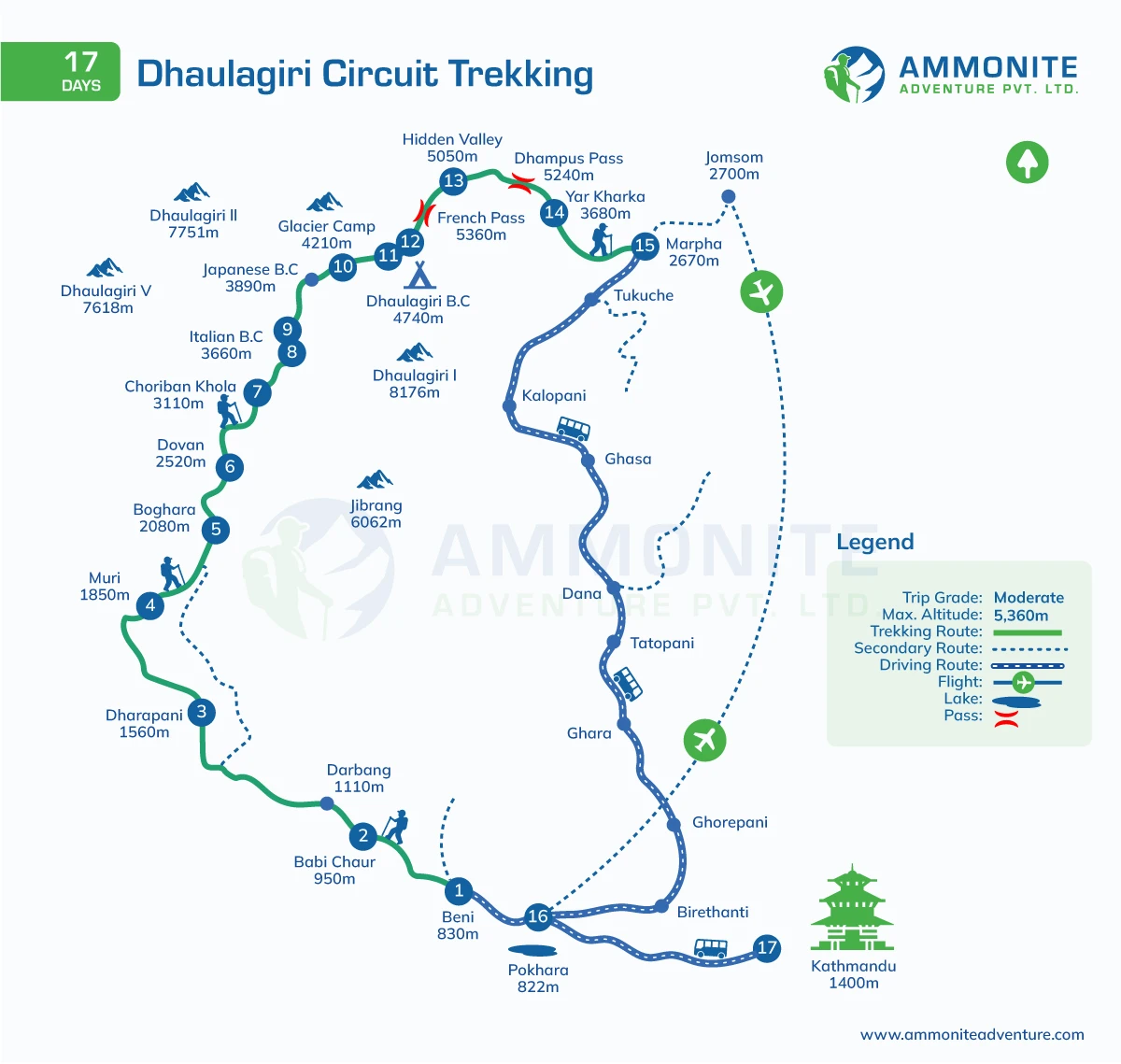
Route Map

Dhaulagiri Circuit Trekking - 17 Days
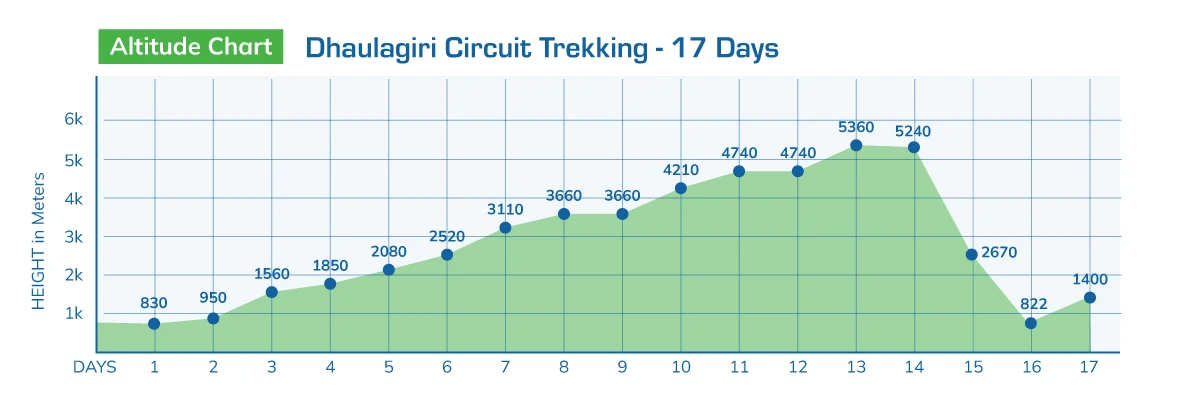
Altitude Chart
Dhaulagiri Circuit Trekking - 17 Days

What is Included?

Hotel in City

  • Kathmandu: 1 night Twin-sharing standard hotel accommodation at Kathmandu on a bed-and-breakfast basis.
  • Pokhara: 1 night Twin-sharing standard hotel accommodation at Pokhara on a bed-and-breakfast basis.

Transportation

  • Airport Transfers: For your international and domestic flights, a round-trip transfer and pick-up . 
  • Trek Start: A sharing vehicle transfer is scheduled from Pokhara to Beni.
  • Trek End: A sharing vehicle transfer is also scheduled back from Marpha to Pokhara.
  • Return to Kathmandu: Tourist bus ride from Pokhara to Kathmandu.
  • Staff Transport: All ground transport for the guides, assistant guides, porters, and any other support staff.

Accommodations

  • Trek Accommodation: Overnight local tea house accommodation on a twin-sharing basis. Single rooms can be arranged for a small surcharge, subject to availability.
  • Total Accommodation Nights: 15 nights of standard twin-sharing accommodation during the trek.

Food

  • Full Board Meals: Breakfast, lunch and dinner meals and hot drinks are provided during the entire trek. 
  • Special Inclusions: Water purification tablets for safe drinking water.
  • Total meals included: There will be a total of 17 Breakfasts, 16 Lunches and 15 Dinners.

Guide

  • One government-licensed English-speaking guide. The assistant guides will join the group, depending on the size of the group.
  • All Guide fees, food, insurance, salaries, accommodation, transport and all equipment will be covered.

Porter

  • Porters: One porter for every two trekkers. Each trekker's personal luggage weight limit is 9 kg.
  • All Porter fees, food, insurance, salaries, accommodation, transport and all equipment will be covered.

Trek Permits and Expenses

  • All necessary permits - including special area permits - are pre-scheduled to make your trek a bit easier and trouble-free. Included permits are:
  • Annapurna Conservation Area Permit (ACAP)
  • Dhaulagiri Restricted Area Permit
  • Trekkers' Information Management System (TIMS) Card

Medical Assistance

  • Emergency Provision: Guides will be equipped with the emergency oxygen and a first aid medical kit on the trek.
  • Rescue Arrangements: Trained rescuers in case of emergency (included in your Trek Travel Insurance).

Souvenir

  • Goodbye Souvenirs: All participants will receive an Ammonite Adventure cap and T-shirt.
  • Completion Certificate: A completion certificate for all participants.

Gear and Trekking Equipments

  • Sleeping bags and down jackets, duffle bag (one for every two trekkers) if you do not have your own
  • Dhaulagiri Region map.

Additional Services

  • Luggage Storage: Free secure storage for your luggage throughout the trek with us.
  • Full Coordination: Our full coordination team will take care of all logistics, planning, and requirements for you.

Farewell

  • A cultural farewell meal in Kathmandu at the conclusion of your journey.

What is Excluded?

International Flight

  • International flight to and from Nepal is not included.

Accommodations

  • Hotel accommodation in Kathmandu before and after the Trek.
  • Extra nights in Kathmandu on early arrival, late departure, or early return from the trek due to any cause.

Food

  • All meals in Kathmandu/ Pokhara before and after the trek are at your own expense.
  • Extra meals required due to early arrival, late departure, or early return from the trek are not included.

Guide and Porter

  • Guide, porter, and local support staff tipping is excluded and appreciated on a service basis.

Visa

  • Nepal entry visa fees (to be paid in cash upon arrival at Tribhuvan International Airport) are the traveler's responsibility.

Travel Insurance

  • Travel insurance is mandatory and must include high-altitude medical emergencies, helicopter evacuation and treatment costs.

Personal Expenses

  • Personal expenses such as snacks, beverages (alcoholic/hot/cold), hot water/boiled water, hot showers, Internet/ Wi-Fi, mobile/phone calls, charging batteries, laundry, and additional porter fees.
  • Personal clothing and trekking gear.

Other Expenses

  • Charges for excess baggage (a trekker can carry only 9 kg).
  • Unforeseen additional costs due to natural calamities, adverse weather, modifications to the itinerary for safety reasons, political unrest, government policy, illness, or other unforeseen circumstances beyond our control.

Dates & Availability

Starts:June 01, 2026Ends:June 17, 2026
PriceUS$1986
AvailabilityGuaranteed
Starts:June 14, 2026Ends:June 30, 2026
PriceUS$1986
AvailabilityGuaranteed
Starts:June 29, 2026Ends:July 15, 2026
PriceUS$1986
AvailabilityGuaranteed

Additional Information

What sort of food and accommodation are available en route to the Dhaulagiri Circuit?

Along the trekking route to the Dhaulagiri Circuit, trekkers can stay in teahouses and lodges in the village at lower elevations such as Beni, Babichaur, Muri, Dobang, and Boghara. Although the accommodations are often very basic, with shared twin bedrooms and limited facilities, they are reliable enough for a comfortable night.

As you ascend to a higher altitude area, the options become more primitive, where camping is the only option in that remote high altitude where you will get to spend nights on base camps and beyond up at French and Dhampus at already set tents when choosing our service at Ammonite Adventure.

Trekkers will get to savor the freshly cooked meals in these teahouses, lodges, or tents, usually consisting of typical Nepali-Tibetan dishes and some international cuisines in the lower elevation, which also provides warm, boiled water refillable at various stopping places. Modern facilities such as the charging of electronic devices, internet connections, and hot showers can be very limited and are usually available at some additional cost.

Visitors hence visiting the Dhaulagiri Circuit are advised to have some spare batteries, a high-storage power bank, local SIM cards, and a water purification system for a more embellished experience while we provide you with the best of the best services available on the way to conquer the Dhaulagiri Circuit.

When is the best time to visit the Dhaulagiri Circuit?

Generally, considering the stable weather conditions, comparatively safer and more scenic route, mild temperature, and unobstructed visibility, spring from March to May and autumn from September to November are considered the best times for trekking the Dhaulagiri Circuit.

Packing appropriately and keeping yourself up to date mentally and physically, trekking to the Dhaulagiri Circuit is possible even in the winter and monsoon, which may require extra consideration of hiking equipment and gear, which overall does provide a unique experience that you could be one of the first ones to relish.

Where can you get trekking permits for the voyage to the Dhaulagiri Circuit?

To trek the Dhaulagiri Circuit, you’ll need two specific permits, which are the Trekkers Information Management System Card (TIMS) and the Annapurna Conservation Area Permit (ACAP), that you can get from the Nepal Tourism Board (NTB) and the office of the Trekking Agencies Association of Nepal (TAAN) in Kathmandu or Pokhara.

Generally, when you choose the package service from one of the local tour, travel, and trek operators like Ammonite Adventure they will have these necessary permits prearranged for you even before the start of your journey to the Dhaulagiri Circuit, which saves you from the hassle of visiting authorities by yourself, while solo trekkers without a guide are completely banned and not recommended from April 1st, 2023.

Why is the trek to Dhaulagiri Circuit considered moderate to strenuous difficult?

The odyssey to Dhaulagiri Circuit is regarded as moderately to strenuously demanding for a high Himalayan expedition due to several factors, such as the rough, uneven, and less frequented trails, steep ascents and descents, rocky paths, and loose gravel requiring good balance and physical strength.

At certain points, the jaunting to the Dhaulagiri Circuit also includes navigating across glaciers at extreme elevations, requiring the use of crampons and ice axes afar from everyday modern amenities, while the rapidly varying weather adds much to the difficulty level that can be tacked easily with some advanced physical preparation, proper acclimatization, and guidance from one of the professional guides from any trustworthy travel or trekking agencies in Nepal, like Ammonite Adventure.

Must you get trekking guides, porters, and insurance to embark on the Dhaulagiri Circuit Hike?

Yes, absolutely. Given the remoteness, demanding nature of the trekking trail, and high altitude of the Dhaulagiri Circuit, it is wise to hire government-authorized guides and porters, along with purchasing travel insurance covering emergency helicopter evacuation from higher elevations from locally based agents.

Trekking guides help a lot in navigating this remote, less trodden, and difficult terrain safely, having collected years of extensive knowledge of local culture, geography, and wildlife. They also aid you during emergency assistance such as altitude sickness or injuries, where the porters lift up the weight from your shoulder so you get to experience what the Dhaulagiri Circuit has to offer to its fullest.

Similarly, travel insurance covering high-altitude trekking and emergency evacuation, medical emergencies, and trip cancellations and delays provides you with financial protection. That is why getting trustworthy guides, porters, and travel insurance for the Dhaulagiri Circuit Trekking is crucial.

Trekking group/single

The Dhaulagiri Circuit Trek is one of the most challenging but fun trekking routes in Nepal because it is made for trekkers who want to trek in higher elevation remote wilderness. 

This trek is available for individual and group trekking. Solo trekking allows for the most flexibility and provides individual control over the speed or ability to hike. Group trekking is a team approach and experience among a team. If you organized your own group, trekkers can receive group discounts depending on the group size. Group discounts is unavailable if Ammonite Adventure organizes the group

We are able to take groups of any size. If we have a minimum of 12 trekkers, we will have an assistant guide to help coordinate the entire team. 

Extra personal expenses on trekking

Our Dhaulagiri Circuit Package includes everything needed for your trek, but for your expenses, you will need to budget appropriately. In Kathmandu, first you will need to budget for your meals and accommodation (either budget guest houses to luxury hotels), and you can pre-book your accommodation online. 

You will want to take cash for your personal expenses indicator listed including food and accommodation in Kathmandu, visa fees for Nepal, travel medical insurance, snacks, tea/coffee, and cold drinks, tips for your guides and porters (if applicable), and whatever souvenirs you wish to buy.

You will also want to ensure that you are carrying foreign currency so that you can convert it to Nepali Rupees prior to beginning your trek, because you will be trekking in a remote part of Nepal, and the Dhaulagiri region does not have banks, ATMs, or money exchange services.

Ammonite Adventure Crew

Throughout your trek on the 17-day Dhaulagiri Circuit, you are going to be led by experienced leaders who are all licensed and trained in high-altitude trekking.

When you trek, the local porter/Sherpas will carry your gear and two other trekkers, max 18 kg total gear weight. If you want your porter, you will need to arrange for this ahead of time before the trek. 

The crew are from Himalayan communities and are close to calibrated for quality western trekking in extremely conditions. They will also be paid a living wage with insurance, clothing, food, shelter, health care, etc, will ensure they are doing their best service on the trek.

Our trek leaders have also accomplished:

  • Wilderness First Aid Certification
  • Trekking Certification from the government of Nepal
  • Fluency in English and other languages
  • An extensive knowledge of proper safety procedures and mountain culture
  • A storyteller's ability to bring life to the region of wilderness tourism
  • An ability to relate to trekkers from vastly different cultural backgrounds
  • A calm, logical approach to problem-solving
  • Strong planning and organization skills
  • A sense of humour to keep the group's spirits up
  • An awareness of individual trekker needs
  • A commitment to responsible trekking.

Booking & Payment Method 

Ammonite Adventure is officially licensed with the Government of Nepal, as well as a member of the TAAN and NMA. In order to reserve your trip, you are required to make a payment of 10% (a deposit) via bank transfer, Western Union, or online. 

Once you arrive in Nepal, you can settle the remaining cost in cash, via card (including 3% credit cost), or bank transfer. Within 1 week of lodging your booking, please send us a copy of your passport (including dependents), current photos, proof of travel insurance, and flight information.

Last-minute booking

We accept last-minute bookings for the Dhaulagiri Circuit trek. All payments must be made in full a minimum of 24 hours before departure. Last-minute bookings can be more difficult, as the Dhaulagiri trek is remote and has pre-arranged logistics.

Trip Extension

After completing the Dhaulagiri Circuit trek, you can extend your visit and add additional trips such as cultural tours in Kathmandu, jungle safari, and exciting sports like paragliding to rafting!

Equipments

This trek will occur at high altitudes, and the weather can range from warm valleys to freezing snow on high passes. You need to plan for various types of weather and be prepared. For this trek, a porter will be arranged for every two trekkers.

Each pair of trekkers has a shared duffel, which each trekker will load with gear when we meet at the point of departure.

Duffle bags need to be a minimum of 60 liters and a maximum of 9kg each. Each trekker will carry in a day pack (or unit) valuables and daily essential items.

Head

  • Wide-brimmed sun hat
  • Insulated beanie
  • Glacier sunglasses
  • Neck gaiter or buff

Upper Body

  • Thermal base layers (long sleeve)
  • Fleece jacket
  • Expedition-weight down jacket
  • Waterproof shell jacket

Hands

  • Liner gloves
  • Warm insulated gloves
  • Waterproof over-mittens

Lower Body

  • Trekking pants
  • Thermal leggings
  • Waterproof over-pants

Feet

  • Mountaineering-grade trekking boots
  • Thick wool socks and liners
  • Warm camp shoes

Toiletries

  • Toothbrush and toothpaste
  • SPF 50+ sunscreen
  • Lip balm
  • Wet wipes and sanitizer
  • Small towel

Backpacks

  • Daypack (30–35 liters)
  • Rain cover

Accessories

  • Trekking poles
  • Hydration bladder or bottles
  • Headlamp with extra batteries
  • Power bank and solar charger
  • Dry bags for gear organization

Extra Items

We can provide you with a (used, nonwaterproof) duffle bag, (used) down jacket, and (used) sleeping bag if you do not have your own.

FAQs

Yes, however, it is important to understand that the meaning of solo trekking since April 1st, 2023, in Nepal, has been updated as a trip with at least two members where the hiring of a professional guide is mandatory for off-beaten remote Himalayan routes like the Dhaulagiri Circuit.

Yes, if you are concerned about your safety and security with the male guides, which usually you don't have to be, but for your convenience, you can hire female guides as well for various Himalayan journeys such as the Everest Base Camp, Annapurna Base Camp, or peak climbing to Mera Peak, including venturing to the Dhaulagiri Circuit.

Well, it depends. If you are a group of trekkers hopping for the circuit trek to Dhaulagiri independently without hiring any mountain guides or taking service from reputed travel and trekking agencies, you are bound to have your own camping gear, while it is a better alternative to join organized treks with operators who provide necessary gear and logistical support, ensuring a safer and more comfortable option.

The highest altitude you will reach during the alpine rambling to Dhaulagiri Circuit is Dhapmpus Pass after Hidden Valley at an altitude of 5,240 m (17,192 ft) before descending steeply to the Kali Gandaki Valley passing through, which is a major achievement for sure.

Yes, you can summit to the top of the Dhaulagiri mountain range, which, however, is not for faint hearts with significant technical challenges and risks. Although there is no blanket restriction to prevent climbing in the region, it is considered extremely sacred for the locals.

  • Best Price Guarantee
  • Fully Cutomizable Trip
  • Instatnt Booking
  • Flexible Itinerary
Speak to an Expert