Kanchenjunga North Base Camp Trekking - 19 Days

Kanchenjunga North Base Camp Trek - 19 Days

484 reviews
113 reviews
Recommended by 99% of travelers

The 19-Day Kanchenjunga North Base Camp Trek is a remote Himalayan adventure that takes trekkers to Pang Pema (5,143 m), the base camp of Mt. Kanchenjunga, the world's third-highest mountain. Covering approximately 180 kilometres, this itinerary is designed to balance adventure with proper altitude acclimatization. The trek offers an uncrowded and pristine alternative to Nepal's more popular trekking routes, with package costs typically starting from USD 1,605 per person, depending on group size and included services. 

⚠️ 2026 Trail Update 

  • Restricted Area Permit Update: Solo trekkers can now obtain a Kanchenjunga permit, but a licensed guide is still mandatory.
  • Teahouse Expansion: The route is now fully supported by teahouses and basic lodges up to Lhonak.
  • Trail Conditions: Sections above 4,000 m feature rocky trails, glacial moraines, and scree slopes requiring careful footing.
  • Transport Update: Flying to Bhadrapur and driving to Taplejung is the most reliable way to reach the trek start point.
  • Connectivity & Power: Mobile coverage ends beyond Ghunsa, while limited charging and satellite communication are available at higher camps.
At a Glance
Duration19 Days
Trip GradeModerate
CountryNepal
Maximum Altitude5,143m at North Base Camp
Group Size2-10
StartsKathmandu
EndsKathmandu
Travel StyleTrekking
Best TimeSpring & Autumn

Overview 

The 19-Day Kanchenjunga North Base Camp Trek is a remote Himalayan adventure that takes trekkers to Pang Pema (5,143 m), the North Base Camp of Mt. Kanchenjunga (8,586 m), the world's third-highest mountain. Starting with a flight from Kathmandu to Bhadrapur and a drive through Ilam and Taplejung, the journey passes through lush forests, traditional villages, alpine meadows, and glacial landscapes. The carefully designed 19-day itinerary includes essential acclimatization days in Ghunsa and Kambachen, ensuring a safer and more enjoyable high-altitude experience.

The trek offers a unique blend of wilderness, culture, and mountain scenery while staying in local teahouses and lodges throughout the route. At Pang Pema, trekkers are rewarded with spectacular views of Kanchenjunga and its surrounding glaciers and peaks. Due to its remote terrain and elevations above 5,000 meters, the trek requires good physical fitness, proper acclimatization, and a sense of adventure.

The total cost of the Kanchenjunga North Base Camp Trek typically ranges from USD 1,605  to USD 2,175  per person, depending on group size, transportation, and included services. Trekkers must obtain both the Kanchenjunga Conservation Area Permit (KCAP) and Restricted Area Permit (RAP), and while solo travelers can now obtain permits, a licensed guide remains mandatory. For those seeking an uncrowded alternative to Everest Base Camp or Annapurna Base Camp, this trek offers one of Nepal's most authentic and rewarding wilderness experiences.

Highlight

  • Venture deep into the untouched part of the Himalayas in a remote location, boasting the rugged, unspoiled landscapes at their greatest purity.
  • Traverse around the majesty of the third-highest mountain in the world, Kanchenjunga, and several other towering snow-clad peaks.
  • Mark your victory at Daredevils Pangpema Base Camp by trekking along the rigorous Kanchenjunga glacier in serenity.
  • An intimate insight into the traditional way of life, culture, traditions, and customs in the Himalayas, guided by Buddhism and Hinduism
  • Unobstructed views of Mt. Makalu, the fifth tallest peak globally, the east face of Mt. Everest, and numerous others.
  • A perfect off-the-beaten-track destination for nature lovers, expeditors, photographers, and climbers alike.
  • A once-in-a-lifetime opportunity to appreciate the diverse, unpolluted Himalayan ecosystem, from lush woodland to alpine pastures inhabited by a wide range of flora and fauna, etc.

Short itinerary 

  • Day 01: Kathmandu → Ilam: Fly from Kathmandu (1,400 m) to Bhadrapur (91 m) in ~45 min, then drive 3–4 hrs (approx. 90 km) to Ilam (1,627 m).
  • Day 02: Ilam → Taplejung: Drive from Ilam (1,62 7m) to Taplejung (1,820 m) in ~6–7 hrs (approx. 150 km) through hilly mountain roads.
  • Day 03: Taplejung → Chirwa: Trek 5–6 hrs (approx. 12 km) from Taplejung (1,820 m) down to Chirwa (1,270 m) through forest and riverside trails.
  • Day 04: Chirwa → Lelep: Trek 6–7 hrs (approx. 14 km) from Chirwa (1,270 m) to Lelep (1,750 m), crossing suspension bridges and river valleys.
  • Day 05: Lelep → Amjilosa: Trek 6–7 hrs (approx. 10–12 km) from Lelep (1,750 m) to Amjilosa (2,510 m) through dense forest trails.
  • Day 06: Amjilosa → Gyabla: Trek 5–6 hrs (approx. 9–10 km) from Amjilosa (2,510 m) to Gyabla (2,730 m) via bamboo and rhododendron forest.
  • Day 07: Gyabla → Ghunsa: Trek 6–7 hrs (approx. 10–12 km) from Gyabla (2,730 m) to Ghunsa (3,595 m) through alpine villages and waterfalls.
  • Day 08: Acclimatization at Ghunsa: Rest or hike 2–4 hrs (2–5 km side hike) at Ghunsa (3,595 m) for altitude adaptation.
  • Day 09: Ghunsa → Kambachen: Trek 6–7 hrs (approx. 10 km) from Ghunsa (3,595 m) to Kambachen (4,100 m) through rocky alpine terrain.
  • Day 10: Acclimatization at Kambachen: Short hike 2–3 hrs (2–4 km) around Kambachen (4,100 m) for acclimatization.
  • Day 11: Kambachen → Lhonak: Trek 5–6 hrs (approx. 8–9 km) from Kambachen (4,100 m) to Lhonak (4,780 m) across glacial moraine trails.
  • Day 12: Lhonak → Pangpema (Base Camp) → Lhonak: Trek 7–8 hrs (approx. 14–16 km round trip) from Lhonak (4,780 m) to Kanchenjunga North Base Camp (5,143 m) and return.
  • Day 13: Lhonak → Ghunsa: Trek 7–8 hrs (approx. 18–20 km) from Lhonak (4,780 m) down to Ghunsa (3,595 m).
  • Day 14: Ghunsa → Amjilosa: Trek 6–7 hrs (approx. 12 km) from Ghunsa (3,595 m) to Amjilosa (2,510 m) descending through forest trails.
  • Day 15: Amjilosa → Tapethok: Trek 5–6 hrs (approx. 10–12 km) from Amjilosa (2,510 m) to Tapethok (1,456 m) via river valleys.
  • Day 16: Tapethok → Mitlung: Trek 5–6 hrs (approx. 12–14 km) from Tapethok (1,456 m) to Mitlung (900 m) through lowland villages.
  • Day 17: Mitlung → Taplejung: Trek 6–7 hrs (approx. 14–16 km) from Mitlung (900 m) to Taplejung (1,820 m) with gradual ascent.
  • Day 18: Taplejung → Bhadrapur: Drive 8–10 hrs (approx. 240 km) from Taplejung (1,820 m) to Bhadrapur (91 m) through eastern Nepal hills.
  • Day 19: Bhadrapur → Kathmandu: Fly 45 min from Bhadrapur (91 m) to Kathmandu (1,400 m), ending the trek.

How much does it cost for Trekking to the Kanchenjunga North Base Camp

Generally, the Kanchenjunga North Base Camp Trekking Cost can experience fluctuation depending on the duration of the trek, the level of services included and excluded, the type of tour operator you have chosen for your trip, such as local or international, and the season of the trip. Usually, trekking packages from reputable locally based travel, trek, and tour organizers like Ammonite Adventure. cover most of the hiking expenses that can cost anywhere from USD 2,235 to USD 2,385 with a service level no less than that of the international operators.

Contact us now for exclusive discounts on every Himalayan trip you do with us at your most affordable prices in 2026 and 2027!

Cost Breakdown 

Cost Component

Included Services

Estimated Cost (USD)

Permits & Fees

Restricted Area Permit, Kanchenjunga Conservation Area Permit, TIMS/administration

$250 – $300

Guide Services

Licensed trekking guide (salary, insurance, meals, equipment)

$350 – $450

Porter Services

Porters for luggage carrying (1 porter per 2 trekkers approx.)

$250 – $320

Accommodation

Teahouses/lodges during trek (15–22 days average)

$300 – $380

Meals

Breakfast, lunch, dinner during trekking days

$450 – $550

Transportation

Domestic flights, jeeps (Kathmandu–Taplejung–trailhead and return)

$350 – $450

Logistics & Camping Support

Remote area logistics, camping gear (if needed in higher sections)

$150 – $200

Insurance (Staff)

Guide/porter insurance coverage

$50 – $80

Agency Service Charge

Organization, permits handling, coordination, profit margin

$250 – $300

Why Kanchenjunga Costs More Per Day Than Everest: While the permits themselves are heavily subsidised by the government to encourage off-the-beaten-path tourism, the true expense of a 19-day Kanchenjunga trip lies in the remote logistics. Every single egg, gas canister, and fresh vegetable served above Ghunsa has been carried for days on a porter's back or by mule trains. Booking through a licensed agency ensures your crew is legally insured and paid fair wages under 2026 regulatory standards.

Best Time to Trek to Kanchenjunga North Base Camp

The Kanchenjunga region in eastern Nepal has changing high-altitude weather, so choosing the right season is very important for safety, clear views, and good trekking conditions.

Seasonal Overview

  • Spring (March–May) – Best Recommended Season: Spring offers stable weather and clear mornings with great views of the mountains. The lower valleys are full of blooming rhododendrons and flowers, and the temperature is comfortable even in high areas like Ghunsa and Lhonak.
  • Autumn (September–November) – Best Overall Season: Autumn is the most popular trekking season. The weather is dry and stable, the skies are very clear, and you get the best views of Kanchenjunga. This season also lets you experience major Nepali festivals like Dashain and Tihar.
  • Winter (December–February) – Very Difficult: Winter is extremely cold with heavy snowfall at higher altitudes. Many teahouses close, and trekking becomes challenging. This season is suitable only for very experienced and well-prepared trekkers.
  • Monsoon (June–August) – Not Recommended: Monsoon brings heavy rain, making trails slippery and unsafe. There is a high risk of landslides and poor visibility. Flights and road travel to Taplejung can also be delayed or canceled.

Expert Recommendation: The best time to trek is late March to May and October to November. Trekking outside these months can be risky due to snow, bad weather, and difficult trail conditions, especially in higher areas like Kambachen and Lhonak.

What is the Difficulty Level of Kanchenjunga North Base Camp Trekking

The Kanchenjunga North Base Camp Trek is a moderate to very strenuous high-altitude trek in a remote and less-developed part of eastern Nepal. It requires strong physical fitness, mental endurance, and prior trekking experience.

The trail reaches a maximum altitude of 5,143 m at Pangpema (Base Camp), with several days spent above 3,500 m. To reduce the risk of altitude sickness (AMS), the 19-day itinerary includes key acclimatization stops at Ghunsa (3,595 m) and Kambachen (4,100 m).

Trekkers usually walk 5–8 hours daily across steep ascents, rocky paths, suspension bridges, and glacial moraine terrain. The route is physically demanding and located in a very remote region with basic teahouse facilities, limited electricity, and weak internet access.

A good level of cardiovascular fitness is essential, and 2–3 months of preparation (hiking, running, cycling, and leg strengthening) is highly recommended before the trek.

Expert Safety Notice: Because solo trekking is illegal in this restricted area, you must trek in a group with at least one other person and hire a licensed trekking guide to pass government checkpoints and ensure safety in remote terrain. In addition, travel insurance must include emergency helicopter evacuation coverage up to 6,000 meters to handle any high-altitude emergencies.

Itinerary

The journey to the North Base Camp begins this day with a scenic 45-minute domestic flight to Bhadrapuer from Kathmandu’s Tribhuvan International Airport after an early morning breakfast.

After the flight, you will take a local bus to Ilam, a 3-4 hour drive to discover the unique beauty of tea plants walking amidst the verdant hills and low mountain passing by Kanyan and Fikkal famous for tea gardens and cardamom.

Max. Altitude: 1,627mMeals: BreakfastAccommodation: Local-Tea-House

The destination of the day is the starting point for many trekking routes heading to the third highest mountain in the world, Mt. Kanchenjunga, including the Kanchenjunga Circuit Trek and Kanchenjunga South Base Camp, winding through mostly narrow and rough trails.

Therefore, four-wheelers like jeeps would be the best means of transportation to use, passing through several charming villages, lush hills, and the constant roar of the river nearby.

Max. Altitude: 1,820mMeals: Breakfast-Lunch-BreakfastAccommodation: Local-Tea-House

The trekking journey to the Kanchenjunga North Base Camp officially commences this day, which starts with a downhill trek through the cardamom jungle along the bank of the Tamor River, encountering mostly the Limbu settlements.

Shortly after the footwalk, you will begin to notice the change in vegetation from tropical to alpine, leading you lastly to Chirwa, home to the ethnic Kirati people of Nepal that has been present for around 2000 years, boasting a rich cultural heritage.

Max. Altitude: 1,820mMeals: Breakfast-Lunch-DinnerAccommodation: Local-Tea-House

On the fourth day, you will leave the charming town of Chirwa behind and follow the banks of the Tamor River at first, which enters the lush forested and agricultural lands later on, calling it a day at Lelep upon crossing several suspension bridges spanning the Tamor River and its tributaries in the serene surroundings.

Max. Altitude: 1,750mMeals: Breakfast-Lunch-DinnerAccommodation: Local-Tea-House

The trek begins with breakfast through the dense woodland rich in flora and fauna that stops at Jaubari for lunch and continues yet along the banks of the Tamor Khola that you will cross back and forth until you finally ascent to Amjilosa, a small village perched on a hillside with spectacular views of surrounding mountains and valleys.

Max. Altitude: 2,510mMeals: Breakfast-Lunch-DinnerAccommodation: Local-Tea-House

The trekking trail of the day involves moderate to steep ascents through thick forests of bamboo, rhododendron, and pine along the bank of the Tamor River that later on trails the Ghunsa River for a significant portion, arriving at Gyabla.

Max. Altitude: 2,730mMeals: Breakfast-Lunch-DinnerAccommodation: Local-Tea-House

Today, you will ascend via traditional stone stairs and walk through landslides, streams, and waterfalls. The ascent of the day passes through several small towns, rhododendron, and oak treks before reaching Ghunsa.

The Tibetan village grants you the most refined views of the surrounding Himalayas one more time, including that of Kumbhakarna Peak.

Max. Altitude: 3,595mMeals: Breakfast-Lunch-DinnerAccommodation: Local-Tea-House

You still have a high altitude to reach several camps crossing notable mountain passes; hence, it is crucial to let your body adapt to the low oxygen level in highly elevated areas, so you will use this day for a short side hike from Ghunsa or complete rest.

From the acclimatization point of view, it is considered good to climb a certain height and descend back to spend the night at a comparatively lower elevation, so it is recommended to participate in a guided side trip and hike nearby Ghunsa for better acclimatization.

Max. Altitude: 3,595mMeals: Breakfast-Lunch-DinnerAccommodation: Local-Tea-House

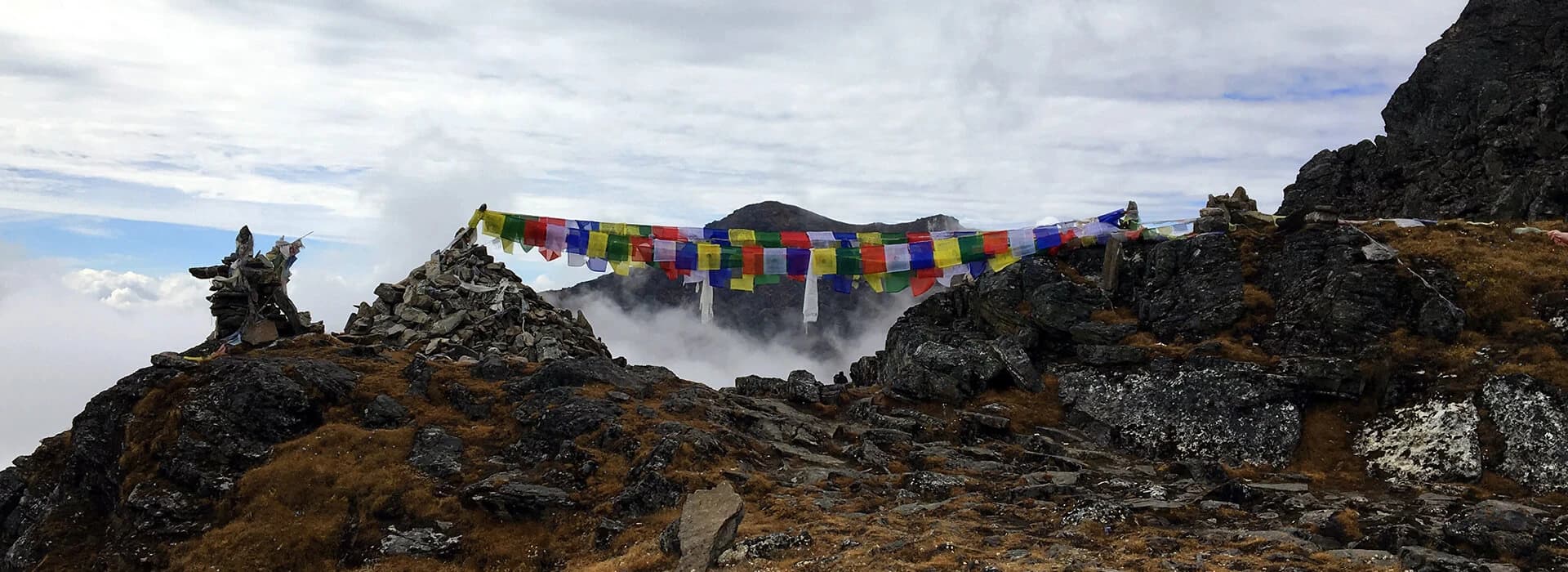
This day, you will make your way through the rocky terrain that begins on the south bank of the Ghunsa Khola, jaunting through scenic and serene forests of rhododendrons, pine chortens, mani walls, and prayer flags.

The journey of the day at the end concludes at Kambachen, culturally profound Tibetan dwellings with 360-degree panoramic views of the snow-capped peaks, majorly dominated by the views of Jannu (7,710 m).

Max. Altitude: 4,100mMeals: Breakfast-Lunch-DinnerAccommodation: Local-Tea-House

As you are already in the highly elevated Kanchenjunga realm and will soon be reaching more heights, the 10th trek day to the Kanchenjunga North Base Camp is allocated as the second acclimatization day.

For that purpose, you will be presented with the options of hiking a nearby ridge in about 2–3 hours, visiting Phaktalung Temple, or simply strolling around the village.

Max. Altitude: 4,100mMeals: Breakfast-Lunch-DinnerAccommodation: Local-Tea-House

The jaunting from Kambachen onwards is the raw Himalayan wilderness alpine rambling that ascends through stony moraine trails and glaciers with dynasty mountain views, along with the first-ever sight of the world’s third highest peak, Mt. Kanchenjunga. Spend the night at Lhonak.

Situated near the dry lake featuring sandy plains, the tranquil ambiance and everlasting sights of Twins Peak (6,750 m), Wedge (6,750 m), Mera Peak (6,344 m), and Nepal Peak (6,910 m) add much to the joy of reaching Lhonak.

Max. Altitude: 4,780mMeals: Breakfast-Lunch-DinnerAccommodation: Local-Tea-House

The day you have been waiting for is finally here when you will mark your footprint in the Kanchenjunga North Base Camp and also in Pangpema, your dream destination. You will begin quite early so that you can avoid the afternoon’s weather, which is usually not favorable for climbing the higher altitudes.

Nestled amidst the majesty of several snow-capped peaks, it would be thrilling to reach the foot of Kanchenjunga as you come across ever-changing terrain, sometimes icy depending on the season, and return to Lhonak for the night.

Max. Altitude: 5,143mMeals: Breakfast-Lunch-DinnerAccommodation: Local-Tea-House

Now begins the return trip to Ghunsa simultaneously to get back to Kathmandu, retracing the same route via Kambachen, followed by alpine scenery and breathtaking snow-capped peaks.

At Ghunsa, you would be able to take a hot shower, charge your electronic device, and even get wifi or a stable internet connection, usually for some additional amount.

Max. Altitude: 4,780mMeals: Breakfast-Lunch-DinnerAccommodation: Local-Tea-House

The descending hike continues like usual days after a delicious breakfast. Following the pleasing aroma of juniper, you will be in the lower region of Kanchenjunga, Amjilosa, near Gyabla.

In between the dense bamboo trees, the serene air adds much to the journey, and lastly, spending overnight at the tea house of Amjilosa in about 5–6 hours of trekking from Ghunsa.

Max. Altitude: 3,595mMeals: Breakfast-Lunch-DinnerAccommodation: Local-Tea-House

The trek of the day includes a combination of descents, some moderate ascents, and enjoyable flat stretches all through the beautiful forests, riverbanks, and adventurous hanging bridges, concluding at Tapethok for overnight.

Max. Altitude: 2,510mMeals: Breakfast-Lunch-DinnerAccommodation: Local-Tea-House

From Tapethok, you will begin the trek to arrive at Mitlung, another alluring mountain village in the Kanchenjunga Trekking region at low elevation through lush forests, the river shore of the Tamor River, and several other traditional small settlements.

Max. Altitude: 1,456mMeals: Breakfast-Lunch-DinnerAccommodation: Local-Tea-House

You are bound to experience the varying terrain one more time, at first a moderate ascent with some flat and then descending sections to reach Taplejung, which serves both as the starting point and ending point for several trekking routes in the Kanchenjunga region.

The landscapes are also diverse, usually featuring forests, terraced fields, and numerous lovely typical villages.

Max. Altitude: 1,820mMeals: Breakfast-Lunch-DinnerAccommodation: Local-Tea-House

From Taplejung, you can choose an optional direct flight to Kathmandu, flying over the lowlands in the foothills into the capital city instead of driving to Bhadrapur, which allows for scenic views, diverse landscapes, and insight into eastern Nepalese culture one last time before you officially bid farewell to the whole Kanchenjunga region.

Max. Altitude: 1,820mMeals: Breakfast-Lunch-DinnerAccommodation: Local-Tea-House

The 19-day Himalayan journey to the Kanchenjunga North Base Camp ends this day. Enjoy the scenically stunning flight over Eastern Nepal as you catch the surreal aerial view of the Himalayas, lush valleys, and terraced fields below.

It can be extremely overwhelming to reflect on your trekking experience as you fly back to the bustling city of Kathmandu, filling you with unforgettable memories.

Max. Altitude: 1,820mMeals: BreakfastAccommodation: Three-Star-Hotel
Customize Trip

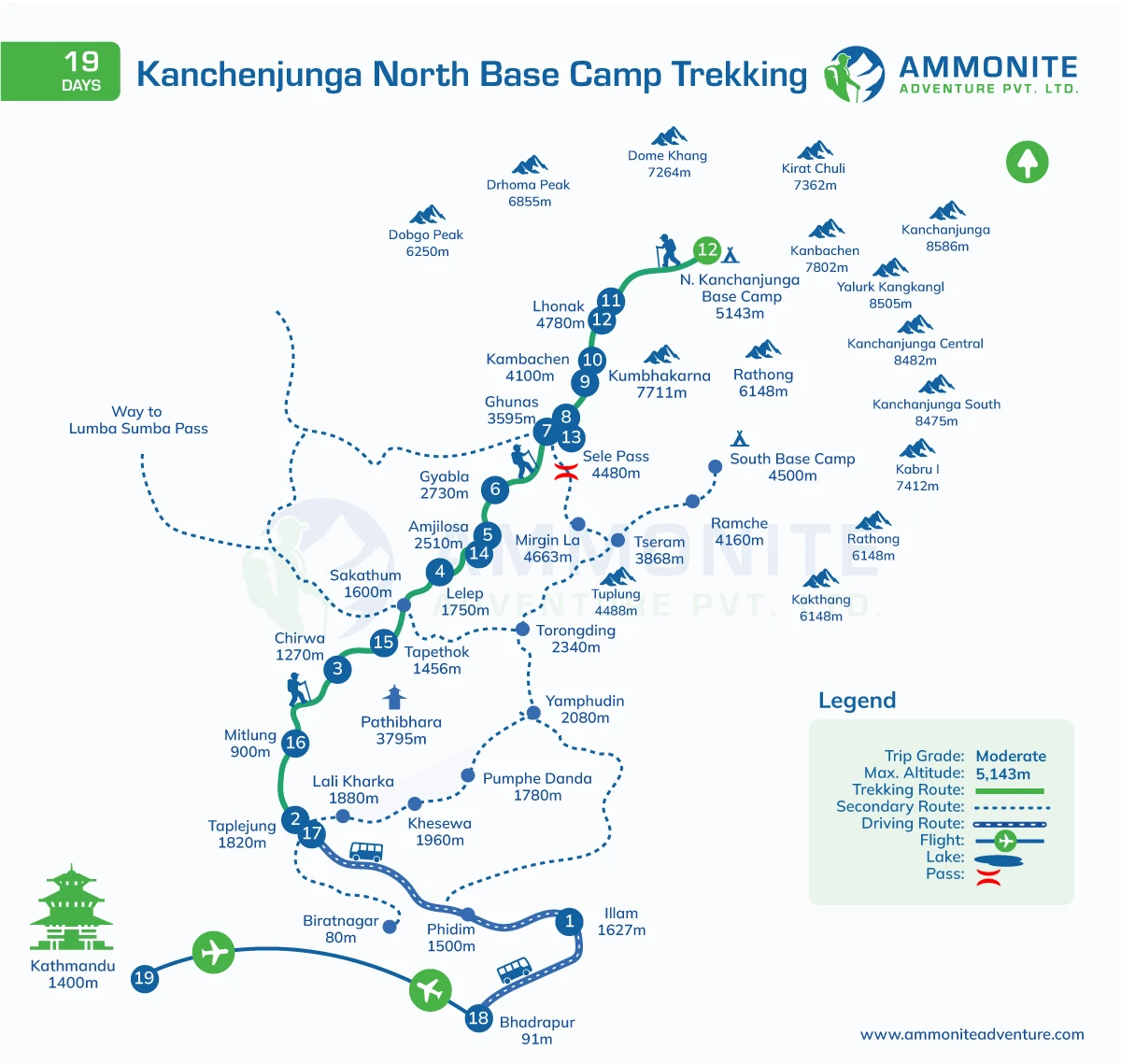
Route Map

Kanchenjunga North Base Camp Trekking - 19 Days
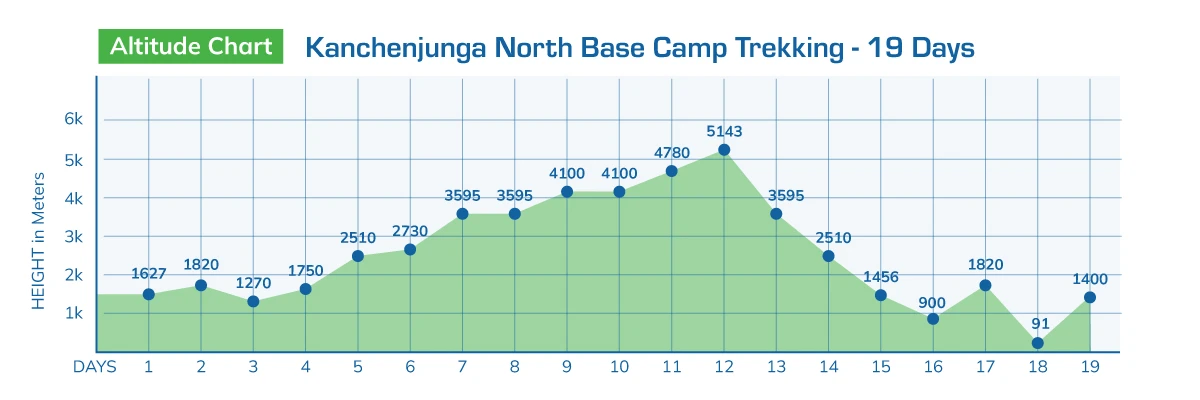
Altitude Chart
Kanchenjunga North Base Camp Trekking - 19 Days

What is Included?

Hotel in City

  • Kathmandu: 1 night Twin-sharing standard hotel accommodation at Kathmandu on a bed-and-breakfast basis.

Transportation

  • Airport Transfers: For your international and domestic flights, a round-trip transfer and Pick-up.
  • Trek Start: One-way flight Ticket from Kathmandu to Bhadrapur. A sharing vehicle transfer is scheduled from Bhadrapur to Ilam to Taplejung.
  • Trek End: A sharing vehicle transfer is scheduled from Taplejung to Bhadrapur. 
  • Return to Kathmandu: One-way flight Ticket from Bhadrapur to Kathmandu. 
  • Staff Transport: All ground transport for the guides, assistant guides, porters, and any other support staff.

Accommodations

  • Trek Accommodation: Overnight local tea house accommodation on a twin-sharing basis. Single rooms can be arranged for a small surcharge, subject to availability.
  • Total Accommodation Nights: 18 nights of standard twin-sharing accommodation during the Trip.

Food

  • Full Board Meals: Breakfast, lunch and dinner meals and hot drinks are provided during the entire trek.
  • Special Inclusions: Water purification tablets for safe drinking water.
  • Total meals included: There will be a total of 19 Breakfasts, 18 Lunches and 18 Dinners.

Guide

  • One government-licensed English-speaking guide. The assistant guides will join the group, depending on the size of the group.
  • All Guide fees, food, insurance, salaries, accommodation, transport and all equipment will be covered.

Porter

  • Porters: One porter for every two trekkers. Each trekker's personal luggage weight limit is 9 kg.
  • All Porter fees, food, insurance, salaries, accommodation, transport and all equipment will be covered.

Trek Permits and Expenses

  • All necessary permits - including special area permits - are pre-scheduled to make your trek a bit easier and trouble-free. Included permits are:
  • Restricted Area Permit (RAP)

  • Kanchenjunga Conservation Area Permit (KCAP)

Medical Assistance

  • Emergency Provision: Guides will be equipped with the emergency oxygen and a first aid medical kit on the trek.
  • Rescue Arrangements: Trained rescuers in case of emergency (included in your Trek Travel Insurance).

Souvenir

  • Goodbye Souvenirs: All participants will receive an Ammonite Adventure cap and T-shirt.
  • Completion Certificate: A completion certificate for all participants.

Gear and Trekking Equipments

  • Sleeping bags and down jackets, duffle bag (one for every two trekkers) if you do not have your own
  • Kanchenjunga Region map.

Additional Services

  • Luggage Storage: Free secure storage for your luggage throughout the trek with us.
  • Full Coordination: Our full coordination team will take care of all logistics, planning, and requirements for you.

Farewell

  • A cultural farewell meal in Kathmandu at the conclusion of your journey.

What is Excluded?

International Flight

  • International flight to and from Nepal is not included.

Accommodations

  • Hotel accommodation in Kathmandu before and after the Trek.
  • Extra nights in Kathmandu on early arrival, late departure, or early return from the trek due to any cause.

Food

  • All meals in Kathmandu/ Pokhara before and after the trek are at your own expense.
  • Extra meals required due to early arrival, late departure, or early return from the trek are not included.

Guide and Porter

  • Guide, porter, and local support staff tipping is excluded and appreciated on a service basis.

Visa

  • Nepal entry visa fees (to be paid in cash upon arrival at Tribhuvan International Airport) are the traveler's responsibility.

Travel Insurance

  • Travel insurance is mandatory and must include high-altitude medical emergencies, helicopter evacuation and treatment costs.

Personal Expenses

  • Personal expenses such as snacks, beverages (alcoholic/hot/cold), hot water/boiled water, hot showers, Internet/ Wi-Fi, mobile/phone calls, charging batteries, laundry, and additional porter fees.
  • Personal clothing and trekking gear.

Other Expenses

  • Charges for excess baggage (a trekker can carry only 9 kg).
  • Unforeseen additional costs due to natural calamities, adverse weather, modifications to the itinerary for safety reasons, political unrest, government policy, illness, or other unforeseen circumstances beyond our control.

Add-ons & Options

Private Porter Support

Make your 19 days of Kanchenjunga North base camp trek easier by hiring a private porter only at USD 380 and letting your heavy backpack go. Enjoy your adventure, and let the porter worry about the belongings that you need while trekking. The cost of the porter can be shared between two trekkers. 

Dates & Availability

Starts:September 01, 2026Ends:September 19, 2026
PriceUS$2175
AvailabilityGuaranteed
Starts:September 04, 2026Ends:September 22, 2026
PriceUS$2175
AvailabilityGuaranteed
Starts:September 07, 2026Ends:September 25, 2026
PriceUS$2175
AvailabilityGuaranteed
Starts:September 10, 2026Ends:September 28, 2026
PriceUS$2175
AvailabilityGuaranteed
Starts:September 12, 2026Ends:September 30, 2026
PriceUS$2175
AvailabilityGuaranteed
Starts:September 14, 2026Ends:October 02, 2026
PriceUS$2175
AvailabilityGuaranteed
Starts:September 16, 2026Ends:October 04, 2026
PriceUS$2175
AvailabilityGuaranteed
Starts:September 18, 2026Ends:October 06, 2026
PriceUS$2175
AvailabilityGuaranteed
Starts:September 20, 2026Ends:October 08, 2026
PriceUS$2175
AvailabilityGuaranteed
Starts:September 21, 2026Ends:October 09, 2026
PriceUS$2175
AvailabilityGuaranteed
Starts:September 23, 2026Ends:October 11, 2026
PriceUS$2175
AvailabilityGuaranteed
Starts:September 25, 2026Ends:October 13, 2026
PriceUS$2175
AvailabilityGuaranteed
Starts:September 27, 2026Ends:October 15, 2026
PriceUS$2175
AvailabilityGuaranteed
Starts:September 28, 2026Ends:October 16, 2026
PriceUS$2175
AvailabilityGuaranteed
Starts:September 29, 2026Ends:October 17, 2026
PriceUS$2175
AvailabilityGuaranteed
Starts:September 30, 2026Ends:October 18, 2026
PriceUS$2175
AvailabilityGuaranteed

Additional Information

Accommodation, Food, and Drinking Water During the Trek

During the Kanchenjunga North Base Camp Trek, accommodation, food, and water are simple but sufficient for trekking needs.

Accommodation

  • Basic family-run teahouses with twin-sharing rooms.
  • Rooms are unheated and very cold at night.
  • Shared toilets are standard throughout the route.
  • Facilities become more basic at higher elevations.

Food on the Trek

  • Common meals include dal bhat, noodles, soup, potatoes, eggs, and tea.
  • Menu options become more limited as you go higher.
  • Fresh variety decreases in remote villages.

Drinking Water

  • Always use filtered or boiled water provided by teahouses.
  • Carry a reusable bottle and purification tablets as backup.
  • Avoid drinking untreated water from streams or taps.

Permits and Rules

The Kanchenjunga North Base Camp Trek is in a restricted area near the borders of India and Tibet. To trek here legally, you need the following permits and must follow these rules:

  • Restricted Area Permit (RAP): USD 20 per person per week for the first 4 weeks.
  • Kanchenjunga Conservation Area Permit (KCAP): USD 20 (around NPR 2,000) per person.
  • TIMS Card: Not required for this trek.
  • Guide Requirement: A licensed trekking guide is mandatory.
  • Solo Trekking: Not allowed. You must trek with at least two people and arrange your trek through a registered Nepalese trekking agency.

What makes the Kanchenjunga North Base Camp Trekking special

The adventurous odyssey to the Kanchenjunga North Base Camp is no wonder one of the fantastic, challenging yet extremely rewarding high-altitude trekking through the wonderful Himalaya mountains, including Kanchenjunga, traversing and viewing sub-tropical landscapes, rhododendron and pine forests, and glaciers in the upper region.

With adequate acclimatization days, this alpine voyage to the North Base Camp requires notable physical and logistical preparation, combining physical challenge with natural beauty and cultural immersion amidst some of the most unexposed and remote landscapes in the Nepalese Himalaya to expect:

The gratifying Himalayan Vistas

One of the most awe-inspiring aspects of the trek is the ever-changing view of the Kanchenjunga massif. As the trail ascends through remote valleys and alpine terrain, trekkers enjoy panoramic sights of snow-capped peaks, glaciers, waterfalls, and pristine rivers. Sunrise and sunset add further beauty to the Himalayan landscape.

Major peaks visible during the trek include Kanchenjunga (8,586m), Yalung Kang (8,505m), Jannu (7,710m), Kirat Chuli (7,362m), Pyramid Peak (7,168m), and Kabru, creating a spectacular mountain panorama throughout the journey.

The rich culture of the Himalayan natives

The trek offers a deep cultural experience among the Rai, Limbu, Sherpa, and Tibetan communities of eastern Nepal. Due to the region's proximity to Tibet, Tibetan Buddhism plays an important role in local life, reflected in monasteries, chortens, and colorful prayer flags along the trail.

Many local communities continue traditional practices such as agriculture, animal husbandry, weaving carpets and clothing, handicrafts, and Thangka painting. Trekkers can also experience local cuisine, including Dal-Bhat, momo, and thukpa, while learning about festivals such as Lhosar and Sakewa.

Diverse ecosystem and biodiversity of the Kanchenjunga Conservation Area

Covering more than 2,035 sq. km, the Kanchenjunga Conservation Area spans four ecological zones: subtropical, temperate, subalpine, and alpine. This diverse environment supports extensive forests of rhododendron, oak, maple, magnolia, bamboo, orchids, mosses, and medicinal plants.

The conservation area is also home to rare wildlife, including snow leopards, red pandas, Himalayan black bears, blue sheep, musk deer, and more than 250 species of birds, making it a paradise for nature lovers.

Why is the Kanchenjunga North Base Camp trekking one of the most adventurous off-beaten trekking paths in Nepal

The Kanchenjunga North Base Camp Trek is renowned for its remote location, rugged terrain, limited infrastructure, and sense of wilderness. Compared to more popular trekking regions, the area remains less developed and receives far fewer visitors.

The combination of challenging trails, isolated mountain settlements, and untouched landscapes creates an authentic Himalayan experience for trekkers seeking adventure beyond the commercialized routes of Nepal.

Majestic Pang Pema, the Kanchenjunga North Base Camp

Pang Pema, located at approximately 5,140 m, is the ultimate destination of the trek and one of the major highlights of the Kanchenjunga Conservation Area. Situated in a dramatic glacial basin, it offers breathtaking views of Kanchenjunga (8,586 m) and the surrounding Himalayan giants.

Trekkers reaching Pang Pema are rewarded with unforgettable mountain scenery, including views of Wedge Peak (6,750m), Twin Peak (7,350m), and Tent Peak (7,365m), along with a profound sense of achievement at the foot of the world's third-highest mountain.

Why 19-day itinerary for the Kanchenjunga North Base Camp Trekking

The journey typically begins from Taplejung on foot to the Kanchejunga North Base Camp after almost three weeks of jaunting through several traditional villages amidst the remarkable natural beauty, including lush rhododendron forests, terraced farmlands, and alpine meadows in one of the remotest parts of Nepal, making it to Bhadrapur and Ilam on the first day and to Taplejung on the third day.

Then the odyssey to the Kanchenjunga North Base Camp gradually ascends through Chirwa, Lelep, Amjilosa, Gybla, Ghunsa, Kambachen, Lhonak, and finally to the North Base Camp, Pangpema. Thereafter is a reverse trek descending through Lhonak, Ghunsa, Amjilosa, Tatethok, Mitlung, and Talejung. From Talejung, after successfully reaching the North Base Camp of Kanchenjunga, according to the 19-day itinerary and route, you will drive to Bhadrapur and board the mountain flight to Kathmandu only in the following days.

This 19-day itinerary and trekking route to the Kanchenjunga North Base Camp allows a gradual acclimatization of at least two days separated for it alone, detailed exploration of the cultural and natural gem of the region, a balanced pace, and flexibility even if you wish to extend or reduce the trek days, followed by well-routed optimization ensuring a comprehensive experience revealing mind-blowing vistas of towering peaks, deep gorges, and glacial rivers, culminating in the impressive sight of the Kanchenjunga massif, hence it is considered the best itinerary and route for the Kanchenjunga Traversing.

Why keep your expectations for food and accommodation realistic on the way to Kanchenjunga North Base Camp

The trekking to the Kanchenjunga North Base Camp is to the remote and less developed Himalayan region of Nepal that also features infrastructure for tourism, including lodges and food supplies in a limited manner, having to transport supplies often by porters or mules, making it harder and more expensive to provide a wide variety of food and amenities that overall are filling, nutritious, and comfortable enough for a much-achieving Himalayan journey.

Therefore, for a better appreciation of the raw Himalayan wilderness, it is wise to keep your expectations realistic in terms of food, accommodation, and other modern amenities such as charging of electronic devices, wifi and internet connectivity, and hot showers en route to the Kanchenjunga Base Camp.

Transportation Details

Getting to the remote northeastern corner of Nepal requires a structured combination of air and off-road ground travel.

Leg of Journey

Transit Type

Typical Duration

Key Notes

Kathmandu to Bhadrapur

Domestic Flight

~45 Minutes

Scenic flight operated by Buddha Air or Yeti Airlines.

Bhadrapur to Taplejung

4x4 Off-Road Jeep

7–9 Hours

Winds through the lowlands and up past the famous green tea gardens of Ilam.

Taplejung to Ranipul / Sekathum

Local Shared or Private Jeep

3–5 Hours

The final dirt-road segment before hitting the walking trail.

Altitude Sickness and Acclimatization

The Kanchenjunga North Base Camp Trek reaches a high point of 5,143m at Pangpema, where oxygen levels are very low. Proper acclimatization is essential for a safe journey.

Altitude Sickness (AMS) Risk

  • Risk increases above 3,000 m
  • Anyone can be affected, regardless of fitness
  • Common symptoms: headache, nausea, dizziness, tiredness, poor sleep
  • Ignoring symptoms can lead to serious conditions like HAPE or HACE

Acclimatization Plan

  • Rest day in Ghunsa (3,595m) with short hikes
  • Additional adjustment stop at Kambachen (4,100m)
  • Follow “climb high, sleep low” rule

Prevention Tips

  • Walk slowly and steadily (“Vistari” pace)
  • Drink 3–5 liters of water daily
  • Avoid alcohol, smoking, and sleeping pills
  • Optional: consult a doctor about Diamox before the trek

Safety and Insurance

  • No hospitals on the trail
  • Helicopter evacuation may be needed in emergencies
  • Travel insurance must cover high-altitude trekking up to 6,000m

Physical Fitness and Preparation

The Kanchenjunga North Base Camp Trek is moderate to strenuous, so good physical preparation is important for a safe and enjoyable journey.

Fitness Level Required

  • Expect 5–8 hours of walking daily
  • Long uphill and downhill sections
  • Suitable for trekkers with good basic fitness

Experience Needed

  • Previous trekking experience is helpful but not required
  • Beginners can join if they prepare well in advance

Preparation Tips

  • Focus on cardio training (running, cycling, hiking)
  • Build stamina with regular long walks
  • Train at least 4–6 weeks before the trek
  • Practise walking with a backpack if possible

What to pack for trekking to the Kanchenjunga North Base Camp

Correct packing is key to the hassle-free alpine jaunt to the Nepalese Himalayas, including that to the Kanchenjunga North Base Camp. Therefore, it is crucial to remain extremely conscious while packing for the trek, whether you have the right gear, equipment, or supplies, before officially departing to ensure you have what is required for an achieving journey and consider including:

  • Clothing: thermal tops and bottoms as base layers; fleece or down jacket and insulated pants as insulating layers; water and windproof jacket and pants as outer layers; trekking pants, T-shirts, moisture-wicking underwear, socks, gloves, and warm hats; beanie, sun hat, cap, buff, or neck gaiter as headwear, etc.
  • Footwear: waterproof, high-ankle, perfectly fitting trekking boots with good grip, and lightweight, comfortable camp shoes for evenings.
  • Trekking equipment: a torso-fitting backpack, day pack, sleeping bag, sleeping bag liner, trekking poles, water bottles or water filtration system, headlamps, sunglasses, etc.
  • Personal items: first aid kit, toiletries, high-SPF sunscreen and lip balm, daily snacks, camera, phone, power bank, chargers, etc.
  • Documents: KCAP and RAP permits, passports and photocopies, and travel insurance.
  • Optional Items: gaiters for snow and mud protection, crampons and ice axes if needed, a book or journal, and others.

Travel Insurance for Kanchenjunga North Base Camp Trek

Travel insurance is strongly recommended for this trek due to its remote and high-altitude nature.

What Your Insurance Must Cover

  • Trekking up to 5,000m+ altitude
  • Emergency helicopter evacuation
  • Medical treatment and hospitalization in Nepal

Why It Is Important

  • No hospitals are available on the trekking route
  • Emergency evacuation is the only option in serious cases
  • Weather and altitude can cause unexpected risks

Before Buying Insurance

  • Check all policy exclusions carefully
  • Confirm coverage for high-altitude trekking
  • Keep a copy of your insurance details during the trek

Trekking group/single

The Kanchenjunga North Base Camp Trek is available as a private or group adventure, whether you are traveling solo or in a group. If you can take advantage of traveling in a group, all of the general discounts apply, and you have greater discounts with bigger groups. When Ammonite Adventure organizes the group, the discounts do not apply.

Any size of group can be accommodated, and for groups with 12 or more trekkers, an assistant guide will be added. For each full pair of trekkers, Ammonite will provide a porter, and trekkers' luggage will be set at 9 kg.

Extra personal expenses on trekking

Most costs associated with the entire trek itinerary for Kanchenjunga North Base Camp are included as part of the package. Though most costs are covered, there are costs that we do not cover. 

For example, meals and accommodation in Kathmandu are entirely up to the Clients. In Kathmandu, clients can find every type of hotel/lodge from luxury to budget, and can book online.  

All Clients should take some personal money for their accommodation and food costs in Kathmandu, visa process, travel insurance policy, snacks and hot (tea/coffee) and cold drinks, tips for Crew Members, souvenirs, and so on. 

We recommend bringing cash (major currencies), as the currency can only be exchanged in Kathmandu or Nepal for Nepali Rupees, and trekking regions will accept only Nepali currency.

Ammonite Adventure Crew

Our team of experienced guides and locally hired Sherpas is here to facilitate your journey and make it smooth and memorable.

Every one of our guides is a license holder and has gone through the necessary training to do their job.

The members of our crew will be natives of the high Himalayas, so they can be referred to as mountain people, who are used to being in high altitudes.

We adhere to the principle of fair trade in the paying of wages to our crew, and we also provide us with insurance, food, clothing, lodging, and medical assistance if necessary. We want to make sure our staff is healthy and happy so they can provide you with the best service.

Our trek leader has:

  • Undergone a practical training course to become a wilderness first aid provider.
  • Earned Trekking Certification from the Nepalese Government.
  • Good English speaking skills and also lots of other relevant languages.
  • Armed with knowledge gained through conservation and biodiversity training.
  • The conductor of great tales when the treasures of the local culture and history are at stake.
  • One who is good at communicating and can easily work with wandering people from different backgrounds.
  • Someone capable of handling unpredicted situations in an efficient manner whilst remaining calm.
  • Sharing a number of organisational qualities, including the ability to plan and manage logistics.
  • Very good point of view - will be great for the customer experience on the trip.
  • Attuned to the requirements of the customer/client.
  • Completely based on eco-friendly and responsible tourism and trekking.

Booking and Payment Process

Ammonite Adventure is a licensed trekking company by the Government of Nepal, is a member of the Trekking Agency Association of Nepal (TAAN), and is a member of the Nepal Mountaineering Association (NMA).

So you are getting a good, safe tour group with Ammonite Adventure. To confirm your trek, you need to put down a 10% non-refundable deposit via bank transfer, Western Union, or online.

You can pay the remaining balance upon arrival in Nepal in cash, using a credit card, or by bank transfer. Once you confirm the booking, you will need to email a copy of your passport, and that can include dependent children, a photo, travel insurance, and flight information, one week before the trip.

Last-minute booking

We are still willing to accept the last-minute booking for the Kanchenjunga North Base Camp Trek. Full and final payment for the trip must be made no later than 24 hours before the trek begins.

We always attempt last-minute trek departures, but they are subject to the availability of flights and weather conditions.

Trip extension

Indeed, you have the opportunity to organize visits if you plan to stay at the trek place for a few more days. You can do the following activities: Kathmandu sightseeing, jungle safaris, paragliding, rafting, and canoeing.

Feedback

After the Kanchenjunga North Base Camp trek, Ammonite Adventure organizes a farewell dinner for you in Kathmandu. In addition, you will be handed over a certificate in print, and there is also a chance to give feedback.

Equipments

For your 19-day trek, it is crucial to pack correctly to ensure your comfort and safety. We assigned one porter to the two trekkers. Please arrange to pack your gear into one bag, preferably a duffel bag with a minimum of 60L volume. Here is a packing list to help you:

Head

  • Sun hat or cap
  • Warm woolen hat
  • UV-protection sunglasses
  • Buff or scarf for dust and wind
  • Woolen balaclava for high-altitude cold

Upper Body

  • 3 Warm thermal base layers
  • 4 Quick-dry T-shirts
  • 1 Fleece jacket
  • 1 Down jacket (warm and packable)
  • 1 Waterproof and windproof jacket
  • 1 Light windbreaker for layering
  • 1 Light long-sleeve shirt for sun protection

Hands

  • 1 Pair of lightweight inner gloves
  • 1 Pair of insulated warm gloves
  • 1 Pair of mittens for cold nights
  • 1 Pair of glove liners 

Lower Body

  • 3 Pairs of trekking pants
  • 1 Pair of thermal leggings
  • 1 Pair of comfortable pants for evenings
  • 1 Pair of waterproof pants
  • 1 Shorts or light pants for lower altitudes

Feet

  • 5 Pairs of trekking socks
  • 1 Pair of warm woolen socks
  • 1 Pair of sturdy trekking boots (waterproof)
  • 1 Pair of lightweight shoes or sandals for lodge wear
  • 1 Pair of gaiters for snow or muddy trails
  • Spare shoelaces

Toiletries

  • Toothbrush and small toothpaste
  • Soap or biodegradable body wash
  • Small quick-dry towel
  • Sunscreen SPF 40+
  • Lip balm with SPF
  • Hand sanitizer
  • Pack of wet wipes
  • Personal medication (as required)
  • Small first aid kit
  • Anti-chafing balm

Backpacks

  • Duffle bag (60–70 L, carried by porter)
  • Daypack (25–30 L, for personal use)
  • 2 Rain covers (one for duffle, one for daypack)

Accessories

  • Headlamp with extra batteries
  • Pair of trekking poles
  • Water bottle (1 L) or hydration bladder (2 L)
  • Camera or smartphone for photos
  • Power bank (10,000 mAh or more)
  • Travel adapter
  • Sunglasses strap
  • Compass or GPS device

Extra Items

  • Passport copy
  • Travel insurance policy copy
  • Notebook and pen
  • Pair of earplugs
  • Pack of snacks (chocolates, energy bars)
  • Lightweight book or Kindle
  • Trekking permit copies
  • Map of the region or GPS
  • Emergency whistle

We can provide you with a (used, nonwaterproof) duffle bag, (used) down jacket, and (used) sleeping bag if you do not have your own.

FAQs

100%, although how worth it is for trekkers might be based on what exactly they are seeking in the Kanchenjunga Trekking region, the Kanchenjunga North Base Camp grants an ultimate holistic cultural and natural immersion.

Yes, trekkers, climbers, and expeditors can actually get a solo visa to Nepal and can hop for Kanchenjunga North Base Camp Trekking without having to join a large group for the journey by hiring one of the professional local guides.

The tea houses and local lodges in the lower region of Kanchenjunga North Base Camp Trekking might offer Wi-Fi at some additional cost, which may decrease significantly as you ascend to higher altitudes, where a local SIM card (Ncell or NTC) might provide some connectivity as soon as it receives a good signal; hence, purchasing these SIM cards is advisable.

No, while the water from natural sources like rivers, streams, and falls may look pristine and drinkable, it may not be safe to consume without proper treatment, so it is recommended to use reliable purification methods and stay hydrated and healthy throughout your trek to the Kanchenjunga North Base Camp.

Choosing a tea house trek to the Kanchenjunga North Base Camp over camping is more convenient in terms of safety, environmental impact, and cultural indulgence, while camping comes with its own set of challenges in a preexisting demanding expedition in remote valleys with rugged terrain.

  • Best Price Guarantee
  • Fully Cutomizable Trip
  • Instatnt Booking
  • Flexible Itinerary
Speak to an Expert