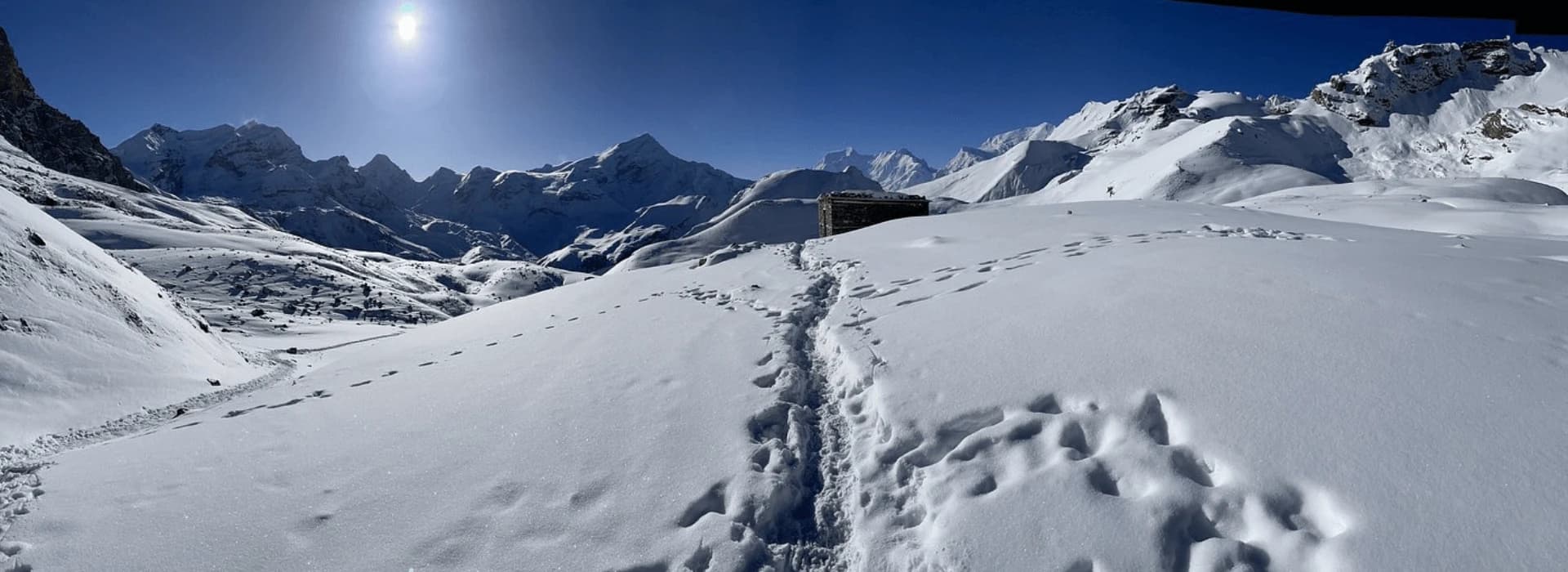
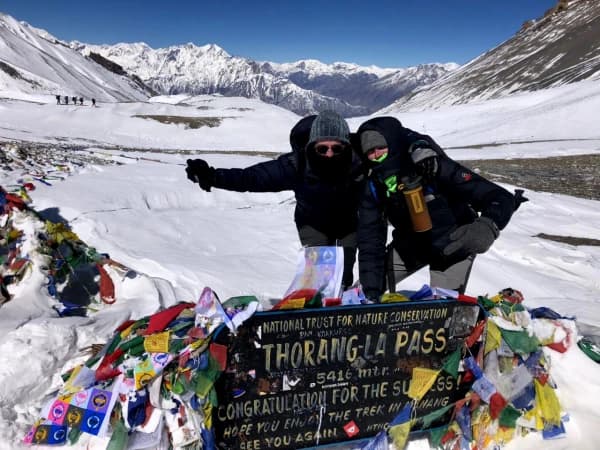
On-the-way-to-crossing-thorongla-pass

Short Annapurna Circuit Trek - 10 Days

456 reviews
104 reviews
Recommended by 99% of travelers
At a Glance
Duration10 Days
Trip GradeModerate
CountryNepal
Maximum Altitude5,416 m
Group SizeUpto 8
StartsKathmandu
EndsKathmandu
Travel StyleTrekking, Touring and Hiking
Best TimeSpring and Autumn

Overview of Trek

Most trekkers complete the Annapurna Circuit in 14 to 21 days. This 10-day itinerary shortens the time, while losing none of the main experience. You still cross the high mountain pass, walk through small traditional villages and catch sight of some impressive peaks. This short hike is best for those lacking three weeks. You bypass a few of the lower sections and take vehicle transport for segments of the route. But, the big, real experience doesn’t change.

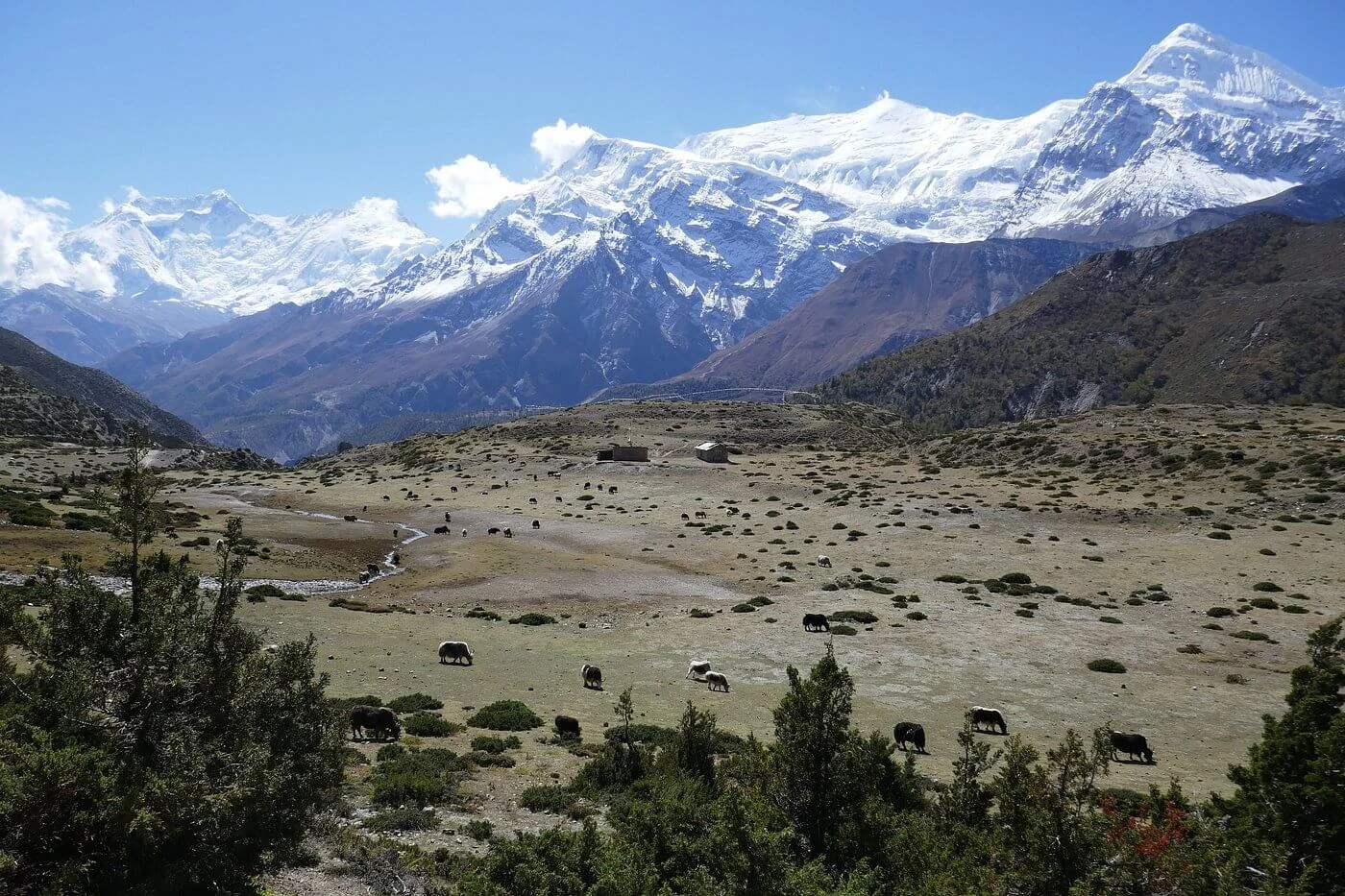
You hike alongside rushing rivers, trek through forests, and get to high altitudes. The mountain views, including Annapurna, Dhaulagiri and Manaslu, are stunning. You hike through Hindu and Buddhist villages. The culture changes with altitude. If you have a longer period of time, take the 12-day Annapurna Circuit Trek route for a more in-depth experience of mountains and local culture.

The 10-day itinerary includes the best of what you need. You start at a lower altitude and ascend to Thorong La Pass. Then you go down to Muktinath and out of the circuit. It's faster but still challenging.

Highlights

  • Short but rewarding trek: Full Annapurna Circuit Trekking in just 10 days
  • Start & End: Kathmandu → Besisahar → Circuit → Pokhara → Kathmandu
  • Distance & Altitude: Total distance of 120 km and altitudes up to 5,416 m at the Thorong La Pass
  • Daily Trekking: 4 to 9 hours each day hike with variable difficulty levels based upon each trekker's fitness level; best for those with moderate fitness levels or above.
  • Day-by-Day Itinerary: Experience local life in the mountain villages and hike along rivers and through forests, glaciers, and breathtaking mountain views.
  • Cost Overview: All permits, accommodations, food, guides/porters, and transportation are included.
  • Best Time to Trek: October, November, March, and April. But June through August are the monsoon months. (So your best choice will be to avoid these months.) 
  • Trekking Tips: Proper packing, acclimatization, water and food safety, weather preparation
  • Optional Longer Trek: The Longer Option For Real Adventure To Complete The Annapurna Circuit (12 Days).
  • Internal Resources: Links to maps, permit guides, packing lists, and trekking preparation

Short Annapurna Circuit Trek Itinerary

The following itinerary is a brief summary for each day. You begin in Kathmandu, and within 10 days, you reach the top of the circuit, then you return.

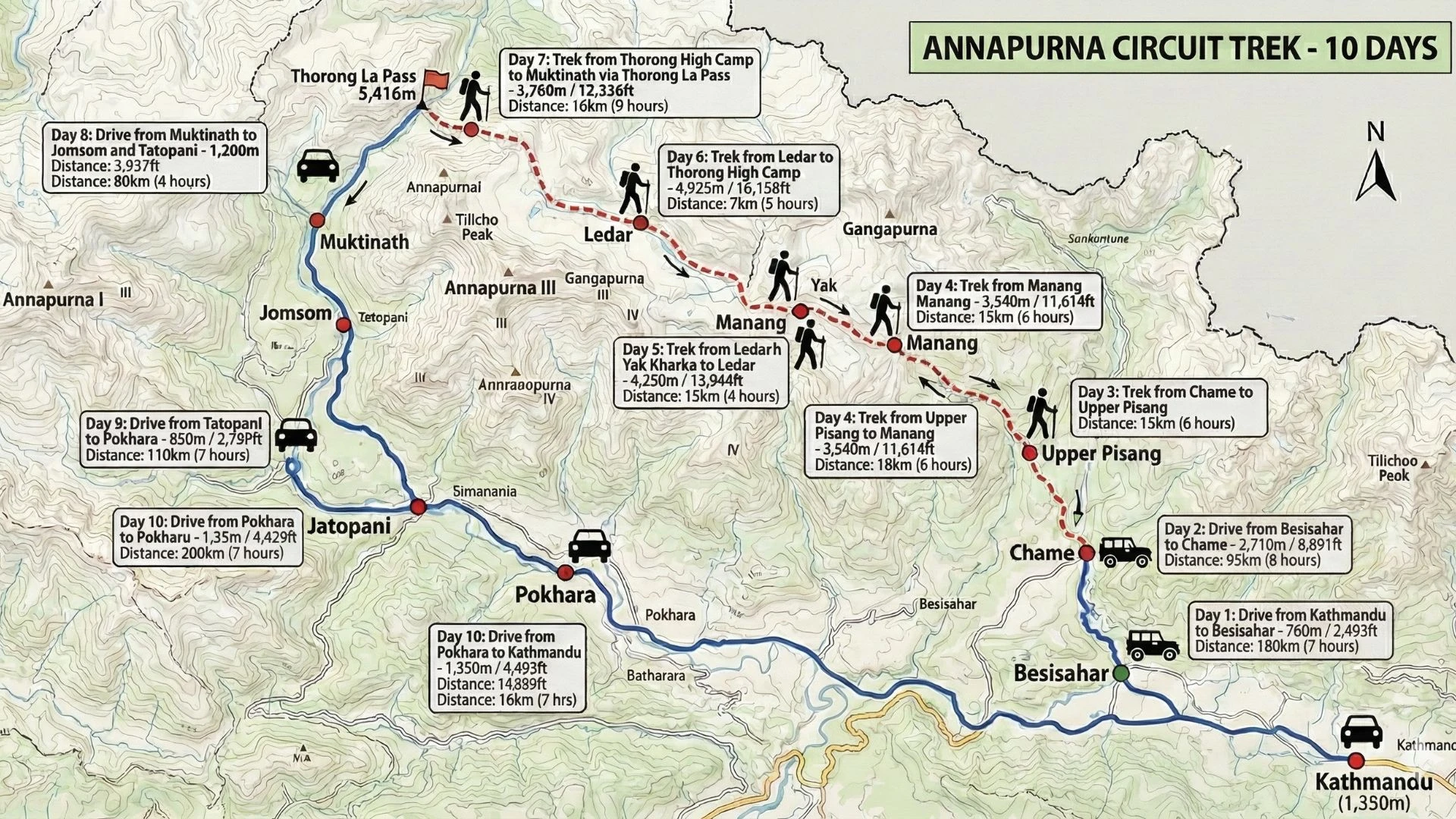
  • Day 1: Drive from Kathmandu to Besisahar - 760m / 2,493ft, Distance: 180km (7 hours)
  • Day 2: Drive from Besisahar to Chame - 2,710m / 8,891ft, Distance: 95km (8 hours)
  • Day 3: Trek from Chame to Upper Pisang - 3,300m / 10,826ft, Distance: 15km (6 hours)
  • Day 4: Trek from Upper Pisang to Manang - 3,540m / 11,614ft, Distance: 18km (6 hours)
  • Day 5: Trek from Manang through Yak Kharka to Ledar - 4,250m / 13,944ft, Distance: 15km (4 hours)
  • Day 6: Trek from Ledar to Thorong High Camp - 4,925m / 16,158ft, Distance: 7km (5 hours)
  • Day 7: Trek from Thorong High Camp to Muktinath via Thorong La Pass - 3,760m / 12,336ft, Distance: 16km (9 hours)
  • Day 8: Drive from Muktinath to Jomsom and Tatopani - 1,200m / 3,937ft, Distance: 80km (4 hours)
  • Day 9: Drive from Tatopani to Pokhara - 850m / 2,789ft, Distance: 110km (7 hours)
  • Day 10: Drive from Pokhara to Kathmandu - 1,350m / 4,429ft, Distance: 200km (7 hours)

Trek Cost Breakdown

The price for completing the trek will vary according whether you hire a guide, a porter or go by yourself. Permits are mandatory for everyone. The more altitude you gain, the higher your food and lodging will cost, prices double past 4,000 meters.

Item Details Approx. Cost (USD)
Permits

TIMS Card & ACAP Entry Permit

$40 – $50
Accommodation

Guesthouses / Tea Houses

$10–20 per night ($100–180 total)
Food & Drinks Breakfast, Lunch, Dinner, Snacks $15–25 per day ($150–250 total)
Guide Fees Licensed trekking guide $25–35 per day ($250–350 total)
Porter Fees Optional porter for luggage $15–20 per day ($150–200 total)

Transportation

Bus/Jeep (Kathmandu-Besisahar-Chame, Muktinath-Tatopani-Pokhara-Kathmandu) $100–150

Total Estimated Cost: $650–$1,180 per person (varies by services selected)

The Annapurna Circuit Trek Cost is dependent on your preferences. Solo trekkers avoid the cost of guides but sacrifice local expertise and assurance of safety. Plus, hiring a guide provides insight into culture, weather and conditions on the route. Porters will carry your main bag, so you'll save your energy for the high altitudes where every breath counts.

Why Trek with Ammonite Adventure?

Ammonite Adventure is a reliable local trekking agency with lots of experience. Here's why you should go with us:

  • Local Experts Team: Your walk is led, managed and supported by passionate and experienced guides who've walked every step of the track.
  • Custom Itineraries: Hikes that suit your fitness level and the time available.
  • Safety First: Trained leaders and redundancy/back-up safety systems.
  • Success Ratio is High: Most trekkers complete this trek successfully.
  • Trusted Throughout The World: Many thousands of happy trekkers worldwide.
  • Think Local, Act Global: Professional service with local knowledge.
  • 24/7 Support: We support you round the clock.
  • Professional Guides: Guides are professionals and trained guides.
  • Transparent Pricing: No surprise fees or charges.

Itinerary

Early morning, you'll drive from Kathmandu along the Prithvi Highway. The highway shadows the Trishuli River along small towns and terraced fields. By early afternoon, you'll reach Besisahar, the entry point of the Annapurna Circuit.​​​​​​

Max. Altitude: 760mMeals: breakfast-meal-dinnerAccommodation: TeahousesDuration: 7 hours driveDistance: 180km by roadMode of Transport: Easy (all driving)

Today, we drive a rough road, circulating in and out of the Marsyangdi River valley. You'll trek through villages like Jagat and Dharapani with views of the Manaslu and Annapurna ranges starting to pop up. You'll arrive at Chame late in the afternoon, where your first day of trekking will start tomorrow.

Max. Altitude: 2,710mMeals: breakfast-meal-dinnerAccommodation: TeahousesDuration: 8 hours driveDistance: 95km by roadMode of Transport: Easy (all driving)

On your first day of trekking, you'll travel along the Marsyangdi River through pine forests and over suspension bridges. Annapurna II and Pisang Peak are the main vistas visible from here. Upper Pisang sits higher up on a hill and is home to older Buddhist monasteries, plus better mountain vistas than those in Lower Pisang.

Max. Altitude: 3,300mMeals: breakfast-meal-dinnerAccommodation: TeahousesDuration: 6 hoursDistance: 15kmMode of Transport: Moderate

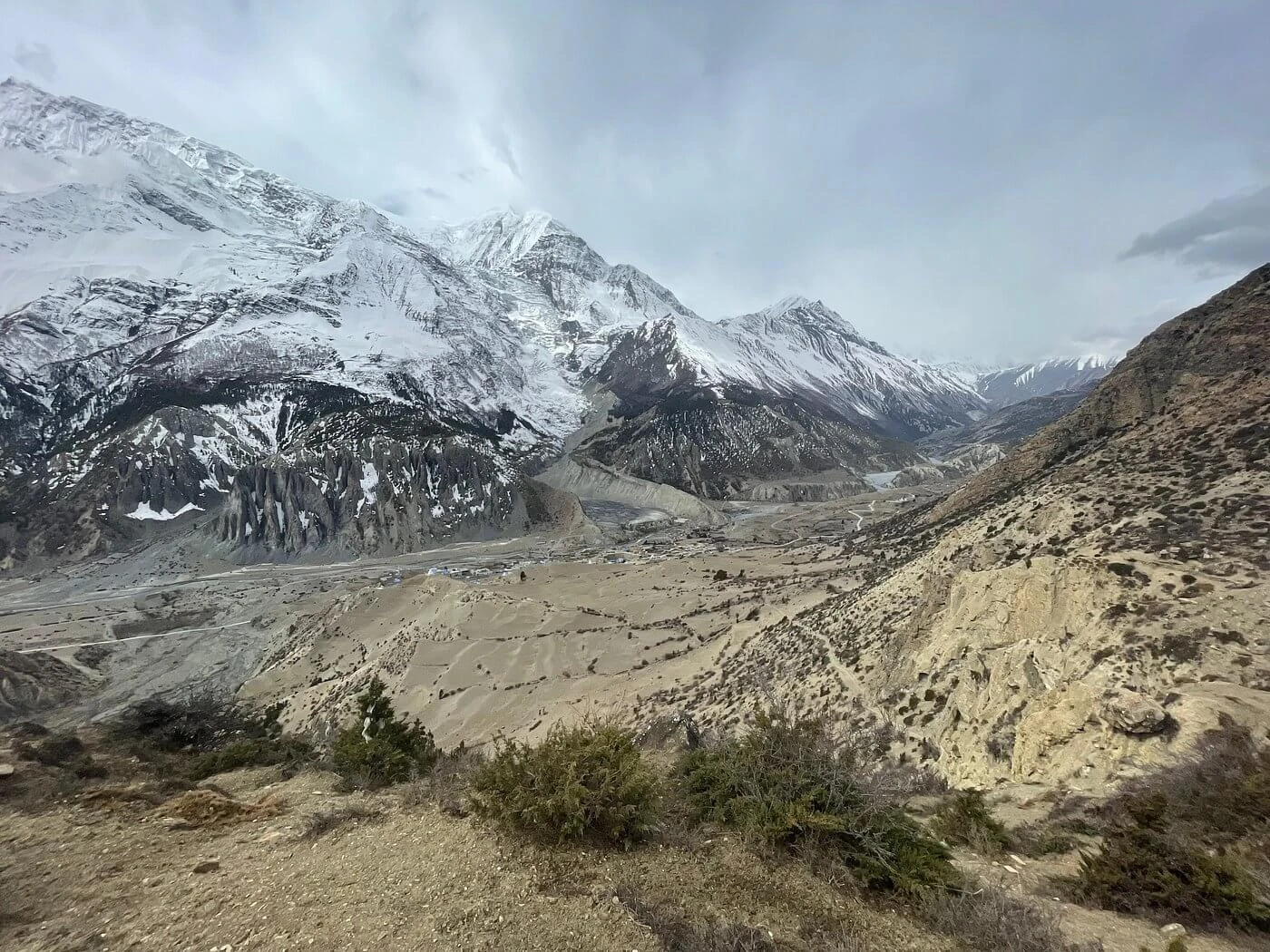
You can take the upper route through Ghyaru and Ngawal for spectacular views or the lower route through Humde. Both paths meet at Braga before Manang, the largest village with shops, bakeries, and Wi-Fi. This is your last major settlement before the high pass, so you should check gear and stock up on snacks.

Max. Altitude: 3,540mMeals: breakfast-meal-dinnerAccommodation: TeahousesDuration: 6 hoursDistance: 18kmMode of Transport: Moderate

 The scenery becomes alpine as the trees recede from view and you hike past Tengi village alongside the river. After 2 hours, you'll pass Yak Kharka and don't stop till Ledar. With each step upward, the air is thinner, the breathing more heavier.

Max. Altitude: 4,250mMeals: breakfast-meal-dinnerAccommodation: TeahousesDuration: 4 hoursDistance: 15kmMode of Transport: Moderate to challenging

You climb gradually through Thorong Phedi to then ascend a further 475 meters up to Thorong High Camp. At 4,925 meters, sleeping is hard due to thin air, which gives headaches and makes for a restless sleep. Drink a lot of water and sleep early because tomorrow begins at 3-4 AM, you'll need every bit of rest you can get.

Max. Altitude: 4,925mMeals: breakfast-meal-dinnerAccommodation: TeahousesDuration: 5 hoursDistance: 7kmMode of Transport: Challenging

You'll wake up at 3 AM and ascend a steep rocky terrain in the dark with headlamps. By mid-morning, you'll reach the 5,416-meter-high Thorong La Pass to breathtaking views of Annapurna and Dhaulagiri. Hike down to Muktinath as soon as possible since the altitude can make you get a headache or other symptoms of AMS fast.

Max. Altitude: 3,760mMeals: breakfast-meal-dinnerAccommodation: TeahousesDuration: 9 hoursDistance: 16kmMode of Transport: Very challenging

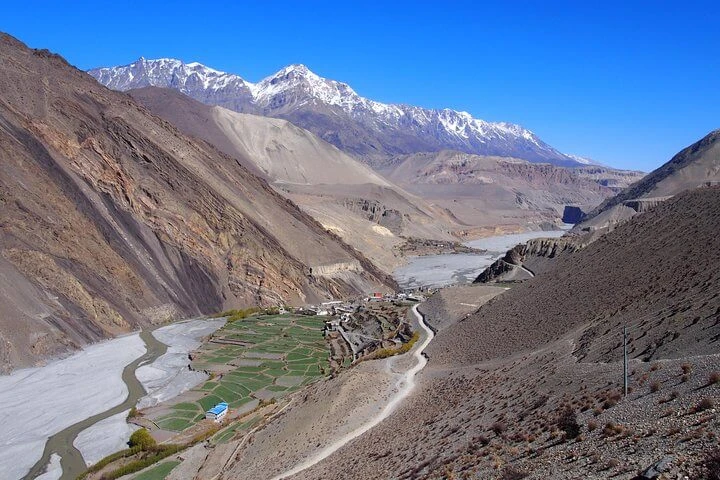
Your body feels better after descending from high altitude. If you've got some energy left, visit the temple at Muktinath, then take a jeep along the Kali Gandaki Valley to Jomsom and on to Tatopani. There are natural hot springs here where you can soak away the wear and tear of hard trekking days, you'll be glad you made it this far.

Max. Altitude: 1,200mMeals: breakfast-meal-dinnerAccommodation: TeahousesDuration: 4 hours driveDistance: 80km by roadMode of Transport: Easy (all driving)

You'll drive from Tatopani down the Kali Gandaki River through villages and terraced fields. And the climate warms as banana trees and rice paddies replace alpine views. By afternoon, you'll arrive at the lakeside town of Pokhara for a hot shower and cozy bed.

Max. Altitude: 850mMeals: breakfast-meal-dinnerAccommodation: Hotel in PokharaDuration: 7 hours driveDistance: 110km by roadMode of Transport: Easy (all driving)

You'll drive back to Kathmandu by tourist bus or private vehicle on the Prithvi Highway. Tourist buses are less expensive but have multiple stops, and private vehicles go faster. A path descends all the way to Kathmandu, and by evening, you'll end your circuit adventure.

Max. Altitude: 1,350mMeals: BreakfastDuration: 7 hours driveDistance: 200km by roadMode of Transport: Easy (all driving)
Customize Trip

Route Map

map of 10 days annapurna short circuit trek
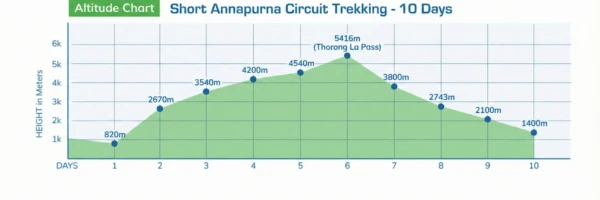
Altitude Chart
elevation of annapurna circuit trek

What is Included?

Hotel in City

  • One night Twin-sharing hotel accommodation at Pokhara following the trek on a bed-and-breakfast basis.

Transportation

  • Airport Transfers: For your international and domestic flights, a round-trip transfer and pick-up are included. 
  • Trek Start: A shared vehicle transfer is scheduled from Kathmandu (1,400m) to Machhakhola (930m).
  • Trek End: A sharing vehicle transfer is also scheduled from Dharapani to Kathmandu (1,400m) or Pokhara.
  • Staff Transport: All ground transport for the guides, assistant guides, porters, and any other support staff.

Accommodations

  • Trek Accommodation: Overnight local teahouse accommodation on a twin-sharing basis. Single rooms can be arranged for a small surcharge, subject to availability.
  • Total Accommodation Nights: 11 nights of standard twin-sharing accommodation during the trek.

Food

  • Full Board Meals: Breakfast, lunch and dinner and hot drinks are provided during the entire trek. 
  • Special Inclusions: Water purification tablets for safe drinking water.
  • Total meals included: There will be a total of 10 breakfasts, 10 lunches and 10 dinners.

Guide

  • One government-licensed English-speaking guide. Assistant guides will join the group, depending on the size of the group.
  • All guide fees, food, insurance, salaries, accommodation, transport and all equipment will be covered.

Porter

  • Porters: One porter for every two trekkers. Each trekker's personal luggage weight limit is 9 kg.
  • All porter fees, food, insurance, salaries, accommodation, transport and all equipment will be covered.

Trek Permits and Expenses

  • All necessary permits - including special area permits - are pre-scheduled to make your trek a bit easier and trouble-free. Included permits are:
  • Manaslu Restricted Area Permit (MRAP)
  • Manaslu Conservation Area Permit (MCAP)
  • Annapurna Conservation Area Permit (ACAP). 

Medical Assistance

  • Emergency Provision: Emergency oxygen and a first aid medical kit will be taken with you on the trek.
  • Rescue Arrangements: Trained rescuers will be arranged in case of emergency (included in your Trek Travel Insurance).

Souvenir

  • Goodbye Souvenirs: All participants will receive an Ammonite Adventure cap and T-shirt.
  • Completion Certificate: A completion certificate for all participants

Gear and Trekking Equipments

  • Sleeping bags and down jackets, duffle bag (one for every two trekkers), if you do not have your own
  • Manaslu Region map.

Additional Services

  • Luggage Storage: Free and seacure luggage storage throughout the trek.
  • Full Coordination: Our full coordination team will take care of all logistics, planning, and requirements for you.

Farewell

A cultural farewell meal in Kathmandu at the conclusion of your journey.

What is Excluded?

International Flight

  • International flight to and from Nepal is not included.

Accommodations

  • Hotel accommodation in Kathmandu before and after the trekking starts.
  • Extra nights in Kathmandu on early arrival, late departure, or early return from the trek due to any cause.

Food

  • All meals in Kathmandu before and after the trek are at your own expense.
  • Extra meals required due to early arrival, late departure, or early return from the trek are not included.

Guide and Porter

  • Tipping for guides, porters, and local support staff is excluded and appreciated on a service basis.

Visa

Nepal entry visa fees (to be paid in cash upon arrival at Tribhuvan International Airport) are the traveler's responsibility.

Travel Insurance

Travel insurance is mandatory and must include high-altitude medical emergencies and helicopter evacuation and treatment costs.

Personal Expenses

  • Personal expenses such as snacks, beverages (alcoholic/hot/cold), hot water/boiled water, hot showers, Internet/Wi-Fi, mobile/phone calls, charging batteries, laundry, and additional porter fees.
  • Personal clothing and trekking gear.

Other Expenses

  • Charges for excess baggage (a trekker can carry only 9 kg).
  • Unforeseen additional costs due to natural calamities, adverse weather, modifications to the itinerary for safety reasons, political unrest, government policy, illness, or other unforeseen circumstances beyond our control.

Add-ons & Options

Make your incredible journey perfect with Ammonite Adventure, as we have strong experience in organizing the Annapurna Circuit Trek. We are happy to offer some exclusive premium add-ons to upgrade your 10-Day Short Annapurna Circuit Trek. These optional services are designed to add comfort, safety, and ease, turning your adventure of a lifetime into a memory of a lifetime.

Kathmandu to Besisahar/Chame (Private Jeep) – USD 220
Start your trek with comfort and flexibility by booking a private jeep. This option avoids crowded public transport and gives you a smooth drive to the trekking starting point. Each jeep can carry up to 5 passengers, making it ideal for families or small groups.

Private Porter Service – USD 380
Make your trek easier by hiring a private porter to carry your luggage. This allows you to walk freely and enjoy the mountain views without stress. One porter can be shared between two trekkers and can carry up to 25 kg in total.

Dates & Availability

Starts:January 25, 2026Ends:February 03, 2026
PriceUS$950
AvailabilityGuaranteed
Starts:January 28, 2026Ends:February 06, 2026
PriceUS$950
AvailabilityGuaranteed
Starts:January 31, 2026Ends:February 09, 2026
PriceUS$950
AvailabilityGuaranteed

Additional Information

Accommodation

You can find teahouses as you go throughout the Annapurna Circuit trail. These are simple lodges owned by local families. You get a simple room with two beds and shared bathrooms. Blankets are offered, but take a sleeping bag for higher altitudes. Warm showers are available, but you'll have to pay $2 - $5 for them, and they may not exist above 4000m.

Food is offered at each tea house. The menus are pretty much the same from one circuit to another. The most common and nutritious is dal bhat (lentils over rice). There's also Western food such as pizza and pasta, but it's more expensive. At high altitudes, stick to vegetarian meals as meat spoils more quickly.

Most lodges charge for wifi and to charge up your batteries. The further you climb, the pricier these services get. Cell phone signals function in most villages, and diminish as elevation increases above Manang.

Safety & Health Tips

The biggest risk on this trek is altitude sickness. Symptoms include headache, nausea, dizziness, and even difficult sleeping. So, ascend gradually and drink at least 3-4 liters of water per day. Don't ignore severe symptoms like confusion or trouble breathing. In that case, descend immediately if symptoms worsen.

Also, bring a simple first aid kit that includes a pain reliever, band-aids, and altitude sickness medication. Some trekkers find that taking Diamox helps them acclimate, and if you take it, consult a doctor. Plus, travel insurance, which has helicopter evacuation coverage, is a necessity.

The mountains are subject to sudden changes of weather. So, wear layers you can add or take off without too much trouble. Also, make sure to check the weather conditions in Manang before crossing Thorong La Pass. Don't try the pass in bad weather.

Emergency contact numbers:

Nepal Police: 100

Tourist Police: +977-1-4247041

Himalayan Rescue Association: +977-985-1071665

Best Time to Trek

October and November are the ideal months to do the Annapurna Circuit. At this time, we'll have clear, stable weather and fantastic mountain views. That said, these being the high months, tea houses can become full. So book early if you're trekking in the month of October.

The months of spring (from around March to April) are also good. The weather gets hotter; Rhododendron forests bloom at lower altitudes. The skies aren't as clear as in the autumn, but they're clear enough for hiking. For seasonal information, also see our Best time to trek Annapurna Circuit guide.

Avoid June to August months. Trails become muddy, sloppy and slippery as monsoon rains arrive. Clouds are in the way of the mountains, and leeches thrive at lower altitudes because of it. The pass can be dangerous in poor condition because of snow and low visibility.

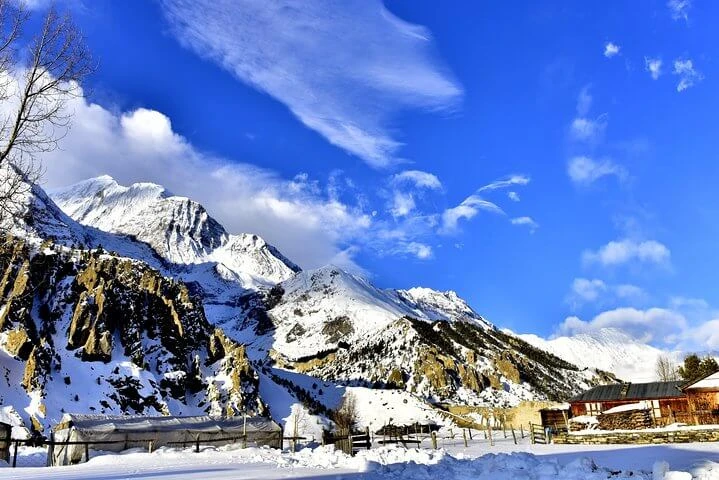
Winter runs from December to February. Heavy snow often makes the pass impassable. What's more, the temperature at night is below zero degrees. So, anyone who is seasoned winter trekkers, only they should do the circuit during these months.

What to Pack During the Trek

If you pack light, trekking is going to be more comfortable, but you need essential items for safety and comfort. Here's what to bring:

  • Backpack: 40-50 liter capacity
  • Sleeping bag: rated for -10C minimum sleeping bag
  • Hiking boots: Worn in, no ankle support
  • Warm baffled jacket: Down or synthetic fill
  • Rainwear: Waterproof jacket and trousers
  • Base: Thermal tops and bottoms
  • Trekking pants: Quick-dry material
  • Warm hat and warm gloves: For pass day
  • Sun protection: Sunglasses, sunscreen and lip balm
  • Water bottles: Two 1-liter bottles
  • Headlamp: With extra batteries
  • Emergency first aid kit: Essential medicine and bandages
  • Personal Items: Eco-friendly soap, toilet paper or tissues and disinfectant hand wipes
  • Snacks: Energy bars, nuts, chocolate

Don't overpack. Climbing equipment is available to buy or rent in Kathmandu or Pokhara, if necessary. See our complete Annapurna Circuit packing list for a full breakdown.

Why Is Acclimatization Important?

Your body needs time to acclimate to the reduced oxygen supply at high altitude. Acclimatization also helps to guard against altitude sickness and, in general, makes the trek less risky. The essential rule is "climb high, sleep low." In other words, you can climb at high elevation during the day while sleeping lower at night.

In Manang (3,540m), the rest day is key. Your body acclimatizes here before climbing higher. Without proper preparation, crossing Thorong La becomes perilous. Be aware that symptoms of altitude sickness can strike suddenly and are likely to worsen rapidly.

Also, make sure you drink plenty of water during the hike. Dehydration makes altitude sickness worse. So, refrain from alcohol and sleeping pills above 3,000m. Walk slowly and steadily. Remember, it's not a race. Pay attention to your body and let your guide know if you don't feel well.

Some trekkers take Diamox (acetazolamide) as an aid to acclimatization. It's also a side medication, which expedites the adjustment but has side effects. So, if you're thinking of taking medication, consult a doctor before the trek.

Who Is This 10-Day Trek Best For?

This short circuit is ideal for those with limited holidays but opting for the full Annapurna Experience. You need good fitness but don't have to be an athlete. A body acclimates well with regular 4–5 hours of hiking or walking.

Fit beginners can do this trek after proper training. It might be a bit tough but not impossible for intermediate-level trekkers. But it's a faster-than-normal circuit, which means even less time to get used to the conditions. So, you need to adapt quickly.

Overall, this hike is for those who prefer having a set itinerary, with daily demands that are easy to define. Every day has its meaning, and steadily you march toward the pass. Plus, it's a great trek if you enjoy beautiful mountain vistas, experiencing village culture, and getting in (trekking) shape.

Who Should Avoid This Trek?

This trek isn't for absolute beginners who've never gone hiking. Basic fitness is a prerequisite for the altitude and hours of daily walking. So, start building up your experience with shorter, lower-altitude treks.

Also, if you dislike very slow, steady walking or prefer life at a leisurely pace, then 10 days is probably not for you. In contrast, with the standard 14-day circuit, there's more time for sightseeing and adjustments.

High-altitude treks aren't recommended for anyone with significant cardiovascular or pulmonary problems. Thorong La Pass's lower oxygen strains your heart. So, if you have any health-related questions, consult a doctor before booking.

Equipments

Head

  • Sun hat/cap for daytime 
  • Warm wool/fleece hat for morning and evening 
  • Headlamp with spare bulbs/batteries (very useful for starting early and when there is no light) 
  • Sunglasses (with UV protection) 
  • Buff/scarf to protect from dust and the cold 

Upper Body

  • Lightweight t-shirts/quick-drying shirts (2-3) 
  • Fleece/warm jacket 
  • Waterproof, windproof jacket 
  • Thermal base layers for cold nights 
  • Down jacket (recommended for high altitudes)

Hands

  • Light gloves for daytime hiking
  • Insulated gloves for cold mornings and higher elevations
  • Waterproof gloves if available​Lower Body
  • Hiking pants (2 pairs)
  • Thermal leggings/long underwear for cold days
  • Comfortable shorts for lower elevation (optional)
  • Waterproof over pants for rain.

Lower Body

  • Hiking pants (2 pairs)
  • Thermal leggings/long underwear for cold days
  • Comfortable shorts for lower elevation (optional)
  • Waterproof over pants for rain.

Feet

  • Hiking boots (broken in)
  • Comfortable camp shoes or sandals
  • Warm socks (2 or three pairs).
  • Lightweight hiking socks (2 pairs).
  • Gaiters (optional; they're nice to have when you're hiking through snow or muddy trails).

Toiletries

  • Toothbrush and toothpaste
  • Quick dry towel
  • Sunscreen (high SPF)
  • Lip balm (with SPF)
  • Soap and shampoo (small size bottle)
  • Toilet paper or tissues
  • Tand sanitizer
  • Nail clippers and a small mirror
  • Regular personal medications
  • Wet wipes (good when showers aren't an option)

Backpacks

  • Large duffle bag (shared space with your partner)
  • A day backpack (25-35 Litres) (for your daily water, snacks, and layers)
  • Rain cover for your pack
  • Packing cubes or large plastic bags to organize your gear and keep it dry.

Accessories

  • Water bottles (capacity of at least 2 liters) or hydration bladder
  • Water purification tablets or filters are recommended.
  • Trekking poles (highly recommended)
  • Power bank
  • Travel adapter
  • Notebook and pen (optional for journaling)
  • Snacks and energy bars are highly recommended.

Extra Items

  • Light book or card game to kill time
  • Safety pins and a small sewing kit
  • Ziplock bags to protect electronics
  • Passport-size photos (2) and/or a copy of your passport (in case we need to obtain permits, etc.)

We provide a (used, non-waterproof) duffle bag, a (used) down jacket, and a (used) sleeping bag for use if you do not have your primary gear.

FAQs

Access and trek in the circuit would need an Annapurna Conservation Area Permit and a TIMS Card. Your permits will be totally taken care of by your trekking agency. And they'll also see to it that the trekking trail is well taken care of.

The ACAP fees are about USD 25 for most foreigners. And the TIMS card fees are USD 20 or 15. All these charges need to be paid prior to or at the time of the trek.

Yes, in fact, it's now required by the Nepalese tourism regulations that foreigners trek with a licensed guide. A guide can be useful in trekking.

Yes, you may employ a porter if you wish. They sure take the weight off your shoulders. So a lot of people like to hire one so that they can do some hiking only with a daypack.

A licensed guide for the Annapurna Circuit will usually cost between USD 25 and 35 per day. The cost includes their meals, accommodation as well as insurance.

The porter will usually be around USD 20 to 25 per day. They assist you with your bags. Plus, they also help on tough treks. This way, trekking would become relatively easier for you. And you won't be tired either.

Most trekkers take a bus or their own jeep from Kathmandu or Pokhara to Besisahar to begin the trek. The price of the shipping depends on the chosen vehicle. It's pretty reasonable.

Altitude sickness. Yes, there's the possibility of some altitude sickness, especially around Thorong La Pass. But you're better off drinking copious water, moving deliberately and following the guidance of your guide. Higher up, you'll be pleased with the acclimatization.

You'd eat in teahouses. And you'd have options such as dal bhat, noodles, soups and momos. Food becomes a little bit pricier as you ascend the trail.

You sleep in tea houses and guest houses that dot the trail, generally in simple rooms with shared bathrooms. The beds will be basic. But after all the walking you'll be doing, they're comfortable.

Carry some Nepalese money with you because ATMs are scarce outside of the major towns. For meals, lodges or internet and charging services, most teahouses can only accept cash.

The best time to come is from October to November, which makes for good weather and clear skies. And the monsoon season, June to August, should also be avoided when rains can make trails slick.

Yes, provided that you're fit and have done some exercise before the trek, you'll be able to handle the trek. It's shorter than the normal trek. But it's still a very long day and a very high altitude trek.

Yes, many villages have paid Wi-Fi access in teahouses, though the network in high-altitude areas can be slow or weak. It's something that can be used for some kind of checking or a messaging service.

You should also budget for items like hot showers and battery charging as well as tipping the guides, porters, etc. These are more expensive than the budget for your daily spending. But they'll make trekking simpler. On cold nights, you'll be glad you budgeted for that hot shower.

Speak to an Expert