November 20, 2024read more +
Tsum Valley Trek: 5 Days of Stunning Views
Thanks to Ammonite Adventure, my Tsum Valley trek was a nice experience. Booking was super easy, and the staff was
Israel Blackwell,
Romania
The 5-day Tsum Valley Trek is a short and fast trip into the “Hidden Valley” of Nepal. The cost is between $1055 and $1355. This route mainly covers the famous Mu Gompa and Rachen Gompa monasteries. As the trail climbs very fast to 3,700 m, this trek is best for very fit and experienced hikers or for people who may use a helicopter if there is a problem.
Last Checked: May 02, 2026, by Senior Trekking Lead Krishna Bahadur Pariyar.
Engineered for high-endurance trekkers on a compressed timeframe, this expedition delivers a high-impact Himalayan immersion. Following an 8–9 hour overland journey from Kathmandu, you embark on a five-day intensive traverse through the secluded Tsum Valley, a pristine sanctuary of Tibetan Buddhist heritage.
The Tsum Valley Trek (Manaslu Region) is a high-intensity expedition engineered for high-endurance trekkers on a compressed timeframe. This five-day express traverse serves as an accelerated journey into the secluded sanctuary of Beyul Kyimolung (the "Hidden Valley of Happiness"). By bypassing the traditional 10-day approach through a strategic private jeep transfer to Jagat, this itinerary provides rapid deployment into the valley’s inner sanctum.
This restricted-access Himalayan route requires a complex permit stack, including the Manaslu Conservation Area Permit (MCAP), Tsum Valley Special Permit, Chumnubri Local Entry Fee, and the Restricted Area Permit (RAP). It is a physically grueling traverse across technical terrain, tailored specifically for those who demand a remote wilderness immersion despite temporal constraints.
The 8–9 hour overland journey from Kathmandu to the trailhead marks the transition into a pristine environment. You will navigate shifting ecosystems from dense subtropical canopy to stark alpine meadows all framed by the mammoth peaks of the Ganesh Himal, Sringi Himal, and Boudha Himal massifs. This strenuous 5-day itinerary demands sustained physical output, with daily trekking durations of 6–8 hours across vertical climbs and rugged descents.
Beyond the physical rigor, the journey offers profound access to ancient Buddhist monasteries and centuries-old Tibetan-lineage heritage near the northern frontier of Gorkha. You will encounter intricate lithic Mani walls and historical chortens that lead to the spiritual epicenter of Mu Gompa.
While the pace is intensive, the route is meticulously designed to capture the valley’s cultural and spiritual essence. Your expedition concludes with a return vehicular transfer to Kathmandu, allowing for internal reflection as you transition from the Himalayan silence back to the urban environment.
This 5-day Tsum Valley itinerary is designed for fit, experienced trekkers who want to complete a normally 10-day trek in a shorter time. By optimizing logistics especially driving directly to Jagat, you can still experience key highlights like alpine views, remote villages, and Tibetan-influenced culture without extending your schedule.
A major advantage of this short trek is the lower overall cost. With fewer trekking days, you reduce expenses on accommodation, meals, and guide/porter services, saving around 30–40% in total:
This makes it a strong option for trekkers seeking a short, physically demanding, and cost-efficient Himalayan experience.
Permit costs remain the same regardless of trek duration:
This 5-day Tsum Valley trek involves rapid altitude gain and long, demanding trekking days, requiring strong fitness and prior high-altitude experience. You’ll walk 6–8 hours daily on steep, rocky trails with limited time for recovery, making it suitable only for experienced trekkers in good physical condition.
Due to the fast pace and high elevation, this itinerary is not recommended for beginners or those without altitude experience. If you prefer a slower and safer approach, the standard 10-day Tsum Valley trek or the Manaslu Circuit trek offers better acclimatization, a gradual ascent, and a more manageable trekking pace while still covering the same cultural and scenic highlights.
For this seasons, we offer optimized, personalized trekking expeditions through the Manaslu and Tsum Valley for small teams. Our tiered pricing structure is designed to provide maximum value based on your group’s size:
As a boutique expedition operator, we strictly limit our group sizes to a maximum of 8 participants. This ensures focused tactical attention, expert technical guidance, and individualized support throughout the traverse. Navigating the remote Manaslu and Tsum Valley regions with a smaller team allows for superior logistical flexibility and a more authentic immersion into the local environment.
The following table outlines the specific logistical and administrative components included in your expedition package. This transparency ensures you understand the value of your investment in a high-velocity, restricted-area trek.
|
Expense Category |
Technical Details & Inclusions |
| Permits |
Includes the mandatory Manaslu Conservation Area Project (MCAP) and the Tsum Valley Restricted Area Permit (RAP). |
| Transportation |
Round-trip private 4WD overland transfers (Kathmandu–Jagat–Kathmandu) to facilitate the accelerated 5-day timeline. |
|
Accommodation and Food |
All high-altitude teahouse lodging and three comprehensive daily meals (Breakfast, Lunch, and Dinner) during the trek. |
|
Guide & Porter Cost |
Compensation for a government-licensed lead guide and experienced porters, including their daily wages, insurance, and equipment. |
|
Miscellaneous Expenses |
Covers Chumnubri Local Entry Fees, administrative service charges, and regional logistical taxes. |
The cost of private transportation for the Tsum Valley Trek (Kathmandu to Jagat and return) typically ranges between $220 and $300 per jeep (one way), depending on season and availability.
If booked as part of a trekking package, this cost is often included, adding convenience without extra planning. Travel time is approximately 7–9 hours, which is faster and more comfortable compared to shared transport options.
The 5-day Rapid Manaslu Circuit Trek is designed to allow you to explore the stunning Manaslu region in only 5 days. The trek is shorter, and the itinerary can be adjusted for reasons of your physical fitness, weather, etc. Our experienced guides hold the authority to change the route in such instances of a challenge as landslides or unforeseen delays for your safety and enjoyment. With Ammonite Adventure and Trek we prioritize flexibility to adjust to changing circumstances and offer a safe and rewarding trek.

The journey starts early in the morning from Kathmandu as you drive to Jagat on a private jeep. The distance covers approximately 140 kilometres which can take about 8-9 hours, varying upon the condition of the road. At the beginning of your trip, see Prithvi Highway and get a chance to sightsee Trishuli River and terraced fields. Breakfast is served at a roadside restaurant at Malekhu, with its fresh fish delicacy.
Then onwards it turns right from Dhunche to Terai region along with Budhi Gandaki River valley. Further ahead, you will have a rugged path with coiling/curving driving settings and darting patches, especially after Arughat. Lunch is had at Soti Khola, which has basic eateries for lunch break, and later drive from Soti Khola till Jagat (1950m )on the narrow tracks along the Budhi Gandaki.
In Jagat, a typical village at 1,340 meters, trekkers can have their first dinner and overnight in a teahouse. A former trading post, Jagat is a compact village of cobbled streets and weathered Tibetan-style stone houses. It also serves as the entrance gate to the Manaslu Conservation Area. Terraced fields and wooded hills surround the village.

The trek from Jagat to Chumling starts after an early morning breakfast at the teahouse. The trail climbs up via stone steps till Sirdibas from where you get beautiful views of the Shringi Himal. Continue straight ahead to reach Philim, a large Gurung village. If you wish to have lunch, trekkers can stop here and visit the rich culture of Philim as well as the Philim Monastery. After Lunch, the trail that takes us up towards Tsum Valley branches off next, crossing over Ekle Bhatti before it reaches Lokpa a few hours later, miles kept aside by mountains full of forest.
From Lokpa, our descent begins through dense forest. We will be frequently crossing suspension bridges over the Siyar Khola (river). Sometimes, we ski promptly along narrow but manageable trails on your slippery hill slope until we cross a tributary stream that flows down into Kape River, after which there are more brief ups and then downs whilst still in the Terai region before finally reaching Chumling, situated in the south face of Shingri Himal.
In Chumling, trekkers can stay at local teahouses and enjoy dinner prepared with ingredients that are locally sourced. The village is a great place to learn about traditional Tibetan-influenced culture, as well as see ancient monasteries, traditional stone houses, and beautiful views of the Ganesh Himal range. It’s a tranquil spot to relax and acclimatize after trekking for the day.

After breakfast in Chumling, the trek continues to Chhokang Paro. The trail crosses the Siyar Khola on a suspension bridge and then climbs through forests of pine and rhododendrons. There are good chances of encountering wildlife in this area. Lunch will be eaten upon reaching Chhokang Paro, which is a combined village of Chhokang and Paro; from here, there are also brilliant views of Ganesh Himal and Himalchuli.
After lunch, you continue along the trail, visiting a well-preserved village of traditional Tibetan design of Niak (3,070m). The path itself is flat, an easy walk and into the panoramas of the landscapes. It also allows travelers a way to view Tsumbas local people's daily life, sometimes to see their traditional farming practices, and sometimes to meet the friendly people you meet along the way.
Arriving in Lamagaon, evening meals and accommodation are provided at locally run teahouses serving traditional Tibetan influenced cuisine. The village is also known for its proximity to the Rachen Nunnery, one of the most important nunneries in the Tsum Valley. Rest up for your next day of trekking with an evening spent in this peaceful village, surrounded by terraced fields and set against a backdrop of looming mountains.

The day starts early with breakfast in Lamagaon and the trek to the Mu Gompa, the highest point of the Tsum Valley trek. The trail ascends gradually past Chhokampar (also transliterated Chhaikampar , a village adorned with prayer flags. Until here, almost every village has its picturesque group of flat-roofed houses and gompas (monasteries). Lunch, too, can be had at the Nile, where you can make the most use of your opportunity to study culture and experience true mountain sentiment-spawned hospitality.
Then onwards from the Nile, follow Siyar Khola while ascending gently all along until arrival at Mu Gompa at 3,700 meters. The gompa is among the oldest in this antiquated region. Additionally, peruse some ancient scriptures and see artifacts preserved here. Panoramic views of the Ganesh Himal range, and Pungen Himal can be observed from vantage points close by. The return journey from the Mu Gompa takes travelers to the overnight stopover in Chhokang Paro village.
In Chhokang Paro, you will spend the night at a local teahouse where dinner is provided and local (traditional) food is served. The peaceful atmosphere of the village and the day’s rewards make this destination an enjoyable stop for the night. Returning to Chhokang Paro also provides a good opportunity for rest and acclimatization before continuing with the trek.

After early breakfast in Chhokang Paro, the trek begins with a descent through the Tsum Valley, retracing steps back to Lokpa. The trail is also a special focal point, the trail takes you through lush forests and traditional villages with panoramic views of Ganesh Himal, and there is a chance to share the local culture and other ways of living. It is well-trodden, with a few steep sections, so care must be taken. The trekkers normally spend the time eating lunch and chilling with Lokpa.
Lokpa trail brings you down further and crosses suspension bridges over the Siyar Khola into the main Manaslu Circuit Trail. You pass a route out of dense forest where there are chances to find local wildlife and scoop up their flora. The sound of the river accompanies the trekkers on their journey in order to complete the journey. The trail then gets you to Philim, a huge Gurung village known for its distinctive culture, as well as the famous and hospitable teahouses.

We descend to Jagat after breakfast in Philim and end the trek on its last day. It’s a very easy trail, and you pass through beautiful landscapes, terraced fields and local villages. You will be able to watch the lives of locals on a daily basis in order to see how they live their lives and what culture they follow along with the best view of Budhi Gandaki River.
Just after reaching Jagat, you reach a local teahouse and get lunch served, and then you may take a rest and reflect on the journey of trekking. A jeep has been arranged to take you back to Kathmandu after lunch. It is around a 140-kilometer drive, or about 8 to 9 hours, depending on road conditions. The route retraces along the Budhi Gandaki River from Soti Khola, along Prithvi Highway, and rejoin. Sections are rough after Arughat on the road and patience and caution are required.
Arrive in Kathmandu, where you will be met by our representative and transferred to your hotel. In the evening, sample a delicious traditional Nepali Welcome Dinner at one of Kathmandu's most popular restaurants with the Ammonite Adventure Team.
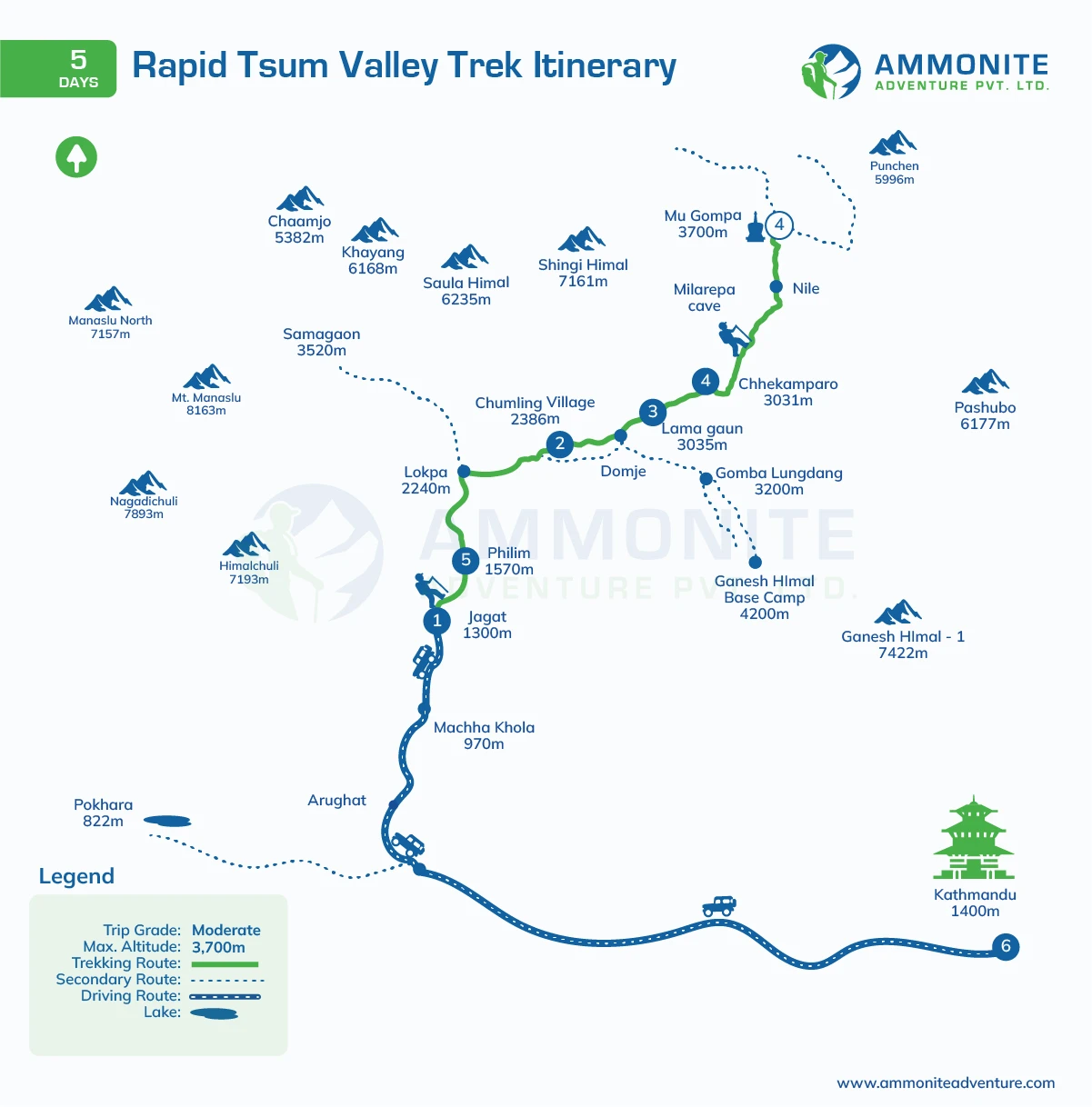
If you are a budget-conscious trekker and looking for a way to experience the Manaslu Region at a decent price, then we can say that the standard package is the best way for you; here, we also get several add-ons to make your trekking experience special.
You can actually hire a guide and hire a porter to make the trek more comfortable. Your heavier items will get taken care of because the porter will take up to 20 kilograms on his back while you enjoy the trek.
One Porter Costs: USD 100
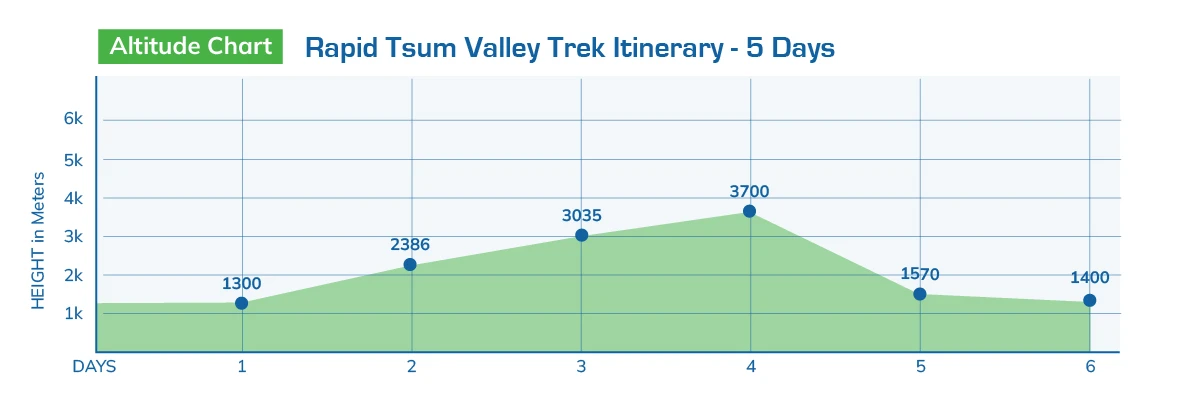
| Day | Route |
Distance (km) |
Elevation Gain |
| 1 |
Kathmandu to Jagat by jeep |
160 (drive) |
Minimal gain (vehicle travel) |
| 2 |
Jagat to Chumling |
10 km |
↑ approx. 600 m |
| 3 |
Chumling to Lama Gaon |
14 km |
↑ approx. 900 m |
| 4 |
Lama Gaon to Mu Gompa via Chekampar |
15 km |
↑ approx. 1,000 m |
| 5 |
Chekampar to Philim |
13 km |
↓ mostly descent |
Rapid Altitude Gain: Ascending to 3,700m (Mu Gompa) in just 5 days poses a high risk of AMS (Altitude Sickness). Without gradual acclimatization, hikers often face severe nausea, headaches, and dizziness due to oxygen deprivation.
Physical Exhaustion: Covering 15–18 km daily over steep Gorkha terrain requires 8–10 hours of active trekking. This pace induces cumulative muscle fatigue, especially without a buffer day for physical recovery.
Remote Wilderness Terrain : Tsum Valley is a restricted, roadless corridor with primitive infrastructure. The isolation means emergency evacuations are difficult, and the rugged, narrow cliffside trails require constant focus.
Navigational Pressure: The strict 5-day timeline leaves zero room for error. Navigating the dense forest switchbacks near Lokpa and the unmarked splits in the upper valley is difficult without local expertise, as the deep gorges often disrupt GPS signals.
Injury Risks : A forced fast pace on slick, uneven rock steps and suspension bridges increases the chance of joint strains or falls. Maintaining careful footwork is harder when physical depletion sets in by Day 3.
Zero Recovery Window : The lack of rest days prevents the body from repairing muscle tissue or adapting to thinner air. This non-stop exertion can lead to burnout before reaching the final landmarks.
Trekking the Tsum Valley in a short 5-day itinerary increases the risk of altitude sickness (AMS) due to rapid gain in elevation without proper acclimatization.
Common signs of Acute Mountain Sickness include headache, nausea, dizziness, loss of appetite, and unusual fatigue. In higher sections, trekkers may also experience shortness of breath and weakness.
A 5-day itinerary allows very limited acclimatization time, meaning the body has minimal opportunity to adapt to reduced oxygen levels. This increases stress during rapid ascent.
To reduce risk:
Tsum Valley trekking requires careful planning and physical readiness, especially on shorter itineraries. Trekkers should ensure they are reasonably fit and prepared for changing mountain conditions.
Pro Tip: Bring a good sleeping bag for colder months, as teahouse bedding may not be enough.
Trekking in the Tsum Valley is considered best during the autumn period – September to November. This time of year, the weather is stable, with clear skies and moderate temps. With beautiful views of surrounding peaks, lush valleys and vibrant autumn foliage, the trekking enthusiasts can enjoy. This season provides a perfect opportunity to photograph and discover the varied landscape of the valley.
It is a great place for short hiking enthusiasts as the trails are dry and doable. Autumn is widely considered the peak trekking season due to ideal visibility and stable mountain conditions.
This is also favorable from March to May during spring. At this time, the valley fills with the blooming rhododendrons and alpine flowers that stripe the trails. It’s a comfortable, mild trek, and the temperatures don’t hurt it. The season has clear mornings.
Nature lovers and those who love to observe the valley’s special variations of flora and fauna have a special charm in the spring. Spring offers one of the most scenic trekking experiences with colorful landscapes and balanced weather conditions.
In winter, between December and February, this is a serene, tranquil trek in Tsum Valley. It’s not easy there’s cold and occasionally even snowfall but they add a little extra charm to the trek, too. They’re less crowded because you actually get to be somewhere pristine and fresh snow.
You can be somewhere all by yourself. Closer to the climb, trekkers should have just the right gear for the cold and icy conditions that they’ll encounter when they reach the summit. Winter is suitable only for experienced trekkers due to harsh cold, but it offers extreme solitude and snow-covered scenery.
From June to August, the Tsum Valley has a summer and monsoon season. All the trails are slippery, and continuous rainfall may cause landslides. Still, the lush greenery, along with the waterfalls, are amazing.
However, experienced guides who have guided properly through the trials of the season can successfully guide through difficulties in order to ensure a safe and rewarding trekking experience. Summer (monsoon) is the least recommended season due to heavy rain, but it offers lush green landscapes and powerful waterfalls for those seeking a different experience.
The Tsum Valley Trek is graded as moderate to challenging, reaching a high point of around 3,700m at Mu Gompa. On average, trekkers will be walking 6 to 8 hours each day in lower areas and approximately 4 to 5 hours in the higher regions. As you may have guessed, this means that the trek can be physically tough with low levels of oxygen above a certain point. Overall, this trek is suitable for trekkers with basic hiking experience and good endurance.
A good level of physical fitness is important as you will find yourself climbing steep inclines, scrambling over piles of rocks and negotiating many ups and downs on uneven paths. Some form of regular aerobic training, such as jogging, swimming or hiking, is highly recommended for up to a month prior to your trek.
The trek itself is manageable for most people who are reasonably fit; however, those suffering from heart, lung or blood diseases would be best advised to consult their doctor before making reservations. Stay hydrated and acclimatize properly during the trek to minimize altitude sickness risks. Trek slowly and steadily based on your own breathing pace.A consistent walking rhythm is more important than speed on this route.
Reliable solar-powered electricity is available in most teahouses throughout the Tsum Valley. You can charge your electronic devices, such as phones, cameras, or portable power banks, for a nominal extra cost. We highly recommend carrying a high-capacity power bank because as you climb toward higher elevations like Mu Gompa, charging facilities become less reliable due to weather dependency. Therefore, device consumption must be managed carefully and efficiently.
For drinking water, local shops along the trail may sell bottled water; however, because of environmental restrictions on plastic bottles in the Manaslu Conservation Area, it is highly recommended to utilize a reusable bottle. You can fill it with boiled or filtered water provided by the lodges.
In addition, please bring water purification tablets or a portable filter system to ensure a constant supply of safe drinking water. Purification tablets can be provided by your trekking company upon request. Avoid consuming water from rivers, taps, or natural sources, as they frequently contain bacteria, parasites, and viruses. Prioritize hydration, especially at higher altitudes, as dehydration significantly increases the risk of altitude sickness.
The 5-Day Tsum Valley Express is a high-altitude expedition that involves inherent risks of altitude sickness, landslides, and variable weather conditions. As of 2026, valid travel insurance is strictly compulsory for all participants to obtain the necessary Restricted Area Permits (RAP).
Your policy must provide comprehensive cover against personal accidents, medical expenses, emergency air ambulance/helicopter rescue, and repatriation costs. We strictly require that the policy explicitly covers trekking activities up to an altitude of at least 4,000 m (to provide a safety buffer for the 3,700 m Mu Gompa reach) as well as any optional activities you may participate in during your stay in Nepal.
Please verify with your insurance provider that helicopter rescue at high altitudes is explicitly included for the Manaslu/Tsum region before you sign up. You must submit a copy of your insurance policy to Ammonite Adventure Treks at least one week before the trek departure date for verification purposes.
In case of accidents or health issues, your guide will coordinate with local authorities, health providers, and your insurer to facilitate immediate assistance. While we can suggest reputable insurance providers based on our previous experience, we do not sell policies directly. Comprehensive insurance ensures a safer and stress-free trekking experience in one of the most remote Himalayan regions.
The local currency in Nepal is the Nepalese Rupee (NPR). You can exchange most foreign currencies at licensed money exchange centers, banks, or hotels in Kathmandu and Thamel. The Nepal Rastra Bank sets the official exchange rates for all commercial banks; however, private exchange booths in Thamel often offer slightly better rates than hotels.
It’s better to have cash rather than traveler’s cheques since most hotels and banks now rarely accept them or charge high commissions. ATMs are easily available in Kathmandu and Pokhara, but they frequently have withdrawal limits and transaction fees. Still, they do not always work due to power or network issues, so it is vital to carry enough cash, as ATMs are generally unavailable throughout the trekking trail.
For Indian travelers, please note that while INR 100 notes are widely accepted, the Nepal Government has restricted the use of Indian notes higher than 100 (such as 200, 500, and 2,000). Always cross-check the prevailing rates at legal money exchanges with a board displaying current rates. Licensed exchanges often provide better value than banks, which may charge service fees. It is necessary to have enough local currency in small denominations for a smooth trek.
Whether you prefer to trek on a private or group basis for this Tsum Valley trek is your choice. If you join as a group, there is a discount; the larger the group, the greater the discount. Please note that if we organize the group for you, specific group discounts may not apply.
Whatever the group size, we have the experience to manage it well. For groups of 12 or more trekkers, we will also provide an extra assistant guide! We assign one porter for every two trekkers, and individual baggage is limited to 9 kg per person.
We have planned specific group logistics for this trek because of the fast-paced nature of the itinerary. This is designed to help maximize your time while allowing for a safe and sustainable pace.
Aside from a few extra costs, most expenses are inclusive in the trek itinerary. We exclude your meals and accommodation in Kathmandu. There are many options for hotels (ranging from luxury to budget) that can easily be booked online.
We ask our valued clients to carry personal spending money to pay for Kathmandu expenses, your Nepal visa fees, travel insurance premiums, snacks, specialty beverages (hot tea/coffee and cold drinks), tips for the trekking crew, souvenirs, etc. Clients should bring cash in major foreign currencies and exchange it into Nepali Rupees for personal spending. The remote areas we trek to only accept local Nepali paper currency.
The 5-day trek will be led by our trained and highly qualified mountain guides and Sherpas to guarantee you have an enjoyable and safe experience. All of our guides are intimately familiar with the Tsum Valley routes and are government-licensed. We will provide porters to transport your luggage at a ratio of one porter per two trekkers. Each porter is permitted to carry a maximum of 18 kg. If requested, we can provide a private porter for individuals as well.
There are other arrangements we make to ensure your comfort. All of our team members are locals from the high Himalaya, meaning they possess natural acclimatization to high altitudes. Also, we guarantee that our guides and support staff receive fair wages, are fully insured, and that their food, equipment, and lodging are provided.
First-aid kits and emergency assistance are available to all, but we prioritize the health of our staff. We believe that by ensuring the well-being of our crew, they will provide superior service for our clients.
Our trek leaders have:
Ammonite Adventure Treks is bonded and registered with the government, a member of the Trekking Agency Association of Nepal (TAAN) and the Nepal Mountaineering Association (NMA). So you can book holidays with Ammonite Adventure Treks in complete security.
An advance trip cost payment of 10% is required to book the trip. You may pay either by western union, bank transfer, or our website directly. If any remaining trip costs you may pay on arrival to Nepal either cash, credit card, bank transfer, or by Western Union. We will provide you with payment details as well as payment options.
Once the trekking is booked, we request that other documents such as a photocopy of passport, passport photos, policy of travel insurance, and flight arrival/departure be sent within seven days from when it is booked. There are not many flights domestically to Lukla, and Lukla airport is packed in peak trek season.
You can book the this trek with Ammonite Adventure Treks last minute. You need to pay the full amount for the trip at least 24 hours before the meeting of the trek. We will always do our best to allow for treks at any time, but last-minute bookings may sometimes take longer to organize due to issues regarding flights, or any adverse weather claims that we cannot control.
In case you want to spend more time in Nepal after the trek, we can arrange activities for you. You can either visit Kathmandu again or take jungle safaris, paragliding, rafting, or canoeing.
Once the Tsum Valley trek is successfully completed, Ammonite Adventure Treks will host a farewell dinner in Kathmandu. We will give a printed trek achievement certificate, and you can give feedback.
It is vitally important to pack light, but also reasonably prepare for this 5-day trek. You will have 1 porter for every 2 trekkers, therefore we encourage you to collaborate with fellow trekkers and pack your combined gear into a single duffle bag of no less than 60 litres capacity.
Each trekker's allowable luggage is limited to 9 kg. Additionally, you will need to run with a normal size rucksack for the duration of the day with your daily needs and belongings. Below is a list to assist you in packing correctly.
If you need gear, we can let you use a (used, not waterproof) duffel bag, a (used) down jacket, and a (used) sleeping bag.


The Tsum Valley Trek is a restricted and cultural trail, plain and simple. It’s known mainly for its unforgettable landscapes, its remote location, and its unique culture.
The walk on this trail is arranged by driving from Kathmandu to Soti Khola. It’s where trekkers begin their walk.
Bringing Pain and altitude sickness is important along with a balanced diet.
Terrain can be rock, steep, or uneven, and you have to have good balance and coordination. A trail that trekkers should be ready for ascents and descents.
You obviously can extend your trek in order to visit the Tsum Valley or the adjoining regions. We arrange custom itineraries for people.
To acclimatize you should try to take your time and take break days when you need them. Acclimatization also happens when you stay hydrated and eat well.
So, if you have any signs of altitude sickness, you’ve got to get down to a lower altitude as fast as you can. So, hydrate and rest some, and if the symptoms persist, seek medical attention.
Tsum Valley is not open to solo trekking unless you accompany a licensed guide. By doing this, it also protects you against any safety or regulation issues.
Before the trek, it is advisable to take advice from a medical health care provider regarding vaccinations and medicines to fight altitude sickness. Somewhere in that personal first aid kit is also recommended.
It is possible to book a trek via various trekking agencies. You have to make sure you choose the right company that offers experienced guides, necessary permits and a well-structured itinerary.
Tsum Valley is famous for its rich Tibetan Buddhist culture, populated by tons of monasteries and chortens. It is a sacred area with many of its locals performing traditional rituals and festivals that depict the spirit of these areas.

Thanks to Ammonite Adventure, my Tsum Valley trek was a nice experience. Booking was super easy, and the staff was
Just got back from the Rapid Tsum Valley Trek with Ammonite Adventure; it was an incredible trip! The five days