

Larke La Pass is a difficult but safe mountain pass for mountaineers and trekkers who are realistically prepared, physically and mentally. At 5,106 meters (16,752 feet), it is the toughest part of the Manaslu Circuit Trek due to the high altitude, cold weather and a long day of walking, not the technical skills. Most of the trekkers take from 8 to 10 hours to cross it, commencing early in the morning to get across before afternoon weather changes. The climb to the pass is slow and steady, and the descent toward Bimthang can be tiring, especially in snow or ice. Fit trekkers with previous multi-day hiking experience generally handle it well, and Your preparation, timing and discipline will determine the day’s difficulty.
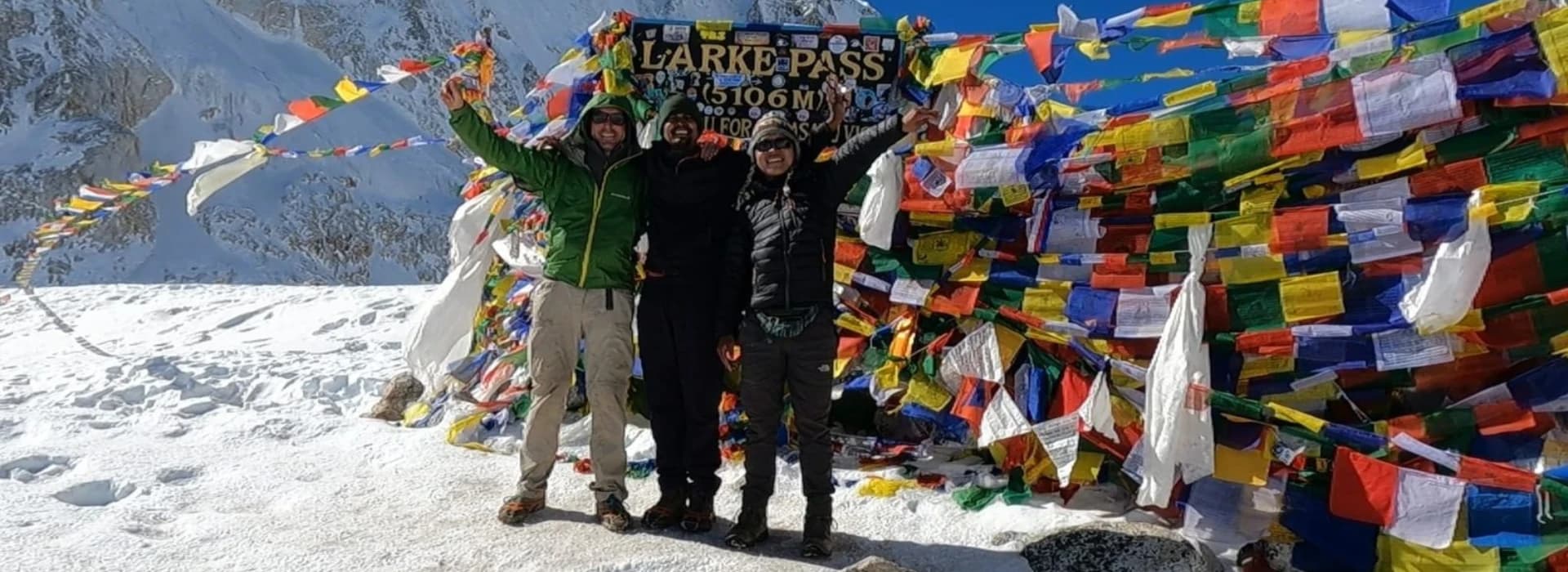
Larke La Pass Guide: Difficulty, Altitude, and Essential Trekking Tips

Why Larke La Pass Is Important
Larke La Pass is the vital junction between two points on this Manaslu Circuit Trek: Dharamsala and Bimthang. This high mountain pass stands at an altitude of 5,106m/16,752ft and is considered the most difficult and highest part of this whole trek. For others, it’s the last meal that lingers with trekkers long after they’ve packed up and headed out.
The pass is not only a physical obstacle in the way, but like a gate between two different regions: from one set of lower valleys to an isolated land high up. Crossing Larke La signals that the toughest section of the trek is over, clearing the way for stunning mountain vistas and less crowded routes.
This day is unsettling for many trekkers as well since it is high and weather can be problematic. Common questions are related to difficulty, safety and physical preparation. It’s natural to be afraid, but with the proper preparation, it’s completely manageable. Local teams will also guide you to ensure a safe passage, and many trekkers come off the other side of this challenge feeling proud and inspired.
Appreciating the significance of being at Larke La Pass is going to put you in a reasonable frame of mind, and that´s what we aim for: nice, calm confidence as part of Nepal's best treks.
Why Larke La Pass Is the Hardest Day of the Manaslu Circuit
Larke La Pass is generally seen as the toughest spot on the Manaslu Circuit, on account of it combining max altitude with long hours, icy conditions and utter remoteness in a single crossing. At 5,106 meters, this is the highest point of the entire trek, and even simple movement feels more challenging with oxygen levels much lower. For trekkers planning a longer Himalayan journey, this pass is also one of the major highlights of the Manaslu With Annapurna Circuit Trek, where adventure continues beyond the Manaslu region into Annapurna.
It is also the longest day on the itinerary, usually taking 8-10 hours. Trekkers begin early, hours before the sun rises and amid freezing temperatures, in order to utilize the stable morning weather. Wind chill factor at the top can be extreme, thus it will be the coldest day among the whole trek, even in the best season.
It is the remoteness of Larke La Pass that really makes it special. Once you leave Dharamsala, there are no villages, lodges or exits until you drop down to Bimthang on the other side. There is no easy way, no road in or out, and no quick rescue. There's also the psychological pressure of knowing that you have to do the crossing in one hit. All in all, these four factors (altitude, duration, cold and remoteness) are what make Larke La Pass the central challenge of the Manaslu Circuit Trek.
Larke La Pass Location
Larke La Pass is between Dharamsala (Larkya Phedi) and Bimthang in north Nepal on the Manaslu Circuit Trek. This might be a seemingly innocent point on the map, but its geography is one of the reasons why it requires so much planning and respect.
The crossing leaves from the high alpine campsite of Dharamsala, with no permanent settlements between there and Bimthang, climbing steadily and then steeply descending to Bimthang on the other side at 5,106 meters, Larke La pass. The whole thing travels above the tree line, completely exposed. Nothing obstructs the wind, so it is quite common to experience strong winds, particularly at or near the summit of the pass. Weather can turn quickly and, even on a clear morning, could deteriorate within hours.
But what makes this spot so dangerous is that there are no settlements at all during the crossing. After Dharamsala, no teahouses, villages or safe refuge until Bimthang, many hours away. There are no detours, no early off-ramps if one falters along the way.
This isolation makes Larke La Pass a point of commitment, rather than simply observation. One should be well acclimatized, geared up and of course mentally prepared to attempt the crossing. The position itself allows no margin for error, which is why timing and weather consciousness and guidance are so critical on this day.
Larke La Pass Altitude Explained (5,106m)
Exact Altitude and Oxygen Levels
Larke La Pass is 5,106 meters (16,752 feet) in altitude; it is the highest point on the Manaslu Circuit Trek. At this elevation, of oxygen level at sea level is available. This drop-off is what many people call “thin air,” and it very much has physical repercussions when you take to the trails. Your body takes in a little less oxygen with each breath, so your heart and lungs have to work harder even when you’re moving slow.
In practical terms, what that thin air means for you is that you can’t walk at your normal walking pace, no matter how fit you are. It becomes a matter of short steps, lots of breaks and controlled breathing. Easy things such as walking on a slight climb seem to require disproportional efforts. This elevation is also where the threat of altitude-related problems starts to skyrocket if trekkers are not well acclimatized.
That’s why it is so important to know about altitude sickness on Manaslu before trekking the pass. The altitude, on itself, is not harmful, however, and really only serves to ignore its effects, as that’s when it goes wrong.
How Altitude Feels on Pass Day
On the Larke La Pass crossing day, the altitude takes its toll in terms of slow walking and much earlier tiredness. Trekkers usually find that a whole night’s sleep has been insufficient, their legs are heavy, and after no more than an hour of climbing, it is challenging to breathe. You might have to pause every few minutes, not because the trail is challenging but because your body has to work harder than you’re used to with less oxygen.
You tire faster at this altitude, and you recover more slowly during rests. This is perfectly fine, and it doesn’t mean you’re weak. What the process of acclimatization does is train your body to slowly adjust by producing more red blood cells and becoming better at utilizing oxygen. Add extra nights at villages like Samagaun before the pass, and your body learns to operate more efficiently in low-oxygen conditions.
Consequently, while Larke La Pass will remain challenging, acclimatised trekkers are unlikely to have headaches, feel dizzy or nauseous, and can cross safely at a steady pace.
Larke La Pass Difficulty Honest Breakdown
How Difficult Is Larke La Pass Really?
Larke La Pass is perhaps best described as moderate to challenging, and the challenge is primarily due to the length, altitude, and conditions, not only due to technical terrain. Typically, trekkers hike 8 to 10 hours on crossing day from Dharamsala down to Bimthang. It’s all steadily uphill (600-700 meters), and then it’s all downhill, a full 1,300+ meters and may be hard on overworked legs.
The difficulty of a day can largely rest on snow conditions. In spring (March–May), there may be some snow near the summit, although typically it is quite feasible. During Autumn (September - November), the trails are generally clear and dry; this is the most stable season.
Difficulty will increase dramatically in winter, when heavy snowpack may complicate the going and force you into some 5th-class terrain or onto alternative lines. The perception of difficulty also depends on acclimatization and the design of your itinerary, so getting a general idea about the Manaslu Circuit Trek difficulty levelis crucial before even trying to do the pass. When well prepared, the challenge is tough but doable for fit trekkers.
Comparison With Other High Passes in Nepal
Larke La Pass firmly falls in the moderate to challenging difficulty range when compared to some other popular high passes in Nepal. Thorong La Pass (5,416m) on the Annapurna Circuit is at a slightly higher elevation but still considered more forgiving thanks to wider trails, decent infrastructure and somewhat gentler climbs. Thorong La seems more “doable” in the minds of many trekkers also, because there are a lot of teahouses and ways one can escape.
Renjo La Pass (5,360m) in the Everest region is shorter and less physically demanding, but can feel steeper and more exposed, particularly in high wind. Larke La Pass is unique in that it features long hours, cold temperatures and total pan as contents of the same day. Although not the highest or steepest of passes in Nepal, its remoteness and scarce settlement make it a greater mental challenge. This contrast should provide a good sense of expectation, and it is fair to say that Larke La Pass actually rewards preparation more than brute strength.
Best Time to Cross Larke La Pass
The climate around Larke La Pass is unfriendly due to its unpredictability and abrupt alterations. So even in perfect trekking seasons, surprise snowstorms or high winds can turn the crossing more difficult and dangerous. The fact that the weather can be so unpredictable means that you need to keep safety as your number one focus when preparing for your trek. It’s essential to know the seasonal conditions so that you don’t take any unnecessary risks and your chances of a successful, fun crossing are high, especially when considering the best time for manalsu circuit trek.
| Season | Weather & Conditions | Notes / Challenges |
| Spring (Mar–May) | Clear skies, moderate temperatures | Best time for stunning views and comfortable trekking conditions |
| Autumn (Sep–Nov) | Stable weather, dry trails | Another ideal season with excellent visibility and stable weather |
| Winter (Dec–Feb) | Heavy snow, cold temperatures | Difficult and risky, requires extra gear and experience; generally not recommended |
| Monsoon (Jun–Aug) | Rain, slippery trails, landslides | Very risky with frequent trail damage; best avoided entirely |
Spring brings clear weather and reasonable temperatures, making it a fantastic season for a foray. The spring snow melts to uncover glorious scenery where hikers can experience good visibility and better temperatures, both of which are conducive to adjusting their bodies to high altitudes with minimal hassles.
Autumn is also ideal, although it can be hot in September, but temperatures are consistent, and the trails are dry. This is the high trekking season thanks to cool, clear air that affords views of those spectacular mountain tops and reliable trail conditions. And the monsoon rains on which he depends don’t usually amount to much until the next few months. And the freezing weather doesn’t kick in until winter.
The winter, by comparison, typically presents trekkers with snow and cold that can lead to delays, hazards and cancellations. Select your crossing season carefully, choosing the best for safety and success, but being ready for sudden weather changes.
Who Should (and Should NOT) Cross Larke La Pass
Larke La Pass requires a good level of fitness and some experience in trekking. Perfect trekkers are those who work on endurance, can hike for many hours in high altitudes and know the choice points of acclimatization. A solid record of previous high-altitude trekking is a huge benefit, since it helps with pacing and knowing when you may be susceptible to altitude sickness. Compared to manaslu circuit trek for beginners.
But not everyone should try this pass. The best policy is to think twice if you have ever had severe altitude sickness or any respiratory or heart problems. Winter hikes are not for beginners or people unfamiliar with freezing weather and that much snow. And if you’re a first-time trekker and have never done multi-day hikes, Larke La could be intense.
In the end, brutal self-assessment of one’s fitness and health is paramount. Preparation and timing can mean the difference between a safe, gratifying hike and unnecessary risk.
What Happens on Larke La Pass Crossing Day
Journey to theLarke La Pass usually begins very early in the morning, before sunrise, around 4 to 5 AM. The cold, as at altitude everywhere, is fierce, with the mercury often falling below freezing: plenty of clothing layers are vital before you set off into the pre-dawn darkness. The air is thin, and every footfall comes slower than it should.
On the way up to the pass, you will find icy spots and perhaps snow depending on the time of year. The top of the pass gives you a feeling of relief and splendid panoramic views as repayment for your struggle.
However, the journey isn’t over. The descent to Bimthang is a long one and can be hard on weary legs. Trails can be muddy or rocky, so trekking poles and caution are necessary. Despite the tough day, the tranquility of the remote high-altitude landscape and the feeling of satisfaction at having crossed one of Nepal’s highest passes mean you won’t forget this experience.
Essential Safety Tips for Crossing Larke La Pass
- Control your pace: Take your time and don’t let altitude sickness or exhaustion get the better of you.
- Use trekking poles: They can really help on snow and icy sections for balance and to ease joint strain.
- Stay hydrated: Drink plenty of water even if you’re not thirsty in cold temperatures.
- Listen to your guide: Follow your guide’s instructions. If they say stop or turn around for safety, stop or turn around without question; there’s a reason they’re guiding, and it’s generally because they know the area well.
- Monitor your body: Keep an eye on the signs of altitude sickness and report any discomfort right away.
- Dress in layers: Adjust clothing to avoid sweating, which can lead to chill later.
What to Pack Specifically for Larke La Pass
- Insulating layers: They include thermal base layers, fleece mid-layers, and a down jacket for extra warmth.
- Windproof outer shell: Blocks the wind to keep the wind chill.
- Warm accessories: Insulated gloves, a thermal hat, and maybe even a balaclava to protect your face.
- Footwear with grip: Solid Trekking shoes with good grip; crampons are preferred for ice conditions.
- Moisture-wicking socks: To keep feet dry and to prevent blisters.
- Lightweight gear: It's essential to have the right, high-performance light and streamlined equipment rather than heavy gear.
Common Mistakes That Make Larke La Pass Dangerous
- Rushing acclimatization: Skipping rest days (or not resting enough on active days) puts you at greater risk for altitude sickness, a potentially deadly ailment. Your body needs time to acclimate to thinning air.
- Ignoring weather windows: Crossing must not be done during the unstable months or before and after it, as trekkers may end up in snowstorms, thus hailstorms, strong winds and mudslides, which make the trail slippery. This can transform a tough day into a dangerous one in a hurry.
- Overconfidence from lower passes: Larke La is steeper and more challenging than most. Experience with lower or less-technical passes is no guarantee of readiness here. Misjudging the challenge means poor pacing and a good chance of hurting yourself.
- Not listening to guides: Disregarding instructions from guides can cause serious consequences in this isolated area.
Final Verdict: Is Larke La Pass Worth It
Crossing Larke La Pass is undeniably complex, but the benefits are well worth the difficulty. At more than 5,100 meters high, this is not only a trek but also a test of stamina, patience and mental fortitude. It's worth every painful step; the incredible panoramic views, the sense of achievement and experiencing something truly different on Manaslu Circuit feels like it makes all hard work worth it. What really matters isn't brute strength but thoughtful preparation. It's possible, with proper acclimatization, pacing and gear, to turn the crossing from terrifying into attainable. It's about honoring your limits while still pushing carefully.
With the right attitude and training, if you hike to Larke La Pass as a new journey instead of an obstacle, it's going to be really beautiful indeed! So yes, it is absolutely worth it, if you're prepared to train intelligently and accept the challenge.

Need Help? Call Us.+977 9851230809