Introduction
Each year, thousands of people travel to Nepal as trekkers. And many are looking to find out which of the two trekking locations would suit them better. Kala Patthar and Everest Base Camp are located fairly close together on the same trekking route, approximately a few kilometres apart. But they're two very different trekking experiences.
Kala Patthar is a rocky summit that stands at an elevation of 5,644 metres. And it's the closest point you can reach to view a full 360-degree setting of the highest mountains and peaks in the world. Plus, you'll see the entire pyramid form of Everest rising on the horizon.
Everest Base Camp is located at 5,364 metres above sea level. And it's connected to about 25 different coloured tents and the rumbling sound created by glacial and ice pieces constantly moving. Our team has guided trekkers from several different seasons to one or the other site. And the true answer is that both sites provide something that the other doesn't.
So if you want to get the most out of both sites, knowing how one site is different from the other will help you plan accordingly. And you'll maximize every moment once you arrive. This guide provides you with a comprehensive overview of trekking in Nepal at the very highest level. Plus, it'll allow you to make an informed choice as to which type of experience will be best for you.
Location and Elevation Comparison
The two viewpoints are located within the Sagarmatha National Park of Nepal's Khumbu region. So they're physically close to one another on the map. But the differences in altitude and terrain make them quite different experiences in terms of the effort required to access them.
Gorak Shep is a settlement at 5,164 metres. And it serves as a base for both sites. Most often, trekkers will visit Everest Base Camp in the late afternoon. And they'll rise early in the morning to hike to the summit of Kala Patthar the following day. So this combination gives you the opportunity to experience both sites within 2 days.
| Location |
Altitude
|
Coordinates (Approx.)
|
|
Kala Patthar
|
5,644 m / 18,514 ft
|
27.9942° N, 86.8317° E
|
|
Everest Base Camp
|
5,364 m / 17,598 ft
|
28.0025° N, 86.8528° E
|
|
Gorak Shep (Base)
|
5,164 m / 16,942 ft
|
27.9803° N, 86.8286° E
|
|
Namche Bazaar
|
3,440 m / 11,286 ft
|
27.8069° N, 86.7139° E |
For your preparation, visit our detailed map and review the best EBC trail maps. They show all GPS points, designate the locations' elevations and mark the places you have to stop to look at views.
Kala Patthar sits at 5,644 m above sea level. So it's higher than Everest Base Camp at 5,364 m by 280 m. The last section of the ascent to the summit of Kala Patthar requires a very steep incline. And it can be difficult to complete after climbing for several hours each day for many consecutive days. But once at the top, you'll see great views that'll make up for all the hard work. And there'll be lots of memories to reflect upon as you enjoy those views.
Tip: You can find a detailed Himalayan trekking maps guide that includes all of the information listed above as it relates to trekking the entire EBC trail.
Scenic Views: Kala Patthar
Kala Patthar is one of the best places to see Mount Everest in its entirety, towering over all other peaks around it. Everest Base Camp has its Everest summit hidden from view due to being obscured by the Nuptse ridge, so you will not be able to see the top until you have travelled to Kala Patthar.
Atop Kala Patthar, no other piece of land will intervene or impede you from viewing the top of Mount Everest in all of its majesty and splendour. You'll have a panoramic view of Mount Everest's 8,849-meter pyramid-shaped summit, extending from the top of the mountain down to the bottom.
The most spectacular time to visit the summit is in the early morning before the sun has risen. As the sky transforms from a deep blue to a pale orange hue and the peaks receive their first rays of light, you will feel surrounded by the silence of the high Himalaya, creating an extraordinary moment. This is the most powerful moment that exists in the Khumbu region.
Peaks Visible from Kala Patthar
- Mount Everest (8,849 m): The absolute peak of Everest is seen in its entirety. And no other view in the Khumbu region offers as good a view of the mountain.
- Lhotse (8,516 m): The fourth-highest mountain in the world sits to the right of Mount Everest. And it towers over the area.
- Nuptse (7,861 m): The mountain forms a wide, prominent and fortress-like ridge to the left of Mount Everest.
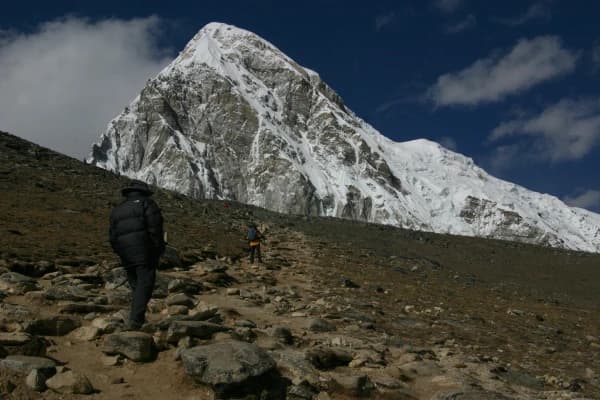
- Pumori (7,161 m): The mountain will be located almost directly above Kala Patthar. And it'll create a dramatic sky and background in all pictures taken here.
- Changtse (7,583 m): Seen from across the Tibetan border, this mountain adds depth and scale to the panorama.
- Khumbu Glacier: The whole glacier unfurls beneath you, a river of ancient ice flowing through the valley floor.
Photography tip: To photograph this view properly, a wide-angle lens is better for panoramic pictures. And you'll want to switch to a telephoto lens for mountain detail. Plus for all shooting locations throughout the day, refer to the Kala Patthar sunrise trek guide for the best positions from which to take photos at specific times of day.
Scenic Views: Everest Base Camp
The honest fact is that Everest Base Camp is not the best location to take photos of Everest. And this comes as a surprise to many trekkers who are experiencing their first trip to Base Camp. The upper section of Everest is blocked from view by the Nuptse ridge and Khumbu Icefall while you're at Base Camp. But it's still a breathtaking image. Just not on Everest.
As you stand at the edge of the Khumbu Glacier, you're looking down at the largest glacier in Nepal. It's an actively moving and cracking mass of ancient ice, looming above you to the West Cwm. And during expedition season, hundreds of rust-coloured tents can be found all along the glacier as climbing teams prepare for their summit attempts.
So the sound of the glacier, the magnitude of the glacier and the energy at Base Camp is unlike anything that can be found anywhere else in the Himalayas.
What You See from Everest Base Camp
- Khumbu Glacier: This is a close-up view directly in front of you. The gigantic size of the Khumbu Glacier, the seracs, crevasses and the blue icy colour of the glacier will be breathtaking as you stand at Base Camp on the ground level.
- Khumbu Icefall: The Khumbu Icefall is the huge, dynamically moving wall of ice located above Base Camp. And it's also where every serious expedition to climb Mount Everest starts their climb.
- North Face of Mount Everest (partial): From Base Camp, you'll be able to see the lower part of the mountain. And you'll see its many ridges surrounding the icefall.
- Nuptse and Lhotse Walls: Both will be towering above. And they create a natural amphitheatre around Base Camp.
- Colourful Expedition Camps: In the spring and autumn climbing season, you'll be able to view bright blue, red, yellow and green tents that international climbing teams set up at Base Camp. And the bright colours of the tents will provide an incredible contrast to the white and grey colours of the glacier.
While at Base Camp, the view is less important than the emotional feeling of being at the base of Mount Everest. Standing at Base Camp will provide you with a sense of place in the world. And you'll know exactly how you arrived there. So that emotional weight can seldom be conveyed with a photograph.
Tip: Between 7am and 10am is the best time to photograph the icefall and glacier walls due to the direct light from the sun. And please refer to our Everest Base Camp photography tips guide for details on angles and camera settings while at Base Camp.
Trek Difficulty and Accessibility
Both destinations are located at the endpoints of the same trekking route. So the difficulty of getting to each one is the same. But the last push to each summit is very different in terms of elevation, terrain and time.
Kala Patthar
- The trail from Gorak Shep to Kala Patthar is approximately 2km long. And it has an elevation gain of about 480m.
- The trail to the summit is very steep, with a lot of rocks, and is exposed. The altitude at the top of Kala Patthar is around 5,600m. So when you think about how much elevation you'll gain over that short distance, it's going to feel far harder than walking on flat ground.
- Most backpackers start climbing before 5am on the first day of their trek in order to reach the summit by 6am for the sunrise. And that means climbing in darkness at freezing temperatures after 5 or more days of being at high altitudes.
- The hike back down to Gorak Shep from the summit will take approximately 1 to 1.5 hours. And it'll be relatively easy compared to climbing up the other side.
Everest Base Camp Difficulty
- The distance to Base Camp from the Gorak Shep trailhead is about 3.5 kilometres each way. And the gradient of the trail is very gentle. The trail is mostly rocky moraine and glacier edges. So you need to pay close attention to where you walk. But the trail is not very steep.
- The average time that trekkers take to complete the trek from Gorak Shep to Base Camp is 4 to 5 hours. And it's usually done in the afternoon shortly after getting to Gorak Shep.
- The main problem with going to Base Camp is not the technical part of the trail. But rather the effects of altitude and the amount of time that you've spent at altitude prior to starting your trek to Base Camp.
Safety Tips: Check out our Everest Base Camp trek difficulty guide for how many acclimatisation days you'll need. And it covers what you can do to prevent altitude sickness. Plus, it'll tell you what to do if you have altitude sickness while above 4,000 metres. So don't skip any days of rest at either Namche or Dingboche.
Photography and Best Time for Views
There are 3 elements that can affect what you'll be able to see from the 2 different lookouts: type of light, weather and time of year. And choosing when to hike, plus how early in the day to arrive at each lookout, can greatly improve both the quality of your experience and your photographs.
Springtime: March to May
- Kala Patthar: Mornings before 9am are generally clear with good visibility. After the sun rises, the sky will have turned to a deep blue. And the mountains will be very well lit with bright white lighting. Lower down the trail, rhododendrons will be blooming on your way to this lookout.
- Everest Base Camp: It's also the time of year when the expedition teams are at Base Camp and getting ready to try for the summit. The whole atmosphere is electric. And the camp area becomes an excellent subject to photograph.
Autumn Season: October to November
Fall Season (October to November)
- Kala Patthar: Our team believes this is the prime season overall. The monsoon rainfall has cleared out the air and left us with excellent visibility. And the summit views are razor sharp. Plus you'll experience very stable and cool morning temperatures.
- Everest Base Camp: The post-monsoon weather at Everest Base Camp brings beautifully clear skies with amazing afternoon cloud formations. Crowds are larger than during the spring. But the reward of getting to see the views makes up for the additional people you have to share them with.
Things to Avoid
- The monsoon occurs during the months of June to August. So the trails to both of these locations will be very difficult because of the quantity of rain that has fallen on them. And these two locations could be considered no-go zones during these months.
- The months of December to February will have a lot of snow and cold temperatures, particularly at elevations greater than 5,000 metres. It's technically feasible for individuals to reach both of these locations during this period. But conditions are very harsh and unpredictable.
Tip: For the best time to trek Everest, our guide has each month outlined with average temperature, precipitation and visibility averages. So it'll help you select the best month to start your trek.
Overall Comparison: Kala Patthar vs Everest Base Camp
This is an all-inclusive comparison of both locations with regards to the major categories. So use this as your final guide to help you choose what to do at both places when deciding whether to trek there.
| Category |
Kala Patthar
|
Everest Base Camp
|
|
Best Views
|
Panoramic Everest summit
|
Glacier and base camp atmosphere
|
| Altitude |
5,644 m - higher
|
5,364 m - slightly lower
|
| Difficulty |
Steeper final climb
|
Longer, gradual walk
|
|
Photography Value
|
Sunrise and summit shots
|
Glacier and expedition scenes
|
|
Crowd Level
|
Moderate |
High in peak season
|
|
Best Season
|
Oct-Nov, March-April
|
Oct-Nov, March-May
|
|
Experience Type
|
Summit viewpoint
|
Journey and achievement destination |
The biggest takeaway is that Kala Patthar provides the best vantage point for photographic opportunities and scenery. But the best destination for achieving your trek is the Everest Base Camp. And the best option is to do both. So all of our itineraries are designed to accommodate both within one 14-day trek.
Tip: If you wish to view how this trek to EBC compares with other similar treks, including Annapurna Circuit and Langtang Valley, please review our Nepal trekking comparison.
Conclusion and Recommendation
Higher than Everest Base Camp, Kala Patthar is not simply a rival. It's also not a competitor. It offers something that Everest Base Camp can't.
But when you stand on top of Kala Patthar at dawn and witness the world's highest mountain turn from grey to golden, trekkers will tell you it's one of those memories you can't forget. Kala Patthar is the place to take photographs or to experience 360-degree views of the mountains that'll change your life forever. And at the very least, you won't ever forget them.
The feeling you get at Everest Base Camp is something you'll never forget either. There's a glacier below you and an icefall above you. And to know that every great expedition to Everest has begun at your feet gives it a feeling that's not even close to what you see from there.
So don't pick one or the other. They both sit on the same route and are only hours apart. And with the right itinerary and proper acclimatisation, you can see both places in one life-changing trek. We've taken hundreds of trekkers to both places. And the combination never lets us down.
Want to do both? Check out our Everest trekking packages. And let our top-notch team take care of all of your plans from the day you arrive in Lukla until sunrise from Kala Patthar.