Trekkers-overlooking-a-mountain-village-and-river-valley-in-the-Himalayas

Spiritual & Fossil Discovery Journey in Mustang

484 reviews
113 reviews
Recommended by 99% of travelers

Picture stepping into a world of another age, a wind-swept land filled with age-old secrets in rocks. It's what Upper Mustang Travel is like. Visit the last kingdom of Tibet in Nepal with our 5-Day Upper Mustang Spirituality and Fossils trip. Monasteries still echo with the sound of monks chanting their ancient prayers, and sacred black stones lie quiet in a turbulent river. This short Mustang Itinerary offers Tibetan Buddhist spirituality with Shaligram fossil exploration in just five incredible Himalayan days. A chance to travel to a restricted Himalayan desert kingdom if you have ever dreamed of visiting but lack time.

⚠️ 2026 Trail Update

Our team has some advice for traveling to Mustang in 2026 before you begin your planning and packing.

  • Mustang road status: From Pokhara to Jomsom and Kagbeni by Jeep, the roads are open, but expect them to be rough between different parts of the valley along the Kali Gandaki River. Some parts of the road are currently undergoing construction.
  • Permit updates: Upper Mustang access info for traveling in Upper Mustang remain the same, i.e. A Restricted Area Permit (RAP) beyond Kagbeni is required, which our team arranges for you in advance.
  • Weather: March through May and September through November, during these times, the weather remains clear, and the mountain views are fantastic; however, due to monsoons, road conditions might get worse, and there could be road closures.
  • Flight reliability: Due to winds, Jomsom's airstrip usually gets disrupted from the afternoon, and therefore we advise everyone to book their flights in the morning and include an extra day in their itineraries for flexibility.
  • 2026 update: Early in 2026, no road closure has been announced, but as the road conditions change constantly, we will keep you informed and provide you with the latest on-ground updates from our guides.
At a Glance
Duration5 Days
Trip GradeModerate
CountryNepal
Maximum Altitude2,804 m
Group Size1-15
StartsKathmandu
EndsKathmandu
Travel StyleTrekking
Best TimeSpring and Autumn

Introduction to Upper Mustang Spiritual & Fossil Journey

There is one corner of Nepal where the mountains form red cliffs, the wind never stops blowing, and the rivers contain more precious stone to Hindus than gold itself. Upper Mustang, a part of Nepal that few even know exists, but even fewer actually get to visit. This is not a typical trekking holiday. Upper Mustang is the mystical Mustang zone, a formerly banned kingdom that has only been accessible to outsiders since 1992, requiring visitors to have a special permit before entry.

For travelers planning this extraordinary journey, our Upper Mustang Trek: 14 Days Complete Guide provides everything you need to know before entering this hidden Himalayan kingdom.

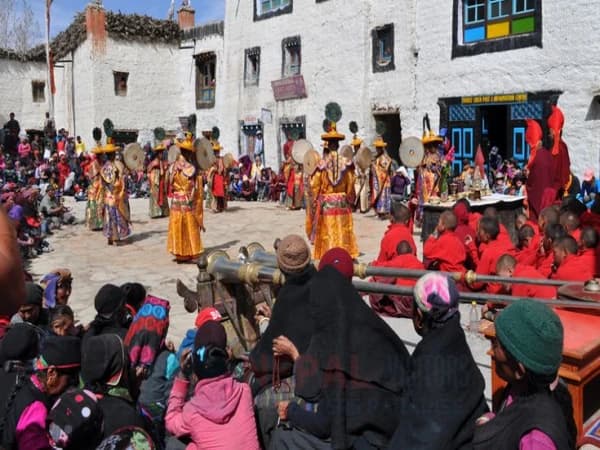
However, our guides feel this is one of the most exciting regions for us to take our trekkers, as there is a depth to the experience that cannot be described easily. Our journey takes visitors on a two-tiered experience of existence. On one hand, there is the sacred spiritual world of Tibetan Buddhism in Nepal, where the experience of ancient gompas, butter lamps, sky-blue prayer flags, and the simple life of monks who have lived in such a manner for hundreds of years is palpable.

Then there is the prehistoric world represented by fossils, the fossilised ammonites which lie in the Kali Gandaki riverbed and predate the formation of the Himalayas some 65-400 million years ago. They are considered in Hindu circles to be physical manifestations of Lord Vishnu himself, the treasure and beauty of our earth, as recognized by scientists and ourselves when they are discovered, still holding millennia of age between them.

This journey brings these two separate yet interconnected worlds together in a five-day exploration of a landscape like no other. We have the guides who will give our guests the experience not of walking through Upper Mustang, but the feeling of having truly touched the essence of it.

Spiritual Highlights of Upper Mustang

The beauty and grandeur of the Upper Mustang have also become its quiet and serene divinity. Here are some of the spiritual experiences the team and travelers found particularly memorable:

  • Monasteries of Kagbeni and surroundings: The Red Gompa at Kagbeni is one of the oldest still operating monasteries of the region, and the experience inside is an unforgettable walk through the complex, past the constantly burning butter lamps, where centuries of prayers fill the air. Buddhism here isn't a relic or a tourist attraction; it's very much alive in the everyday practices carried out at places such as this.
  • Mani walls and mani stone corridors: One may find oneself wandering through narrow corridors lined with intricately carved mani stones and a profusion of colourful Tibetan prayer flags, fluttering in the wind. It's believed that all of them send forth a prayer to the wind, with each flutter a new blessing being released.
  • Muktinath Temple: Perched at the impressive altitude of 3,800 meters above sea level and just a short distance from Kagbeni, Muktinath Temple serves as an important pilgrimage destination for both Hindus and Buddhists alike. Belief dictates that walking through the 108 water spouts of the temple cures all the sins of the person passing through. There is nowhere else quite like this on earth.
  • Monastic way of life and village pace of life. Your guides walk you through the monks' way of life in this region - chanting of early morning prayers, the deep blare of dungchen horns, and the aroma of burning juniper incense wafting from open monastery doors.
  • Bön Buddhist tradition of Lubra village: Lubra, a quiet village close to Jomsom, is the only known enclave of the pre-Buddhist tradition of Tibet known as the Bon Buddhist tradition- an incredible sidetrack if one has time.
  • Sky Caves of Mustang: Believed to be meditation chambers for ancient monks, the man-made caves carved into the cliffs are incredibly mysterious. Access to all of them requires technical climbing skill, but the lower ones, easily visible from the trail, are fascinating.
  • Sacred river rituals along the Kali Gandaki: A local man is supposed to have great luck if he is blessed with finding a Shaligram. Watching a local guide take one of these from the riverbed and hold it in both cupped hands is an experience of the Himalayas that you will never forget

Why Choose a 5-Day Upper Mustang Journey

Not everyone has 3 weeks available for an adventure on a Himalayan path, and to tell the truth, there is absolutely no need to. We've created a compact itinerary of journey to Upper Mustang designed for travelers eager for meaningful travel experiences, without a long commitment. These are just a few of the reasons why a 5-day Mustang trip can be the perfect choice for you.

For travelers seeking a longer and more comfortable way to explore the region, our Upper Mustang Jeep Tour 8 Days offers an excellent alternative, allowing visitors to experience the unique landscapes and culture of Mustang with less walking and more flexibility. A long Upper Mustang trek usually lasts from 10 to 14 days, covering the whole valley until Lo Manthang, the former enclosed city, close to the border with Tibet.

A quick Mustang trip is marvelous but involves high altitude, additional permits, longer travel times, and a considerably higher cost of the trek. Our fast plan to Upper Mustang, on the other hand, centers on the southern border area of Upper Mustang – Kagbeni and the Kali Gandaki valley – and, to our knowledge, it contains one of the most culturally and geologically rich spots of Nepal.

With 5 days, you will have enough time to be beside the river, relax within a peaceful Buddhist monastery, and witness a local family at the beginning of their day, and all that in 5 days return, relaxed, yet with a treasure of experiences. A 5 days travel plan Mustang can satisfy first-time trekkers, travelers who will later on combine the journey with their holidays in Pokhara, and everybody whose interests are fossils and Buddhist cultures. We do feel that the outlined trip is among the shortest and yet the most profound that one can travel to in Nepal.

Route Overview of 5-Day Upper Mustang Journey

The explanation below clearly explains our  Mustang travel route from the starting to the final day of your journey:

  • Kathmandu to Pokhara - Fly to Pokhara; it is known as the adventurer's capital of Nepal.
  • Pokhara to Jomsom - Fly to Jomsom (it's a really awe-inspiring 20-minute mountain flight) or take a jeep ride through the Kali Gandaki valley, if you prefer to go through a more rugged road trip.
  • Jomsom to Kagbeni - Walk or short jeep ride to Kagbeni. Kagbeni is known as the entrance to the forbidden Upper Mustang region.
  • Kagbeni to Kali Gandaki River - The real deal. You will spend your entire day with our professionals, finding Shaligram stones, also known as the sacred fossil stones, while walking along the bank of the river Kali Gandaki.
  • Kagbeni to Jomsom to Pokhara to Kathmandu - To finish up our Mustang travel map, you can spend your day relaxing by the lakeside in Pokhara, and later fly back to Kathmandu.

Our Mustang trek map is a clear, easy, and straightforward journey plan for an enjoyable and extremely thrilling tour.

Why Ammonite Adventure for This Journey

Perhaps of everything we offer, the most unexpected adventure for the traveler is discovering fossils on the banks of the Kali Gandaki River. It is a journey many take with their minds on beautiful mountains, and they leave marveling at the rocks!

Here is why our ammonite adventure Mustang trip is unlike any other:

Millions of years ago, the Kali Gandaki River carved its path along the bottom of the ancient Tethys Sea. As the Himalayas rose to create the mountains we see today, the ocean floor was pushed up from beneath us. Millions of fossilized ammonite shells-spiral creatures that inhabited our seas between 65 million and 400 million years ago-became trapped within the stones. Slowly, as the river travels south, it carves out these marvels for us.

Our Kali Gandaki Experience trip is guided, ethical, and one fantastic learning opportunity. We won't just hand you a stone, but our local guide will teach you how to discern an authentic Shaligram by spiral, shape, and color, as well as the science behind fossil hunting in Nepal: what the fossilized creature once was, what it ate and why this is the only river in the world at such high altitude where this unique fossil can be found.

While our local guides simultaneously talk of the Shaligram trekking experience on a religious basis, and the way in which families keep them upon altars within their homes, perform daily puja in the same way a priest does for them in the monastery, and the journeys families make across the continent, both across India, and into Nepal from wherever they can, to collect their chosen Shaligram from this very river. We consider fossil discovery tour Nepal to be our team's utmost delight and privilege to combine religion and geology, because something of this nature cannot be planned by a guidebook, and is indeed something rather rare, and oh so real.

Itinerary

The highest altitude reached in our trekking is about 3,800 meters, the place name is Muktinath. All the days of trekking, the meals are included, so they will be breakfast, lunch, and dinner at the local teahouses and guesthouses. The room is in standard local guesthouses; they are warm, clean, comfortable, and owned by the local Mustang families.

We will pick you up at 7.00 am in Kathmandu and drive you to the airport to fly to Pokhara. The morning flight takes around 25 minutes. Alternatively, the more adventurous people can take the 6-7 hour tourist bus ride through the hilly terrain of the lower region of Nepal. From Pokhara, we can drive you on the jeep at 7.00 pm to Jomsom, which takes 6 hours and can be quite challenging. If you can get the flights this morning, which is only a 20-25 minutes flight over the magnificent views of Dhaulagiri & Annapurna mountains.

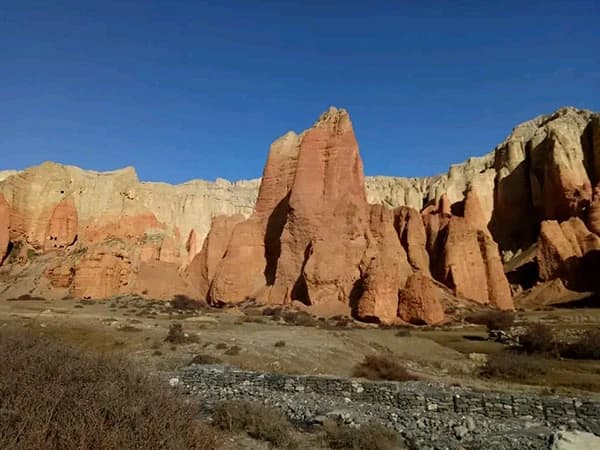
We will reach Jomsom in the afternoon. Jomsom is an unusual bustling little town sitting in a windswept Kali Gandaki valley at 2,720 m. The vegetation quickly disappears, and the air becomes dry, and the landscape becomes dramatic: high, barren cliffs of red and grey on both sides of the Kali Gandaki. Enjoy a relaxed walk beside the riverbank at evening, you have just reached Mustang.

Highlight: The introduction to the Himalayan desert and the wind corridor.

Max. Altitude: 2,743 meters (8,999 feet)Meals: Breakfast-Lunch-DinnerAccommodation: HotelDuration: (Kathmandu → Pokhara → Jomsom) flights: 50-60 minDistance: 362 kmMode of Transport: flight or Jeep

This morning, we walked along the Kali Gandaki River north to Kagbeni. The walk is 2-3 hours, or a short jeep ride. The trail sticks to the river bed and takes you through some of the most striking arid valley scenery of Nepal – pastel colored cliffs, weathered rock walls, and the biggest sky. Kagbeni is a treasure – the entry to the restricted zone of Upper Mustang. Whitewashed stone houses, tiny alleyways, and rooftop prayer flags create the sensation of being stepped back in time. Our guide walks us through the village and to the Red Gompa, where the air is thick with butter lamp fumes and the walls are lined with thangkas, old religious paintings. In the evening, sit on a rooftop and watch the sun paint the mountains a shade of burnt orange.

Trip High Point: The very first in-depth cultural encounter in the restricted heritage zone of Upper Mustang.

Max. Altitude: 2,804 meters (9,199 feet)Meals: Breakfast-Lunch-DinnerAccommodation: HotelDuration: 25minDistance: 11.1 kmMode of Transport: Jeep

It is today, the wait ends. We are all day in the river bed of the Kali Gandaki with our guides, local experts on fossils. The day begins with a briefing from the local fossil expert. He will explain the fossil, its formation, and why these fossils-Shaligrams-exist only here, and in their uniquely sacred form. After the briefing, we walked. The river bed is vast and grey and filled with millions of stones. We are taught by the guide how to look, what markings to look for, which stones will contain an ammonite fossil and which won't, or when to dismiss a perfectly ordinary pebble as just that-ordinary. You find the first spiral marking in a dark stone, and you have just picked up a piece of life from a shallow sea before the mountains, or rather the Himalayas, existed.

In the afternoon, we find ourselves sitting by a river as our guide regales us with local tales of the pilgrims who have trekked this region for hundreds of years. The mountains are everywhere around. The wind whispers through the valley. It is one of those precious few moments when science and religion seem indistinguishable. Travel Highlight: Profound spiritual and geological link with the ancient fossils of Nepal.

Max. Altitude: 2,804 meters (9,199 feet)Meals: Breakfast-Lunch-DinnerAccommodation: Hotel

After breakfast, we leave Kagbeni and take the return track to Jomsom, from where you take either the plane or a Jeep back to Pokhara. Now, going back down south feels different; you recognize the change in terrain, from deserts back to green mountains, from windy corridors back to warm lakeside environments.

You arrive in Pokhara, by the side of Phewa lake in the afternoon. From here on, it is your own time to relax by the lake, enjoy a proper meal, or do anything you desire for a few hours. Pokhara feels like a peaceful exhale from Mustang.

Travel Highlight: The views traveling back through the river valleys and the Himalayan terrain.

Max. Altitude: 822 meters (2,697 feet)Meals: Breakfast-Lunch-DinnerAccommodation: HotelDuration: 8 to 10 hoursDistance: 160 kmMode of Transport: Jeep

On your last day in Pokhara, have an unhurried morning. After breakfast, we take you to the airport or bus station back to Kathmandu. The flight would be about 25-30 minutes long, and a tourist bus 6-7 hours (beautiful Prithvi Highway).

Upon arriving back in Kathmandu, our team ensures a thorough debrief, issues you your certificate for discovering fossils, and hopefully gives you a Shaligram in your pocket.

The highlight of your journey: a unique Himalayan spiritual and fossil exploration experience.

Max. Altitude: 1,324 meters (4,344 feet)Meals: Breakfast-Lunch-DinnerAccommodation: HotelDuration: Bus: 7 to 9 hours, flight: 30 minDistance: 206 kmMode of Transport: Bus / Flight
Customize Trip

What is Included?

Hotel in City

  • One night Twin-sharing hotel accommodation at Pokhara following the trek on a bed-and-breakfast basis.

Transportation

  • Airport Transfers: For your international and domestic flights, a round-trip transfer and pick-up are included. 
  • Trek Start: A shared vehicle transfer is scheduled from Kathmandu (1,400m) to Machhakhola (930m).
  • Trek End: A sharing vehicle transfer is also scheduled from Dharapani to Kathmandu (1,400m) or Pokhara.
  • Staff Transport: All ground transport for the guides, and any other support staff.

Accommodations

  • Trek Accommodation: Overnight local teahouse accommodation on a twin-sharing basis. Single rooms can be arranged for a small surcharge, subject to availability.
  • Total Accommodation Nights: 11 nights of standard twin-sharing accommodation during the trek.

Food

  • Full Board Meals: Breakfast, lunch and dinner and hot drinks are provided during the entire trek. 
  • Special Inclusions: Water purification tablets for safe drinking water.
  • Total meals included: There will be a total of 10 breakfasts, 10 lunches and 10 dinners.

Guide

  • One government-licensed English-speaking guide. Assistant guides will join the group, depending on the size of the group.
  • All guide fees, food, insurance, salaries, accommodation, transport and all equipment will be covered.

Porter

  • Porters: One porter for every two trekkers. Each trekker's personal luggage weight limit is 9 kg.
  • All Porter fees, food, insurance, salaries, accommodation, transport and all equipment will be covered.

Trek Permits and Expenses

All necessary permits - including special area permits - are pre-scheduled to make your trek a bit easier and trouble-free. Included permits are:

  • Manaslu Restricted Area Permit (MRAP)
  • Manaslu Conservation Area Permit (MCAP)
  • Annapurna Conservation Area Permit (ACAP). 

Medical Assistance

  • Emergency Provision: Emergency oxygen and a first aid medical kit will be taken with you on the trek.
  • Rescue Arrangements: Trained rescuers will be arranged in case of emergency (included in your Trek Travel Insurance).

Souvenir

  • Goodbye Souvenirs: All participants will receive an Ammonite Adventure cap and T-shirt.
  • Completion Certificate: A completion certificate for all participants.

Gear and Trekking Equipments

  • Sleeping bags and down jackets, duffle bag (one for every two trekkers), if you do not have your own
  • Manaslu Region map.

Additional Services

  • Luggage Storage: Free and seacure luggage storage throughout the trek.

  • Full Coordination: Our full coordination team will take care of all logistics, planning, and requirements for you.

Farewell

  • A cultural farewell meal in Kathmandu at the conclusion of your journey.

What is Excluded?

International Flight

  • International flight to and from Nepal is not included.

Accommodations

  • Hotel accommodation in Kathmandu before and after the trekking starts.
  • Extra nights in Kathmandu on early arrival, late departure, or early return from the trek due to any cause.

Food

  • All meals in Kathmandu before and after the trek are at your own expense.
  • Extra meals required due to early arrival, late departure, or early return from the trek are not included.

Guide and Porter

  • Tipping for guides, porters, and local support staff is excluded and appreciated on a service basis.

Visa

  • Nepal entry visa fees (to be paid in cash upon arrival at Tribhuvan International Airport) are the traveler's responsibility.

Travel Insurance

  • Travel insurance is mandatory and must include high-altitude medical emergencies and helicopter evacuation and treatment costs.

Personal Expenses

  • Personal expenses such as snacks, beverages (alcoholic/hot/cold), hot water/boiled water, hot showers, Internet/Wi-Fi, mobile/phone calls, charging batteries, laundry, and additional porter fees.
  • Personal clothing and trekking gear.

Other Expenses

  • Charges for excess baggage (a trekker can carry only 9 kg).
  • Unforeseen additional costs due to natural calamities, adverse weather, modifications to the itinerary for safety reasons, political unrest, government policy, illness, or other unforeseen circumstances beyond our control.

Add-ons & Options

Add-On Options

Muktinath Temple Visit (Highly Recommended): Situated slightly above Kagbeni at 3,800m, this is the holy of holies for Hindus and Buddhists. Incorporate a 1/2 day stop at this location for an inspiring and spiritually fulfilling experience on either the morning of day 2 or day 3. Our team can arrange your transport and a local pujari guide to accompany you.

Additional Information

Fossil Discovery in Mustang (Shaligram Guide)

Shaligram stones are basically fossilized ammonites, ancient sea creatures that once swam the Tethys Ocean hundreds of millions of years ago. They were enclosed within rocks as they became a part of the seabed uplift when the Indian tectonic plate pushed into the Asian plate to force up the Himalayas, and they became exposed as they are slowly eroded by the Kali Gandaki River.

In the Hindu religion, they are thought to be a manifestation of Lord Vishnu, no need for any carving or chanting, as the stone itself is sacred. Priests use them in daily puja (worship), and families have them on the home altar. Some pilgrims travel vast distances simply to have their touch or gaze upon one of the rocks. Their connection to religion in the world is unique, and these ammonite fossils Nepal has one of the greatest.

The Kali Gandaki fossil story is the reason why this part of the world is famous worldwide. Holy ammonites like this don't exist anywhere else on the earth. Our guides explain to you both aspects, geology and the belief, because without it, it is really impossible to feel it.

Cost for 5 Days Upper Mustang Journey (2026)

Here's a clear list of what the Mustang budget covers;

Item

Estimated Cost (USD)

Restricted Area Permit (RAP)

$100 (10 days minimum)

ACAP Permit

~$30

Kathmandu–Pokhara flight (one way)

$80–$110

Pokhara–Jomsom flight (one way)

$110–$130

Jeep Jomsom–Kagbeni (shared)

$10–$20 per person

Accommodation (per night)

$10–$25 per room

Meals (per day)

$10–$20

Local guide (per day)

$25–$35

Fossil experience (guided)

Included in package

All of the above costs are generally included in our packages, therefore removing the need for you to chase any bookings or apply for permits. Please speak to our team for a 2026 package with all inclusions.

Permits & Rules for Upper Mustang Travel

Getting your permits right is non-negotiable for this trip. Here is what you need:

  • ACAP (Annapurna Conservation Area Permit): This permits your travel for the duration of your trek, also including Jomsom and Kagbeni. Currently, this will cost $23 each or 3000 NPR per person when obtained on the first day of the trek, either from Thamel or Besishahar.
  • Restricted Area Permit (RAP): This is required for passage into the Upper Mustang and will be the most costly Upper Mustang entry permit, currently at $100 per person (ten-day validity). This permit must be purchased after arrival in Nepal and before the day of arrival in Kagbeni.
  • The Entry point checkpoint, Kagbeni: This is where the check of permits is conducted, 'no permit, no entry' are the stern words.
  • Group requirement: Technically, RAP necessitates a minimum of two individuals and a trekking agency. In case of individual trekkers, one has to pre-book through an agency such as ours.

Our company manages all paperwork related to all Nepal trekking rules.

Best Time for Spiritual & Fossil Journey

Mustang weather can be extreme, and we do want to give you a frank, to-the-point, seasonal guide:

  • Spring (March-May): We would call this the ideal season. The weather will be clear and constant, wild flowers will begin to bloom around Jomsom, and the Kali Gandaki will be flowing at an ideal level for fossil walks. Spring is arguably when the travel season in Nepal is at its best for travel.
  • Autumn (September-November): Our second-best season. Mountains are breathtaking post-monsoon and will offer unparalleled views. Temperatures are cool but comfortable for walking.
  • Monsoon (June-August): Upper Mustang actually gets very little rain during the monsoon (being in a rain shadow). While the roads themselves may be tricky and prone to mud and slides, for those in the know, this is another window of opportunity for an off-season tour.
  • Winter (December-February): Very cold, very windy, and prone to roads shutting down. Avoid this unless you specifically wish for a lonely tour and don't mind the chill!

Overall, we recommend booking a tour for late March to early May for an optimum spiritual & fossil tour!

Difficulty Level & Who Can Do This Trip

This trek is easy to moderate, meaning it will not be a physically demanding and exhausting trek. There is no necessity for you to be a professional mountaineer and/or a professional trekker.

  • Walking: The longest walking day is only about 3 hours, which makes the walking day on day 2 very relaxed.
  • Altitude: The highest altitude reached on this trek is approximately 3,800 meters in Muktinath, and this will not be a problem when ascended slowly and drinking sufficient amounts of fluid.
  • Who is it for: Those who are capable of walking on rugged paths for hours and at a reasonable speed, those who are between 10 and 70 years of age, may embark on this trek. We operate this trip for families, couples, singles, and people interested in culture.
  • Who should take extra care: If you have a heart-related illness, serious lung disease, or past records of AMS, you should consult your doctor before coming on this trip.

The trekking level Mustang is easily within the grade of treks in Mustang. We shall guide you every step of the way and organize every aspect for you. You just need to be open and adventurous.

Responsible Travel & Local Culture Tips

We respect the Mustang landscape and its culture, a place we hope you'll feel too:

Cultural respect:

  • Always pass clockwise around gompas, stupas, and mani walls – never counter-clockwise.
  • Always ask before taking photos of monks, families, or during a ritual.
  • Dress modestly when entering temples (both shoulders and knees covered).
  • Remove your shoes before entering gompas, temples, or monasteries.

Fossil ethics:

  • Shaligram stones are a protected site within Nepal, and it is illegal to take them as geological/archaeological finds out of the country. 
  • We aim to see and explore the fossils, not to take them.
  • Do not disturb or remove stones from their riverbeds unless you have no other option.

Eco-friendly travel behavior:

  • Carrying reusable water bottle-rubbish is a problem in many remote areas.
  • Carry out all of the rubbish you have carried in.
  • Eat locally, shop locally, and sleep locally; support the local teahouse/lodge economy rather than entrepreneurs from outside the region.

Sustainable tourism in Mustang is the responsibility of us all, and with our guides, it will be easy.

Why Book This Journey

Upper Mustang can not keep the secret; it has been forever. Numbers of tourists slowly, but steadily increases, and to protect this controlled zone, the number of travellers is regulated by the government. Therefore, Mustang travel 2026 may be considered as one of the most amazing dates: infrastructure is improving, but still no crowds.

This trip is a unique, once-in-a-lifetime spiritual and fossil journey in one of the most regulated and protected parts of Asia. You will wander through landscapes that not many have seen. You will touch stones considered special by scientists, but by priests as well. And you will bring back home stories no one at your dining table will believe.

Our team is ready. The river is waiting. The stones are here. Book your tour of Upper Mustang now with us-and lets lead you to somewhere unforgettable.

Equipments

Head

  • Sun hat/cap for daytime 

  • Warm wool/fleece hat for morning and evening 

  • Sunglasses (with UV protection) 

  • Buff/scarf to protect from dust and the cold      

Upper Body

  • Lightweight t-shirts/quick-drying shirts (2-3) 
  • Fleece/warm jacket 
  • Waterproof, windproof jacket 
  • Thermal base layers for cold nights 
  • Down jacket (recommended for high altitudes)      

Hands

  • Light gloves for daytime hiking
  • Waterproof gloves if available​Lower Body
  • Hiking pants (2 pairs)
  • Thermal leggings/long underwear for cold days
  • Comfortable shorts for lower elevation (optional)
  • Waterproof over pants for rain.

Lower Body

  • Hiking pants (2 pairs)
  • Thermal leggings/long underwear for cold days
  • Comfortable shorts for lower elevation (optional)
  • Waterproof over pants for rain.

Feet

  • Hiking boots (broken in)
  • Comfortable camp shoes or sandals
  • Warm socks (2 or three pairs).
  • Lightweight hiking socks (2 pairs).
  • Gaiters (optional; they're nice to have when you're hiking through snow or muddy trails).

Toiletries

  • Toothbrush and toothpaste
  • Quick dry towel
  • sunscreen (high SPF)
  • Lip balm (with SPF)
  • soap and shampoo (small size bottle)
  • toilet paper or tissues
  • hand sanitizer
  • nail clippers and a small mirror
  • regular personal medications
  • wet wipes (good when showers aren't an option)

Backpacks

  • Large duffle bag (shared space with your partner)
  • A day backpack (25-35 Litres) (for your daily water, snacks, and layers)
  • Rain cover for your pack
  • Packing cubes or large plastic bags to organize your gear and keep it dry.

Accessories

  • Water bottles (capacity of at least 2 liters) or hydration bladder
  • Water purification tablets or filters are recommended.
  • Trekking poles (highly recommended)
  • Power bank
  • Travel adapter
  • Notebook and pen (optional for journaling)
  • Snacks and energy bars are highly recommended.

Extra Items

  • Light book or card game to kill time
  • Safety pins and a small sewing kit
  • Ziplock bags to protect electronics
  • Passport-size photos (2) and/or a copy of your passport (in case we need to obtain permits, etc.)

We provide a (used, non-waterproof) duffle bag, a (used) down jacket, and a (used) sleeping bag for use if you do not have your primary gear.

Speak to an Expert