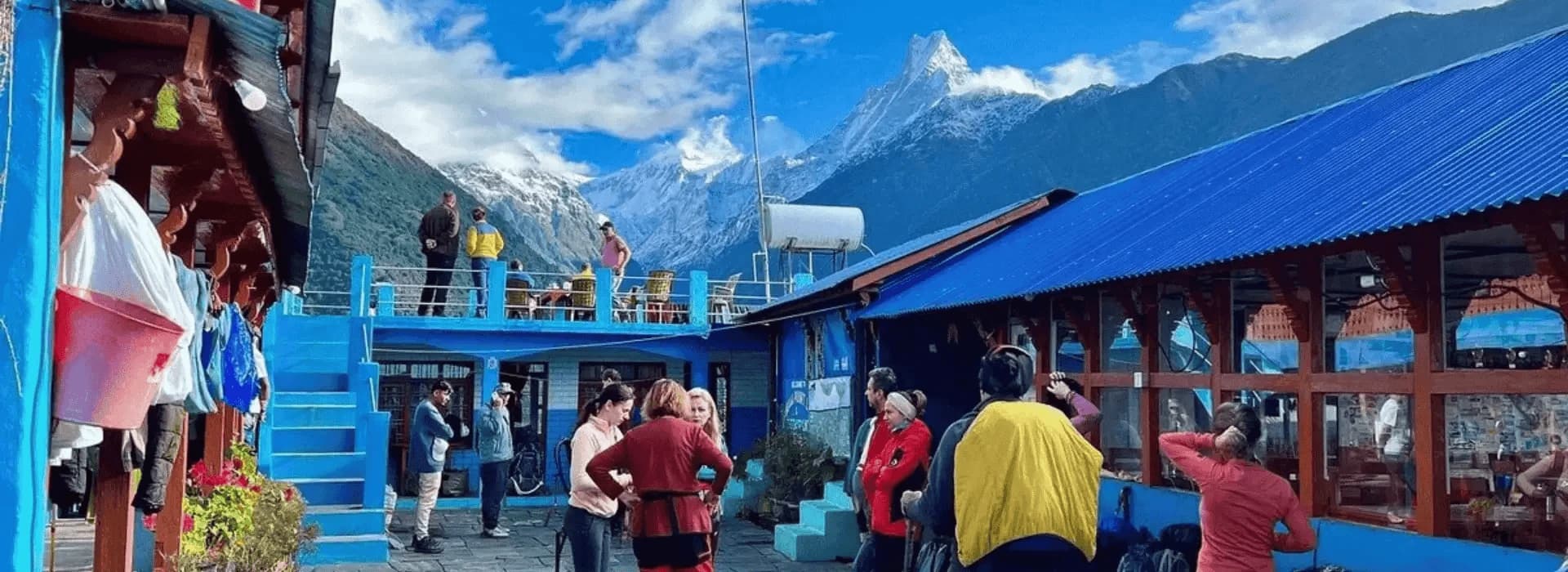
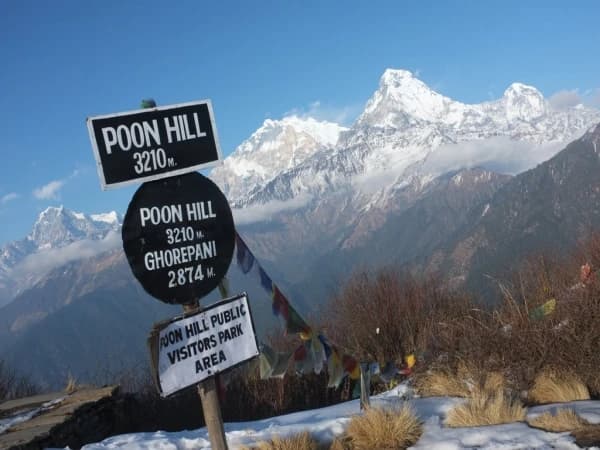
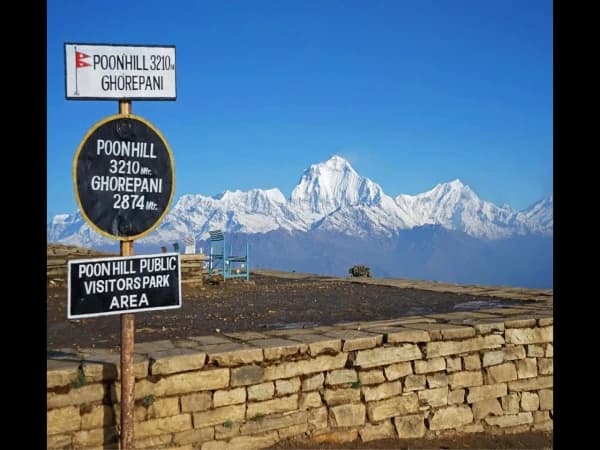
This 5-day Annapurna Base Camp Trek starts and ends in Pokhara and takes place entirely within the Annapurna Conservation Area Project (ACAP). From Pokhara, you travel by jeep to Jhinu Danda/Siwai, then trek through Chhomrong, Bamboo, Deurali, and Machhapuchhre Base Camp to Annapurna Base Camp. The 2026 cost is $400–$900 per person, depending on whether you trek independently, join a group, or book a private/private-guided package. The difficulty is moderate to hard, with March–May (Spring) and September–November (Autumn) as the best seasons. You need an ACAP Permit, arranged in Pokhara on the morning before departure.
5-Day Annapurna Base Camp Trek From Pokhara: Itinerary & Cost
What Is the 5-Day Annapurna Base Camp Trek From Pokhara
The Annapurna Base Camp Trek from Pokhara lasts for 5 days, and this is a short tea house trail that starts from Nepal’s most beloved tourism city until you reach Annapurna I, one of the world’s strongest mountain amphitheaters. The Annapurna Base Camp is at 4130 meters in the Annapurna Sanctuary, which is a high glacier basin with ten peaks of more than 6000 meters; this includes Annapurna I (8091 m), Machhapuchhre (6993 m), Hiunchuli (6441 m), and Annapurna South (7219 m).
"Being in the Annapurna Sanctuary means being in the center of the world. You can see mountains from all angles as there is no horizon, only rock, ice, and clouds. I have taken trekkers to this place over 150 times, and I still have the same reactions every time I visit." – Krishna Pariyar, Senior Guide.
Why Pokhara is the best starting city for this trek: Pokhara is approximately located 30-35 kilometers away from the major starting points of the ABC trail. It has several options of good hotels, trekking agencies, and offices for processing permits. There are several rental properties, as well as jeep services that can directly take you to your embarking points. No other location allows you that proximity to the Annapurna region.
Why the 5-day version is shorter than the standard ABC trek: A classical ABC trek is 7-day - 12-days long, whereas a five-day trek is shorter due to the use of a jeep on the first and last hiking days instead of walking, absence of the extra routes like Poon Hill, and increased walking hours every day compared to the standard trek. The 5-day trek also reaches the same destination point but in a shorter time.
Who should choose the 5-day ABC trek:
- You have good fitness, but limited time off work.
- You are already staying in Pokhara and want to hit the trail immediately.
- You have a certain degree of high altitude or multi-day trekking experience.
- Solo travelers or couples who are comfortable with more rapidly paced mountain walking.
Who should avoid the 5-day version:
- You are a novice walker (have never trekked before).
- You're not looking for a relaxed trek through local mountain villages, but for a journey with a high dose of culture.
- You are traveling with small children.
- You have an issue with high altitude, or any cardiovascular problems.
- You are keen to trek to Poon Hill or the Ghorepani loop.
To compare all the treks starting from Pokhara, read our guide on Best Treks from Pokhara.
5-Day Annapurna Base Camp Trek Cost in 2026
Prices range between $400 to $900 in 2026 to do the 5-Day Annapurna Base Camp Trek, which begins from Pokhara. The amount of money that you pay depends on whether you go for independent trekking, group package trekking, or private guided trekking. Below is how much you are to pay for each trek type.
Cost Overview by Trek Style
|
Trek Style |
Total Cost Per Person (2026) |
Daily Budget |
|
Budget Independent Trek (no guide, no porter) |
$400 – $550 |
$80 – $110/day |
|
Standard Guided Group Trek |
$550 – $750 |
$110 – $150/day |
|
Private Guided Trek (dedicated guide + porter) |
$700 – $900 |
$140 – $180/day |
Full Cost Breakdown Table
| Item |
Estimated Cost 2026 |
Notes |
|
ACAP Permit |
~$22 USD (NPR 3,000 + 13% VAT) |
Required for all foreign trekkers |
|
TIMS Card |
~$10–$20 USD |
Check current regulations before departure |
|
Licensed Guide |
$25 – $35/day |
$125–$175 for 5 days |
| Porter |
$18 – $22/day |
$90–$110 for 5 days; carries 20–25 kg |
|
Accommodation (tea house) |
$5 – $15/night |
Rises with altitude |
|
Meals (3/day) |
$20 – $40/day |
Higher above 3,000 m |
|
Jeep transport (Pokhara ↔ trailhead) |
$10 – $20/person (shared) or $60–$100 (private round trip) |
Depends on road point and group size |
|
Hot shower |
$2 – $5/use |
Extra charge at most tea houses |
|
Wi-Fi |
$1 – $3/day or per card |
Not always reliable above 3,000 m |
|
Device charging |
$1 – $3/device |
Solar at higher stops; hall-only above 3,000 m |
|
Drinking water |
$0.50 – $3/liter |
Use purification - saves $30–$50 over 5 days |
|
Tips (guide + porter) |
$50 – $80 total |
Cultural expectation - not optional |
|
Gear rental |
$1 – $2/day per item |
Sleeping bag, down jacket, poles available in Pokhara |
|
Travel insurance |
$30 – $80 |
Must cover helicopter evacuation to 5,000 m |
Common Cost Mistakes Trekkers Make
- Forgetting to take cash - the last ATM is in Pokhara, and you will need NPR for 5 days on the trail.
- Thinking Wi-Fi will be free; most trekkers realize above Chhomrong this is never the case.
- Not factoring in for drinks on trek – tea and coffee on trek may cost as much as $2-4 dollars per cup at higher altitude.
- Not asking about what your package included in terms of meals beforehand or just presuming it did.
- Not taking out a travel insurance policy – a helicopter evacuation from an altitude of 4,130 meters will cost you approximately $4,000-8,000 dollars without insurance.
Prices last checked: 2026. All costs are estimations and will vary per season, agency, and group size, as well as exchange rates. Always confirm costs with your trekking agency before booking.
For another ABC trek cost guide, visit our article on Annapurna Base Camp trek cost guide (ABC trekking Cost).
Itinerary
This 5-day Annapurna Base Camp Trek follows a direct route from Pokhara to Jhinu Danda, Sinuwa, Deurali, Annapurna Base Camp, Bamboo, and back to Pokhara. The trek combines forest trails, stone steps, mountain views, and the Annapurna Sanctuary, with the highest point at 4,130 m. Each day includes guided trekking, teahouse accommodation, meals, and gradual changes in altitude and scenery.
Today starts with an early morning drive by Jeep from Pokhara to Jhinu Danda. The road continues to the Modi Khola river valley in dense jungle and small villages, and upon coming to the first turn, a glimpse of mountains is obtained. After Jhinu Danda, you are crossing a suspension bridge and then starting the actual uphill trek right on the spot.
Your climb starts on honest straight stone steps and goes upwards through rhododendron and bamboo forests leading to Chhomrong.
A lot of effort, but your eyes will see the striking peaks of Machhapuchhre above you while you climb the way. This will compensate you. Chhomrong, which lies at an advantageous position in the Annapurna region with all paved roads and flowered gardens, is just behind the hill from the last turning of your path. After having lunch at the guest house in Chhomrong, you descend down a steep stone path to cross the Modi River at one stretch and then climb again to Sinuwa through the jungle.
Krishna's Pro-Tip:
"Before we start actual trekking, I often advise my clients to make a halt at the Jhinu hot spring for 20 mins. After the jeep ride it will relax your muscles and minds - consider it a break before the mountains take control of you; it will be again open for you to enjoy your dip in the pool of hot water during the last day of the trip on Day 5." - Krishna Pariyar (Lead Guide)
Health Tips:
Today you'll enter the Annapurna region. No altitude yet to worry about; however, you’ll find yourself at high altitude in the next two days. Thus, from the first hours of the trek, you should try to take in two or three liters of drinking water as your basic training to keep yourself healthy and in control.
(Daily water intake to an extent on the first and second day at walking pace really makes the difference from the third and fourth day in attitude).
Teahouses in Sinuwa
- Number of good teahouses: 4-5
- Options: Rooms with attached bathrooms: None of them
- Private Vehicle Parking: Available with extra charges.
- Wi-Fi: Available (Slow)
- Charging: Available in rooms (Rs. 300-500), in the hall (Rs. 100-200)
- Hot water for bath: Solar - paid
- Mobile network: Available
Today the forest begins to close in, and you will see a shift in the landscape from farmland to the rugged wild. As you traverse the trails, the passage passes the Bamboos (2,310 m - a standalone lodge house in the bamboo forest; sound of water continually running). The route leads on to Dobhan, Himalaya Village, and then to Hinku Cave and subsequently your final destination for the day, Deurali.
Lunch usually happens at the Himalaya Village and is the point where the forest canopy begins to reveal fine glimpses of some of the tallest mountains to the heavens. Your last few kilometers of trek into Deurali lead through a more dramatic natural setting; the narrowing valley gets steeper, and there’s a perceptible chill in the air that bites at your exposed skin. At an elevation of 3,230 meters, Deurali will truly let you know of its altitudes.
Krishna's Pro-Tip:
"Deurali is where the entire mood of the trek changes. Before this point, it’s the forest and the houses, while above it’s the glaciers and rock. I will just say to the trekker, eat everything available on the platter for dinner at Deurali, drink a lot of water, and go to sleep immediately. The real journey starts in two days."
Health Update:
Today you are at an altitude of 3,230 meters. Some trekkers have trouble with breathing on the final hike to Deurali; the breathlessness experienced on the last bit is very common. It's ok if some of the trekkers get a headache; also, consume dinner with water and then proceed to sleep. I repeat, don't treat the headache symptom. Report your guide about your situation.
About Deurali Teahouses:
- No. Of best teahouses: 3-4 available Options.
- Good Room attached to common toilets (Attached Room):– No available Options.
- Wifi available: No available Options.
- Charge in Room: No available Options.
- Charge in Hall: Available (Solar operated with limited supply)
- Good Shower: Heated Water shower available – Paid.
- Good Network available on mobile: No available Options
This is the big day. Deurali fades behind, and you enter Annapurna Sanctuary, that high cirque, open at one end, that cradles that perfect ring of Himalayan giants. It's a progressive then instantaneous thing: forests vanish, the valley walls recede, and boom.
In every direction, it all appears: an all-360-degree panorama of rock, snow and pure sky dominated by the awesome Annapurna I (8,091 m), the sacred Fishtail, Machhapuchhre, to the front, Annapurna South and Hiunchuli to the left.
For any non-technical climber, there aren’t many places on earth that compare for overwhelming grandeur. Passing through Machhapuchhre BC at 3,700 m – useful for a hot tea and a final assessment of the weather – you arrive in late morning on your final few miles of rock and moraine where Annapurna glacier hugs the left bank before turning sharply up to Annapurna Base Camp, 4,130 m and its lodges that cluster in the bowl of peaks.
Krishna's Pro-Tip:
"That is my favorite hour of a whole trip: to stand where every guest feels the magnitude of the landscape shift. You can see it when talking stops, the cameras come out, then retreat into the ether, to when we can only look. That, more than the views themselves, is the 4,130-meter feeling.”
About ABC Teahouses:
- Number of decent teahouse options: 4 or 5
- Room with attached bathroom: None
- Wi-Fi: None
- In-room charging: None
- In-hall charging: Available – with severely limited outlets – so an external charger power bank essential
- Hot shower: None
- Mobile signal: None
Early morning wake-up at pre-dawn. The early light show you watch of the Annapurna range from ABC will forever be etched on your memory.
Before dawn, the peaks show gold and orange colors, and when the sun comes on the horizon, they turn bright white.
After having breakfast and our last glance at the sanctuary, we’ll head downwards. It’s always faster but tougher than our uphill journey on the joints of the knee. You will spend most of the hours on the stones built by the locals (from Deurali to Bamboo), so use the trekking poles very diligently to protect your knees while making a long, steady descent. As you reach each stage, the scenery will transition from what you would find at higher altitudes - rock and barren lan - to vegetated areas and even thick bamboo forests towards Bamboo Village.
Reaching the bamboo tea house for our dinner will make you feel the faraway mountains.
Krishna's Pro-Tip
I’ll always remind our trekkers: Injuries can happen during down trekking, not ascent, so walk carefully, especially the steep, stone steps. "Be gentle on your knees, as they will carry us home,".
Health Check
Losing approximately 1800 meters of altitude from 4130 m to 2310 m in one day is considerable, so most of the symptoms of acute mountain sickness start dissolving soon while going down and will also make us happy and optimistic about our health condition after acclimatizing properly, yet persistent symptoms of any kind on moving down the altitudes should be reported to the guide at once.
About Bamboo Teahouses:
- Number of good teahouses: 3 - 4 good alternatives
- Room with attached bathroom: Not available
- Wi-Fi: Available
- In-room charging: Not available
- Charging in hall: Available – free with shower only
- Hot shower: Available (with charges)
- Mobile network: Available
The trek from Bamboo to Sinuwa and further to Jhinu Danda is the easiest walk of all. After all, you have already traversed difficult tracks earlier. Most of the trekkers stop at the hot spring at Jhinu Danda before taking a jeep. Relaxing at the hot spring is a great way to conclude the trek as one of the most thorough pleasures of trekking in Nepal.
Then, the jeep takes you to Pokhara through the Modi Khola valley. You will reach the city before lunch and have enough time for a shower at the hotel.
Krishna's Pro-Tip
"Jhinu Hot Spring is the only thing on the last day of my trekking plan. After all, your body is responsible for taking you the distance of 4130 meters and back. Therefore, it deserves at least half an hour in the hot spring. In my experience, no person has ever regretted taking a stop at the hot spring."
Additional Information
Permits Needed for the Annapurna Base Camp Trek
Any trekkers from outside the country wanting to use the Annapurna Base Camp trail must have two valid documents before they enter the conservation area. The relevant checkpoints will check their original documents at the crossing of the Chhomrong bridge and at many places on the trail. The authorities will check only the original documents and will not accept photocopies.
ACAP Permit – Annapurna Conservation Area Permit
This permit allows you to enter the Annapurna Conservation Area Project officially. This organization is responsible for the protection of the environment of the entire Annapurna region. The permit will help in maintaining the trails, implementing conservation projects, and developing the local community.
- Permit: ACAP
- Why It Is Needed: Entry to Annapurna Conservation Area
- Where to Get It: Pokhara Tourism Board Office, Kathmandu NTB, or through your trekking agency
- Who Needs It: Most foreign trekkers
Required Documents:
- Original passport (for validation)
- Photocopy of passport
- One passport-size photograph (can be required in some offices)
- Travel insurance information if needed at any of the offices
Step-by-step: How to get permits in Pokhara
- Go to the Nepal Tourism Board office situated in Pokhara Damside on the first day early in the morning.
- You will need to bring along your passport, one passport photo, and have enough money in NPR with you.
- Complete the application form (takes about 5 mins).
- Pay the fee and collect the stamp on your permit card.
- Carry both the permits along with you in a Waterproof Wallet while trekking all through your trek.
- Make Sure that you don't start your trek without these Arranged Permits because officers at the checkpoints can take penalties if found without them, or they will send you back from Chhomrong itself.
To access complete permit and fee information, refer to ACAP Permit Guide.
How Difficult Is the 5-Day Annapurna Base Camp Trek
The ABC Trek, spanning five days, is not a walk in the park. Its classification is moderate to difficult, and it is an accurate depiction of the reality of the trek rather than a clever marketing practice. While traveling at high altitudes could be challenging in itself, it requires a combination of traveling at high altitudes, traveling for long hours, climbing steep stone stairs (particularly in the Chhomrong descent and Sinuwa ascent), and the fast pace required for a five-day trek.
In most cases, it takes seven to ten days to cover the distance because the arrangement allows the trekkers to rest and climb at an easier pace, while the compressed timeline of this trek doesn’t provide the same luxury.
Walking hours: Medium to hard — 4–6 hours on lighter days and 6–8 hours on big days.
Altitude: Medium risk — ABC is at 4,130 m, with a faster ascent than the 7-day route.
Trail condition: Challenging — thousands of stone stairs with steep ascents and descents.
Weather: Variable — weather can change quickly above 3,000 m, even during the trekking season.
Fitness requirement: Good fitness needed — you should be able to walk uphill for 5+ hours with a daypack.
Can you do this trek? Ask yourself honestly:
- Could you hike up for 5 hours straight carrying a day pack of 5-8 kg?
- Have you ever trekked or hiked above 2500 m before?
- Can you rough it a bit in terms of weather and comfort – cold nights, basic rooms, no phone signal?
- Have you got no heart or lung condition or blood pressure problems?
If the answer to all 4 questions is ‘yes’, the 5-day trek is possible under a licensed guide. If you say ‘no’ to any of them, take a 7-day or 10-day version.
Myth vs Fact:
- Myth: It will be easy as it's only 5 days.
- Truth: It's quick and tough – same altitude but at a more aggressive pace.
For details of how the five-day trek compares to others, consult our Annapurna Base Camp Trek Difficulty Guide.
Best Time for the 5-Day Annapurna Base Camp Trek
The best time for this Trek is March–May and September–November, when the weather is generally clear and mountain views are excellent. October is the best month, while June–August is not recommended due to heavy rain, leeches, landslide risks, slippery trails, and poor visibility. Winter months are possible with extra care because of cold and snow at higher elevations.
- Spring (March-May): The rhododendron trees located between Chhomrong and Sinuwa are in full bloom from March till April the area is filled with red, pink, and white flowers. April is the best month for photography in particular. At the end of May, a pre-monsoon haze appears in the afternoon.
- Autumn (September-November): After the monsoon season, the temperature is clear, and even though October is the best month for hiking, November is still great but cold, so warm clothes are recommended if climbing higher than 3,000 m.
- Monsoon (June–August): Not recommended. There are leeches on the lower trail, a landslide threat between Bamboo and Deurali, always cloudy, restricting any mountain views, and truly slippery stone stairs during this time of the year; it is unsafe and unfruitful to be trekking for five days.
Mountain weather can change quickly. Even in mid-October WE have seen that what starts as a clear day can turn into a blizzard by the afternoon at ABC. Therefore, make sure to start your Day 3 as soon as you can – get to ABC by lunchtime if you can.
To figure out the full weather in Nepal, consult our guide Best Time to Trek in Nepal.
Food, Rooms, Wi-Fi, Shower, and Charging on the Trek
The tea house is a key characteristic of trekking in Nepal - it is like small lodges that are managed by locals themselves and cater to your overnight stay, bed, and food all in one same stop. Tea houses have no luxuries like those you will find in hotels - they are basic, friendly and comforting to have at such locations in the mountain environs.
To find out more about tea house trekking, read our article Tea House Trekking in Nepal.
Food on the ABC Trek
Dal bhat is the most sought-after dish on this trail. It is cheap, filling, and comes with free unlimited refills. And when the altitude goes above 3,000 m, dal bhat becomes a wise and logical choice for dinner.
There are also other options:
Breakfast:
- Porridge
- Eggs: boiled, fried, scrambled
- Toast
- Muesli
- Tibetan flatbread
Lunch:
- Vegetable noodle soup
- Fried rice
- Momos (dumplings)
- Macaroni
- Garlic soup
Dinner:
- Pasta
- Noodles
- Vegetable curry
- Etc.
Drinks:
- Milk tea
- Ginger lemon honey tea
- Black coffee
- Hot chocolate
Snacks:
- Energy biscuits
- Local honey
- Apple pie (which is famous along this route and is available at low altitudes)
At higher elevation food costs more because all ingredients need to be carried in by the porters. A plate of fried noodles costs USD 4 in Chhomrong. At ABC, it will cost USD 8-10 instead. Plan your budget properly and do not skip meals at higher altitudes.
- Room: Basic twin tea house room; simple wooden beds; blankets provided
- Food: Simple Nepali and basic international dishes; quality is good
- Hot shower: Extra cost at most stops; solar or gas heated; fee $2–$5
- Wi-Fi: Extra cost; available below 3,000 m; not available above
- Device charging: Extra cost; hall charging below 3,000 m; very limited above
- Drinking water: Buy, boil, or purify - never drink untreated stream or tap water
Every day, additional costs apply: All boiler showers, wifi cards, charging devices, and boiled water are charged separately in any tea house above 2,000 m. Plan on spending $5–$10 per day for your extra spending.
Safety, Altitude Sickness, and Travel Insurance
The 5-day ABC Trek is relatively safe with proper planning; however, the fast altitude gain heightens the risk of altitude sickness compared to the classic 7-day path. Knowing the symptoms and taking action in time is what drives trekkers to safety.
What is altitude sickness? Acute Mountain Sickness (AMS) happens when people do not have time to adapt to the low level of oxygen. At an altitude of 4,130 m, the air has about 40 % of oxygen compared to sea level.
AMS Symptoms to watch for:
- Unremitting headache, no better with rest/water
- Nausea and/or vomiting
- Dizziness and/or loss of balance
- Tiredness beyond the effort to gain altitude
- Difficulty sleeping
- Loss of appetite
What to do if symptoms appear:
- Stop going any higher immediately. Do not ascend further with symptoms.
- Rest and hydrate at your current elevation.
- Notify your guide immediately. Do not hide the symptoms.
- If your symptoms don't resolve after six hours of rest, descend.
Travel Insurance Essential for the Trek
In the absence of a policy, a helicopter evacuation from Annapurna Base Camp (4,130 m) would cost anywhere between $4,000 and $8,000 per flight. Therefore, the insurance policy must contain coverage for the following:
- High-altitude trekking to at least 5,000 m (cover above the highest point)
- Emergency helicopter evacuation
- Medical expenses and hospitalization
- Cancellation or delay of the trip
This information only serves as general knowledge - it does not constitute medical advice, and it is advisable to consult a medical doctor before embarking on high-altitude trekking. For the complete guide regarding AMS, readers must refer to our guide on Altitude Sickness in Nepal Treks.
Guide, Porter, and Transport From Pokhara
Do you need a guide for the 5-day ABC Trek?
Though the hiring of a guide is not compulsory for trekking to ABC, we recommend hiring a guide especially for the five-day trekking expedition. However, the limited duration of the trek makes it hard for trekkers to detect altitude sickness on time. Besides, there are areas for which navigating along the route is a challenging task due to poor visibility and snow.
Guide responsibilities on the ABC Trek:
- Overall navigation by the guide from the start to base camp.
- SpO2 monitoring on a daily basis after reaching altitudes of more than 3,000 m.
- Booking tea houses beforehand.
- Ensuring checkpoints for permits.
- Coordinating in case of an emergency.
- Checking weather conditions in the morning before starting the climb.
Porter role: One of your 10-12 kg duffel bags is being carried by a porter so you can trek with a light day bag. On a trek with as many rock stairs as the ABC trek, this feels very noticeably in your legs, especially from ABC down on Day 4.
| Option |
Best For |
Pros | Cons |
|
Guided trek |
First-time and most trekkers |
Safer; easier logistics; altitude monitoring |
Costs more |
|
Guide + porter |
Comfort and safety |
Maximum support; less physical load |
Highest cost |
|
Independent trek |
Experienced trekkers only |
Lower cost; full freedom |
More planning; higher risk above 3,500 m |
Transport from Pokhara:
- Pokhara → Jhinu Danda: Shared jeep—1–1.5 hours, approximately 10–15 per person.
- Pokhara → Jhinu Danda: Private jeep—1–1.5 hours, approximately 60–80 round trips.
- Jhinu Danda → Pokhara: Same jeep returning on Day 5—1–1.5 hours, included in the round-trip booking.
Private jeeps offer higher comfort levels on the journey to Jhinu Danda compared to shared vehicles, and they are also better suited to the terrain. If you're travelling in a group of three or more people, the price per person is practically the same, while comfort-wise private jeeps score.
"Hire a licensed person - not just any person. Check before you pay your deposit that your guide has an NTB (Nepal Tourism Board) trekking guide license. A licensed person has received the required training, is aware of the altitude adjustments, and can be held responsible. An unlicensed person is just not worth the risk."
For information about hiring people and what to look for, read our guide on Hiring a Trekking Guide in Nepal.
Is the 5-Day ABC Trek Right for You
If you are healthy and have little time, the five-day ABC trek is advisable. The seven-day version is safer in regard to altitude and more comfortable. I recommend the fast trek option only if you show genuine qualification or fitness. For full comparisons on various itineraries, please check our guide.
Choose the 5-day trek if you:
- You are fairly fit and can walk 5-7 hours a day uphill without too much effort.
- You only have a week off and want to see ABC and back.
- You are an experienced trekker or walker at altitude.
- You are flying out from Pokhara and want a direct mountain experience without much travel time.
- You want a challenge and don't mind moving at a challenging pace.
Consider the 7-day or longer trek if you:
- You are an inexperienced trekker or have never been above 2500m before.
- You wish to explore at a slower pace and take in cultural side trips
- you have any heart problems or are concerned about altitude sickness
- you are travelling with children or other family members of mixed abilities.
- You want to include Poon Hill and Ghorepani or further route extensions.
The ABC trek of 5 days is advisable if you are fit and do not have much time. But a trek for 7 days is better in terms of safety and comfort at altitude. I never recommend anyone to go for the faster option unless they meet all necessary conditions."
Booking Tips and Common Mistakes to Avoid
Booking your trip can turn it into a nightmare trek if you get it wrong, as a 7-day option guarantees the right amount of rest and a slow down in acclimatization.
Before booking, always ask your agency:
- Be sure to ask your travel agency the following questions before making a reservation:
- Is the cost of permits (ACAP and TIMS) accounted for in the total package rate?
- Has your guide passed the NTB certification? Can you show me the license?
- Is their fee included in the package, as well as the maximum weight limit?
- Are the meals on the trek included in the package?
- Will the travel agency cover the jeep between Pokhara and trek return?
- What are the consequences of cancelling a trip?
- Am I required to have my own travel insurance in order to travel with the agency?
Common booking mistakes to avoid:
- Choosing the cheapest package solely, failing to check what is included.
- Not checking that the guide has an NTB license before making the payment.
- Assuming that insurance is included in the package.
- Not asking what the cancellation policy is.
- Not ensuring transport pick-up time and location.
- Not taking enough NPR cash from Pokhara.
Be cautious if:
- There is no itinerary in writing.
- There are no license details of the guide.
- There is pressure to pay for the whole package without getting a receipt.
- The agency does not answer questions about inclusions clearly.
For the complete selection process of an agency, please refer to our guide Nepal Trekking Agency Checklist.
Why Choose Ammonite Adventure for This Trek
Ammonite Adventure is an excellent option for the 5-day trek to Annapurna Base Camp from Pokhara because we possess in-depth local knowledge of routes, utilize certified NTB guides who have traversed the ABC route in all seasons, have straightforward pricing without any hidden costs, allow customize packages for group or individual trekking arrangements, and most importantly, ensure safety at every step of the trek.
How Ammonite Adventure Helps
|
Trekkers Need |
Ammonite Adventure Helps With |
|
Clear itinerary |
5-day route plan from Pokhara with full day-by-day detail |
| Permits |
ACAP and TIMS arranged in Pokhara before departure |
| Safety |
NTB-licensed guides, daily SpO2 monitoring, weather updates |
| Transport |
Private or shared jeep from Pokhara to trailhead and return |
|
Custom package |
Porter, gear rental, hotel nights, private trek, helicopter return option |
|
Budget clarity |
Written inclusions and exclusions before any payment |
|
Emergency support |
Direct coordination for medical evacuation, route changes, and weather decisions |
Key Reasons to Choose Ammonite Adventure
- Experience local ABC trekking through spring, autumn, and winter seasons.
- Give detailed costings with no hidden extra charges.
- Option of trekking type for any budget, either private or group treks.
- Safe trekking to be conducted with trained trekking staff and rules for approved altitude.
- All transportation to be provided and tea house accommodated on trekking from Pokhara.
- Better for beginners, couples, families, singles, as well as groups.
- Trekking ethically with fair handling of porters and No Trace Policy.
Trust the evidence.
- License numbers for your guide's NTB will be supplied upon request prior to booking
- Company registered with the Nepal Tourism Board, plus TAAN
- Clients’ trekking reviews available on Google and TripAdvisor
- Authentic photos from the real ABC treks provided
- Office in Pokhara where guests can walk in at any time
- Refund policies are communicated in writing in every booking
- Porters' weight limits are respected during treks, plus fair wages and conditions
Final Tips Before You Start the Trek
Make sure you have checked off everything on your list before leaving your accommodation in Pokhara on Day 1. Any minor things you overlook right now will cause you big problems on the mountain.
The night before:
- Check the forecast for the next 5 days, particularly Day 3 at the ABC.
- Confirm your jeep pick-up time with your guide, as well as the pick-up point.
- Withdraw enough Nepali currency for 5 days' personal expenses ($150-200 minimum).
- Charge the batteries of all electronic devices.
- Pack your daypack with your layers, water, snacks, and permits in a dry bag.
- Confirm that your travel insurance is valid and covers a helicopter evacuation to 5,000 m.
On trail every day:
- Aim to start walking by 7:00 AM. Temperatures above 3,500 m can fluctuate greatly by mid-afternoon.
- Walk at a slow and consistent pace, especially when above 3,000 m.
- Aim to drink 2 to 3 liters of water daily. We all drink more on especially demanding days.
- Don’t skip meals. Appetites are lower on the higher ground, yet you must consume calories.
- Always carry easily accessible warm layers in your daypack as the temperatures drop quickly above 3,000 m.
- Keep your permits to hand in a waterproof case in your daypack at all times.
- Notify your guide right away of any headache, nausea, or light-headedness.
- Take all plastic rubbish back to Pokhara. Do not leave it to be burnt or buried on the trail.
- Do not collect or disturb anything: plants, wildlife, stone cairns, or even cairn markers.
- Use only specified toilets at tea houses.
- Use local tea houses by eating your supper and breakfast where you sleep.
Conservation reminders:
- You must carry all the plastic to Pokhara. Don’t burn it on the trail or bury it. Respect the natural environment - please do not pluck any flowers, disturb wild animals, or damage any trail signage.
- Use toilets provided at every lodge at trail - not on the trail
- If possible, use the services of the same lodge as your own, then enjoy your meal there.
“My one last piece of advice for all trekkers going into Day 1: the mountains will wait another year; they are in no hurry. There is no shame in going a bit slower, taking a bit longer a rest, or turning around if that's what your body demands. The trekkers that I've found have been the most successful on the mountain are those who listen; listen to the mountain and listen to their own bodies.” - Krishna Pariyar, Lead Guide
To read our full responsible trekking guide to Nepal, visit our Responsible Trekking in Nepal page.
Equipments
Head
- Warm beanie or fleece hat (for evenings & mornings at over 3,000 m)
- Sun hat or baseball cap (for daytime trail walking)
- UV-protectant sunglasses (crucial over 2,500 m)
- Buff or neck gaiter (for cold patches near Deurali and MBC)
Upper Body
- Moisture-wicking base layer top (x2)
- Mid-layer fleece or light down jacket
- Heavy-duty down jacket (for ABC & High Camp nights)
- Waterproof hardshell jacket (This is crucial. Rain is possible at all times of the year.)
- Trekking shirts (x2 or x3), either synthetic or merino wool
Hands
- Lightweight liner gloves (for morning trail walking)
- Warm insulated gloves (for over 3,500 m sections)
Lower Body
- Trekking pants (x2 pairs)
- Thermal base layer bottoms (for cold nights)
- Waterproof overpants (for rain)
Feet
- Waterproof high-ankle hiking boots, broken in prior to your trek
- Camp sandals or lightweight shoes (for tea house evenings)
- Hiking socks (wool or synthetic; 3 or 4 pairs)
- Gaiters (for snow over 3,500 m), season dependent
Toiletries
- Biodegradable soap and shampoo
- Sunscreen factor 50+ (UV radiation is strongest at altitude)
- Lip balm with sunscreen
- Wet wipes (useful over 3,000 m where there are no more showers)
- Hand sanitizer
- Personal first aid kit: blister kit, painkillers, rehydration salts, personal medicines
Backpacks
- Main trekking bag/duffel (40-60 L, for the porter), maximum weight 10-12 kg
- Day pack (15-20 L, to be carried by yourself), for essentials like water, snacks, extra layers, camera, and permits
Accessories
- Trekking poles (x2, important on steep stone staircases near ABC on descent)
- Headlamp plus spare batteries (for your 3 am start on Day 3)
- Reusable 1 L water bottle with Steripen or tablets for purification
- Power bank (minimum 10,000 mAh), charging availability is extremely poor over 3,000 m
- Offline maps downloaded (Maps.me or Gaia GPS)
Extra Items
- Sleeping bag liner or lightweight sleeping bag for cold nights at ABC
- Emergency whistle
- Copies of passports and permits stored waterproof
- NPR cash (sufficient for 5 days of personal spending)
- Snacks and energy bars bought from Pokhara (so much cheaper than on trail)
- Small padlock (for your duffel bag)
The full details for a comprehensive Nepal trekking pack list can be found here.
FAQs
This is a brief tea house trek that starts and finishes in Pokhara and which attains the Annapurna Base Camp at 4130 m inside the Annapurna Sanctuary. The trek uses a jeep for the first and last parts of the trek and thus completes the journey in just five days instead of the usual seven days in trekking time.
Yes, but you will need to be fit and have some experience of trekking. The 5-day trip involves longer daily hours of walking and altitude gain than on the standard route but can be accomplished by any trekkers.
Day 1: Pokhara to Jhinu Danda (by jeep) to Sinuwa, located at 2360 meters. Day 2: Sinuwa to Deurali (located at 3230 meters). Day 3: Deurali to MBC to Annapurna BC (located at 4130 meters). Day 4: ABC to Bamboo (located at 2310 meters). Day 5: Bamboo to Jhinu Danda (by jeep), going back to Pokhara. Total distance walked is up to 38 to 40 km for 5 days.
The trekking starts in Pokhara, where a jeep is taken to go to Jhinu Danda, which is where the trekking starts.
The trek concludes in Pokhara, where the return via jeep across Jhinu Danda occurs on Day 5 after a morning walk from Bamboo. Most trekkers stop at the Jhinu Danda hot spring before boarding the jeep; this is highly recommended, as the half-hour stop is worth the time.
Day 1: 4–5 hours. Day 2: 5–6 hours. Day 3: 4–5 hours (highest and most significant day - walk slowly). Day 4: 5–6 hours (long descent). Day 5: 3–4 hours (easy descent to the jeep).
The Annapurna Base Camp is located at 4,130 meters (13,550 feet), which is the highest point reached on Day 3, and the Machhapuchhre Base Camp (3,700 m) is another important destination reached on the same day.
Moderate to hard level of difficulty. The difficulty of this trek comes mostly from the long walking sections, thousands of stone steps (especially in Chhomrong and Deurali), faster altitude gain compared to the regular seven-day trek, and low temperatures as the altitude exceeds 3,500 meters. The trek is an option for well-prepared trekkers but should be avoided by beginners.
This trek is not recommended for total beginner trekkers. The faster altitude gain along with long walking hours on a daily basis does not leave ample time for properly recognizing symptoms of AMS. It would be more suitable for beginners to undertake the seven-day version instead, which leaves more time for acclimatization.
For skilled adventurers who do not have ample time, 5 days is an appropriate time to finish this trek. Nevertheless, for the rest of the trekkers, including novices and families, and for people's safety, it is better to take 7 days to complete this trek. As we've mentioned above, being on foot for 7 days makes it possible to acclimatize better and to walk fewer hours, as well as to recognize the symptoms of altitude sickness earlier.
The cost of budget independent treks is between $400–$550 per person. The cost of standard themed group packages is between the cost of $550 and $750. The cost of private theme-guided treks is between $700 and $900. The cost varies depending on various factors, like group size and time of the year. It is wise to bring $150–$200 in extra money for trail expenses.
Standard packages include ACAP and TIMS permits, licensed guide and porter arrangements, twin-share tea house accommodation, all meals during the trip, jeep round-trip cost from Pokhara, as well as guide and porter accommodation and food costs, and applicable taxes. It is always a good idea to verify inclusion in writing before payment.
These will cover international flights and travel insurance, also the cost of extra beverages on flights not part of the meal, hot showers, Wi-Fi fees, charging the devices (if need arises), tipping guides and porters, your own personal snacks & snacks provided by the tour company, the fee for rented gear for a trek in your country, and costs for helicopter evacuation in the event of the worst-case scenario, etc.
The permits required include the ACAP permit, which stands for Annapurna Conservation Area Permit, and the TIMS card, which stands for Trekkers Information Management System. The permits can be obtained from either Pokhara or Kathmandu before starting the journey. The permits must be kept in their original forms with the authorities. The checking authority only checks for the original ones at Chhomrong and many other stops along the trekking route.
The ACAP permit costs $22 (NPR 3000) plus 13% VAT for foreign trekkers. The TIMS card costs around $10-20 depending on the category of the trekkers. The amounts chargeable are subject to change. The latest amount can be confirmed from the Nepal Tourism Board office in Pokhara prior to the trip.
Yes, ACAP and TIMS are available from the Nepal Tourism Board office in Pokhara (Damside area) and from the TAAN office too. One has to show a passport, one photograph the same as the passport, and some cash in NPR too. The processing time is nearly 15 to 20 minutes in most cases. Moreover, in case the trekkers have any trekking agency booked through them, the agency will also ensure the acquisition of permits.
A guide is not an obligation, but it is strongly suggested for the five-day journey. The licensed guide checks the blood oxygen level on a daily basis above 3,000m, finds trail junctions, books lodges in advance for the peak season, and makes emergency evacuations when needed. The time limit for the five-day period makes the altitude monitoring very important.
Yes!! It is a must. The evacuation from ABC (4,130 m) by helicopter costs from $4,000 to $8,000 per flight without insurance coverage. The insurance must cover trekking to an altitude of 5,000m and evacuations by helicopter. Do not trust standard insurance products; double-check if they cover the altitude range.
A guide will evaluate the weather conditions every morning before departure. Light rains are normal and can be managed using waterproof equipment. Heavy rains, other precipitation at higher altitudes above 3,500m, or no visibility at Deurali mean that the group should stay in the same tea house for the whole day. This is the reason why it is necessary to have a budget of $100–200 for emergency accommodation.
The main ABC trek trail was opened on July 26 and was in excellent condition. Two checkpost permits are functioning well. The vehicle route to Jhinu Danda was operating well, as there were no closures along the way due to landslides. Consult your agency or the ACAP Pokhara office about trail status one day prior to departing.
Wi-Fi is readily available at most tea houses for the trek from Jhinu Danda to Chhomrong and Sinuwa. The charge for it will vary between $1 and $3 per day. As soon as you reach above Sinuwa, up to Bamboo, and then to Deurali and the ABC, there is either no Wi-Fi or it is incredibly slow. It is recommended to take a Nepalese SIM from Pokhara with a data plan for better access.
Yes, and in most tea houses from Jhinu Danda to Bamboo, there is hot water, solar-powered (or gas), that comes at an additional $2-$5 per shower. Above Bamboo, it is neither available nor very poorly provided in Deurali and ABC. Bucket showers with freezing water may be provided in the higher villages. Factor in $2-$5 per shower for the two days where they will most gratefully be provided.
The best season is in October: perfectly clear skies, stable weather, and a dry trail. The top spring month will be April. March, May, and November are all good options. Best to avoid June to August (monsoon season and the associated landslides and zero visibility). December through February can be considered if you have full cold-weather gear, but watch for snow if traveling over 3,500 m.
Waterproof trekking boots (broken in), down jacket, waterproof hardshell jacket, thermal base layers, trekking poles, headlamp, reusable water bottle and purification, power bank, sleeping bag liner, sunscreen (SPF 50+), first-aid kit and cash (NPR for personal needs/tips on trail).